Unterköfler Maria Sophia, Schwingshandl Aria, Eigner Barbara, Pikalo Jutta, Harl Josef, Spergser Joachim, Steinbach Peter, Jeschke Diana, Striese Michael, Striese Elisabeth, Ansorge Hermann, Fuehrer Hans-Peter, Heddergott Mike
Department of Biological Sciences and Pathobiology, Institute of Parasitology, University of Veterinary Medicine Vienna, Vienna, Austria.
Department of Biological Sciences and Pathobiology, Institute of Pathology, University of Veterinary Medicine Vienna, Vienna, Austria.
Sci Rep. 2024 Dec 28;14(1):31232. doi: 10.1038/s41598-024-82581-7.
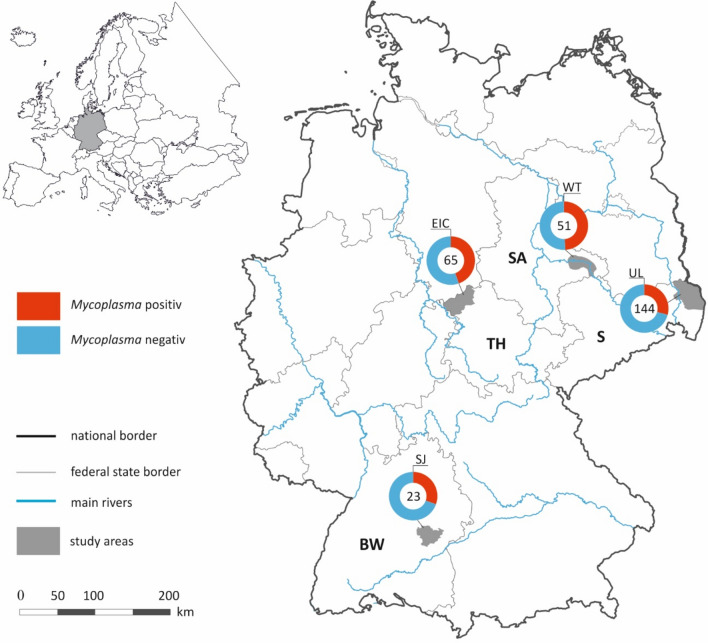
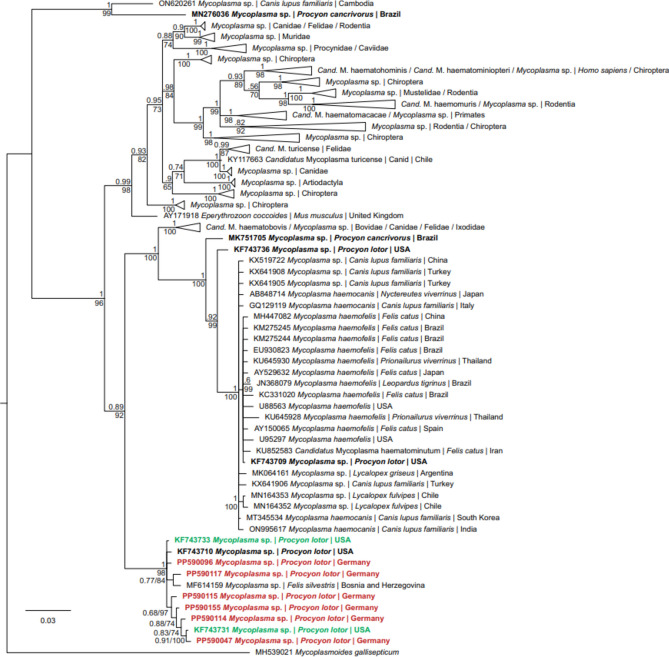
Raccoons (Procyon lotor) originated in North America and have been introduced to Europe. Due to their close contact with human settlements, they are important reservoirs for zoonotic pathogens, such as Baylisascaris procyonis. The relevance and prevalence of vector-borne pathogens have not yet been fully elucidated. In this study, we screened 285 spleen samples of raccoons, collected between 2019 and 2022 in Germany. The samples were analysed by PCR to detect Mycoplasma spp., Anaplasmataceae, Bartonella spp., Babesia spp., Rickettsia spp., Filarioidea, Trypanosomatida and Hepatozoon spp., and positive PCR products were sequenced. In total, 104 samples were positive for Mycoplasma spp. (36.49%), making this the first study to detect Mycoplasma spp. in raccoons outside of North America. Three samples were positive for Babesia spp. (1.05%) and two for Anaplasma phagocytophilum (0.7%). Phylogenetic analysis revealed that the Mycoplasma spp. detected all belong to the haemotrophic mycoplasmas cluster and were grouped within a single phylogenetic clade. Two different Babesia spp. were detected, one of which was closely related to Babesia canis, while the other was more closely related to Babesia sp. from ruminants. It is unclear whether the pathogens detected have an impact on the health of raccoons or whether they may serve as a reservoir for other animals.
浣熊(北美浣熊)原产于北美洲,现已被引入欧洲。由于它们与人类居住地密切接触,它们是诸如浣熊贝蛔虫等人畜共患病原体的重要宿主。媒介传播病原体的相关性和流行情况尚未完全阐明。在本研究中,我们对2019年至2022年期间在德国采集的285份浣熊脾脏样本进行了筛查。通过聚合酶链反应(PCR)分析样本,以检测支原体属、无形体科、巴尔通体属、巴贝斯虫属、立克次体属、丝虫总科、锥虫科和肝簇虫属,并对PCR阳性产物进行测序。总共104份样本支原体属呈阳性(36.49%),这使得本研究成为在北美以外的浣熊中检测到支原体属的首例研究。三份样本巴贝斯虫属呈阳性(1.05%),两份嗜吞噬细胞无形体呈阳性(0.7%)。系统发育分析表明,检测到的支原体属均属于血营养支原体簇,并被归为一个单一的系统发育分支内。检测到两种不同的巴贝斯虫属,其中一种与犬巴贝斯虫密切相关,而另一种与反刍动物的巴贝斯虫属关系更密切。尚不清楚检测到的病原体是否对浣熊的健康有影响,或者它们是否可能作为其他动物的宿主。