Yazdkhasti Amirhossein, Hughes Elizabeth, Norton Joshua S, Olson Gage L, Lam Casey, Lloyd Sophie, Yu Miao, Schwab Joseph H, Ghaednia Hamid
Center for Surgical Innovation and Engineering, Cedars Sinai Health System, Los Angeles, 90048, USA.
California Institute of Technology, Pasadena CA, 91125, USA.
Sci Rep. 2024 Dec 28;14(1):31326. doi: 10.1038/s41598-024-82743-7.
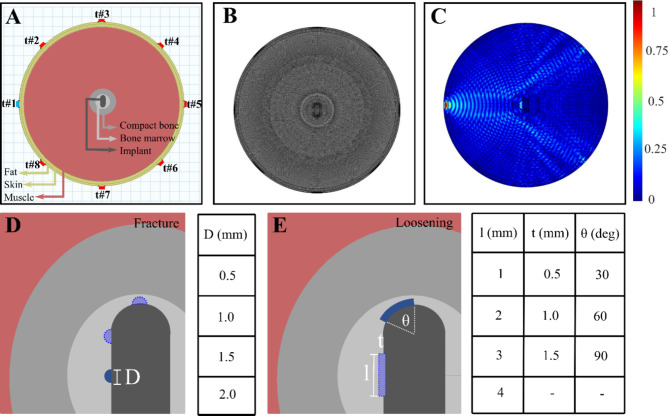
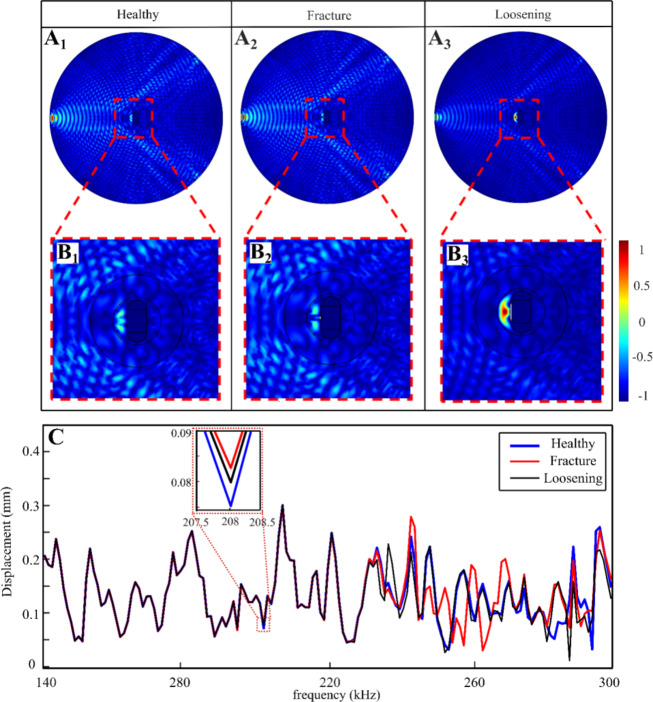
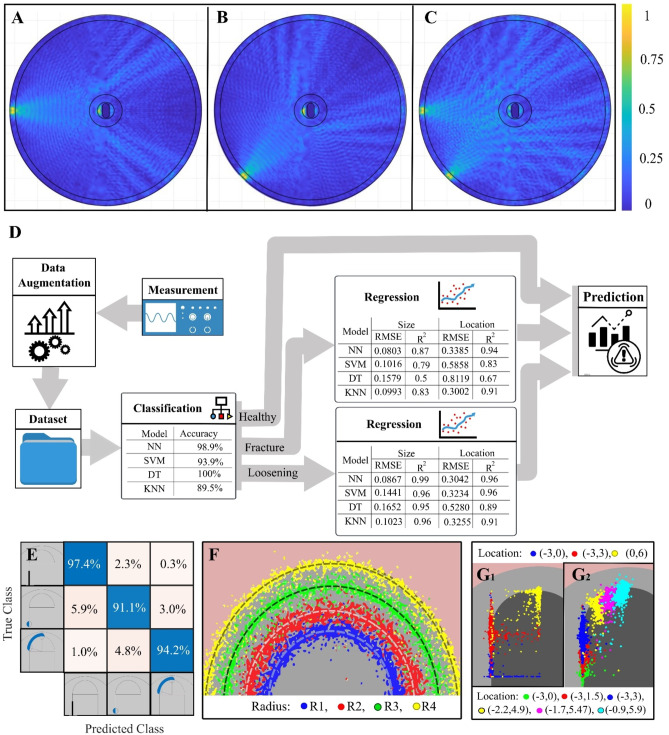
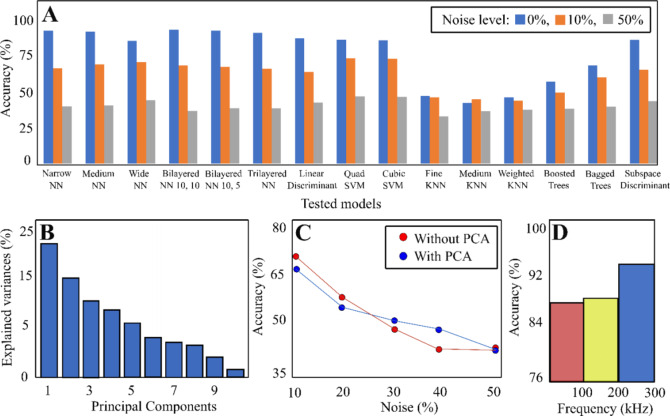
Mechanical failure of medical implants, especially in orthopedic poses a significant burden to the patients and healthcare system. The majority of the implant failures are diagnosed at very late stages and are of mechanical causes. This makes the diagnosis and screening of implant failure very challenging. There have been several attempts for development of new implants and screening methods to address this issue; however, the majority of these methods focus on development of new implants or material and cannot satisfy the needs of the patients that have already been operated on. In this work we are introducing a novel screening method and investigate the feasibility of using low-intensity, low-frequency ultrasound acoustic waves for understanding of interfacial implant defects through computational simulation. In this method, we simultaneously apply and sense acoustic waves. COMSOL simulations proved the correlation between implant health condition, severity, and location of defects with measured acoustic signal. Moreover, we show that machine learning not only can detect and classify failure types, it can also assess the severity of the defects. We believe that this work can be used as a proof of concept to rationalize the development of non-invasive screening acoustic wearables for early detection of implant failure in patients with orthopedic implants.
医疗植入物的机械故障,尤其是在骨科领域,给患者和医疗系统带来了沉重负担。大多数植入物故障在很晚的阶段才被诊断出来,且是由机械原因导致的。这使得植入物故障的诊断和筛查极具挑战性。已经有几次尝试开发新的植入物和筛查方法来解决这个问题;然而,这些方法大多侧重于开发新的植入物或材料,无法满足已经接受手术的患者的需求。在这项工作中,我们引入了一种新颖的筛查方法,并通过计算模拟研究使用低强度、低频超声波来了解植入物界面缺陷的可行性。在这种方法中,我们同时施加和感应声波。COMSOL模拟证明了植入物健康状况、缺陷的严重程度和位置与测量的声学信号之间的相关性。此外,我们表明机器学习不仅可以检测和分类故障类型,还可以评估缺陷的严重程度。我们相信这项工作可以作为一个概念验证,为开发用于早期检测骨科植入物患者植入物故障的非侵入性筛查声学可穿戴设备提供合理依据。