Lee Min Gook, Lee Bo Ram, Lee Poongyeon, Choi Soyoung, Kim Jong-Hui, Oh Mi-Hwa, Yoo Jae Gyu
Animal Biotechnology Division, National Institute of Animal Science, Rural Development Administration, Wanju, Republic of Korea.
Animal Genomics and Bioinformatics Division, National Institute of Animal Science, Rural Development Administration, Wanju, Republic of Korea.
Sci Rep. 2024 Dec 28;14(1):31373. doi: 10.1038/s41598-024-82928-0.
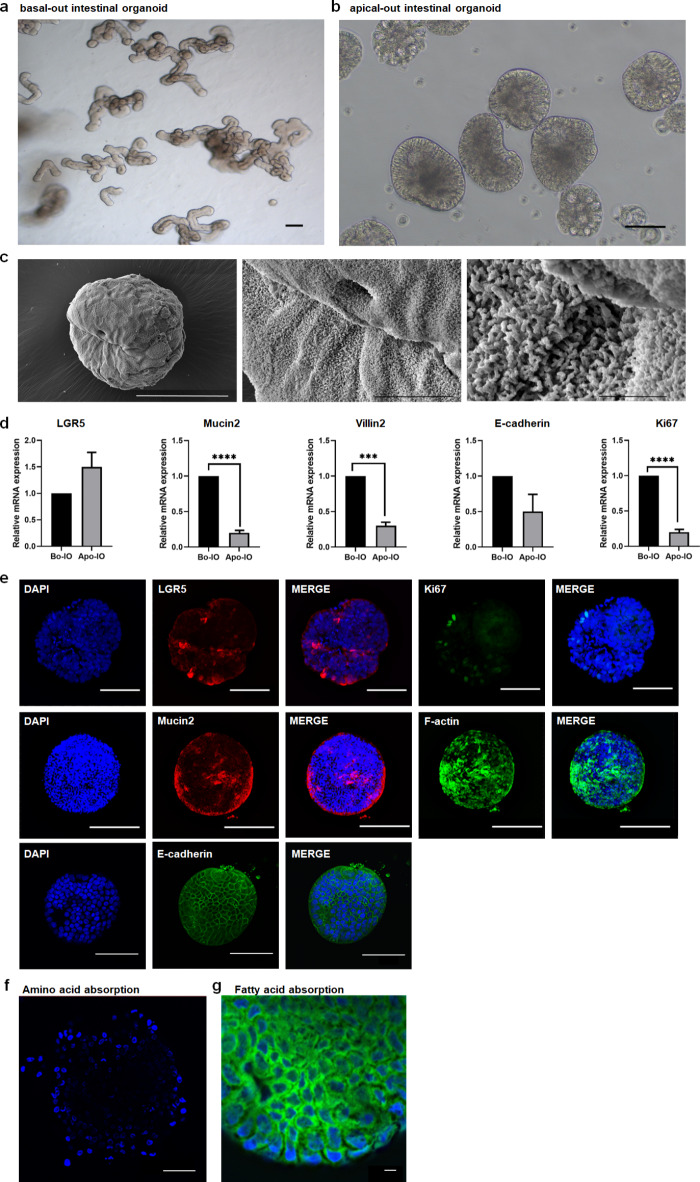
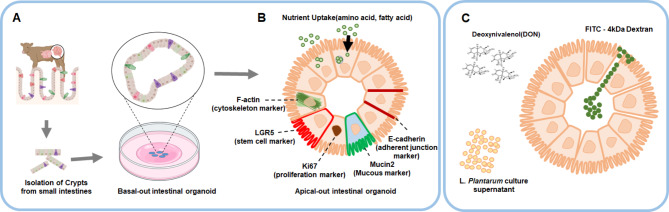
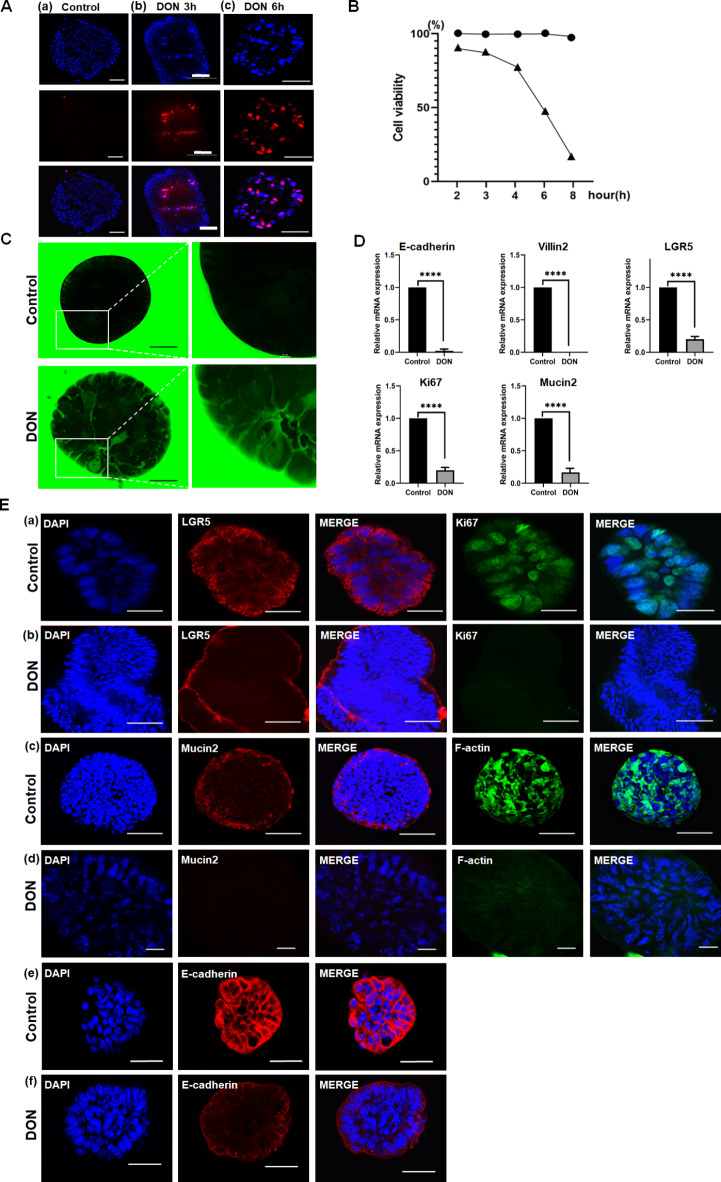
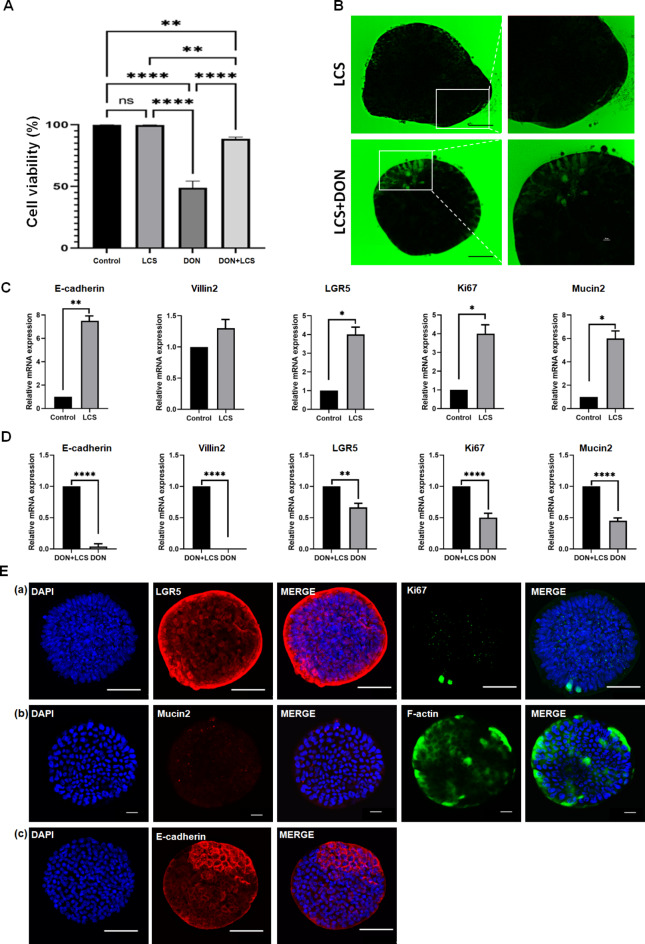
Small intestinal organoids are similar to actual small intestines in structure and function and can be used in various fields, such as nutrition, disease, and toxicity research. However, the basal-out type is difficult to homogenize because of the diversity of cell sizes and types, and the Matrigel-based culture conditions. Contrastingly, the apical-out form of small intestinal organoids is relatively uniform and easy to manipulate without Matrigel. Therefore, we sought to investigate the possibility of replacing animal testing with bovine apical-out small intestinal organoids (Apo-IOs) by confirming the toxicity of mycotoxins and effectiveness of L. plantarum as mycotoxin-reducing agents. The characteristics and functions of Apo-IOs were first confirmed. The gene and protein expression of stem cell, proliferation, mucous, and adherence markers were detected, and the absorption capacity of amino and fatty acids was also confirmed. FITC-4 kDa dextran, a marker of intestinal barrier function, did not penetrate the Apo-IOs, confirming the role of the organoids as a barrier. However, when co-treated with deoxynivalenol (DON), FITC-4 kDa dextran was detected deep within the organoids. Moreover, qPCR and immunofluorescence staining confirmed a decrease in the expression of key markers, such as LGR5, Ki67, Mucin2, Villin2, and E-cadherin. In addition, when Apo-IOs were treated with Lactobacillus plantarum ATCC14917 culture supernatant (LCS) and DON together, cell death was reduced compared to when treated with DON alone, and FITC-4 kDa dextran was confirmed to flow only to the peripheral part of the organoid. The qPCR and immunofluorescence staining results of LCS and DON co-treatment group showed that LGR5, Ki67, Mucin2, Villin2, and E-cadherin were expressed at significant higher levels than those in the DON treatment group alone. In this study, we found that the characteristics and functions of bovine Apo-IOs were similar to those of the intestinal structure in vivo. Additionally, the effects of mycotoxins and effectiveness of L. plantarum as mycotoxin-reducing agents were confirmed using bovine Apo-IOs. Therefore, bovine Apo-IOs could be applied in toxicity studies of mycotoxins and could also be used as in vitro models to replace animal testing and improve animal welfare.
小肠类器官在结构和功能上与实际小肠相似,可用于营养、疾病和毒性研究等多个领域。然而,由于细胞大小和类型的多样性以及基于基质胶的培养条件,基底向外型小肠类器官难以均质化。相比之下,小肠类器官的顶端向外型相对均匀,且无需基质胶即可轻松操作。因此,我们试图通过确认霉菌毒素的毒性以及植物乳杆菌作为霉菌毒素还原剂的有效性,来研究用牛顶端向外小肠类器官(Apo-IOs)替代动物试验的可能性。首先确认了Apo-IOs的特征和功能。检测了干细胞、增殖、黏液和黏附标志物的基因和蛋白表达,并确认了氨基酸和脂肪酸的吸收能力。肠道屏障功能标志物FITC-4 kDa葡聚糖未穿透Apo-IOs,证实了类器官作为屏障的作用。然而,当与脱氧雪腐镰刀菌烯醇(DON)共同处理时,在类器官内部深处检测到了FITC-4 kDa葡聚糖。此外,qPCR和免疫荧光染色证实了关键标志物如LGR5、Ki67、黏蛋白2、绒毛蛋白2和E-钙黏蛋白的表达降低。此外,当Apo-IOs与植物乳杆菌ATCC14917培养上清液(LCS)和DON一起处理时,与单独用DON处理相比,细胞死亡减少,并且证实FITC-4 kDa葡聚糖仅流向类器官的周边部分。LCS和DON共同处理组的qPCR和免疫荧光染色结果表明,LGR5、Ki67、黏蛋白2、绒毛蛋白2和E-钙黏蛋白的表达水平显著高于单独DON处理组。在本研究中,我们发现牛Apo-IOs的特征和功能与体内肠道结构相似。此外,使用牛Apo-IOs证实了霉菌毒素的作用以及植物乳杆菌作为霉菌毒素还原剂的有效性。因此,牛Apo-IOs可应用于霉菌毒素的毒性研究,也可作为体外模型替代动物试验并改善动物福利。