Le Thanh Dat, Lee Yong-Jae, Park Eunwoo, Kim Myung-Sun, Eom Tae Joong, Lee Changho
Department of Artificial Intelligence Convergence, Chonnam National University, Gwangju, 61186, Republic of Korea.
Engineering Research Center for Color-modulated Extra-sensory Perception Technology, Pusan National University, Busan, 46241, Republic of Korea.
Sci Rep. 2024 Dec 28;14(1):31366. doi: 10.1038/s41598-024-82839-0.
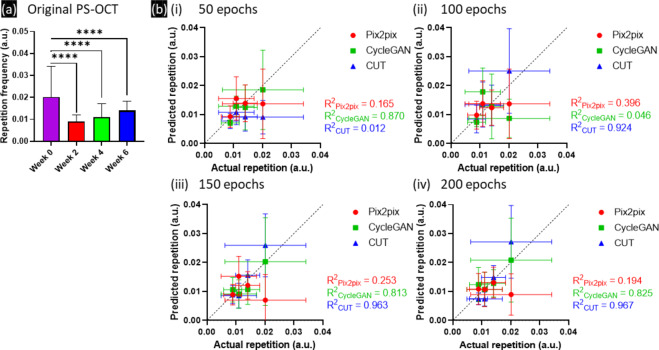
Polarization-sensitive optical coherence tomography (PS-OCT) measures the polarization state of backscattered light from tissues and provides valuable insights into the birefringence properties of biological tissues. Contrastive unpaired translation (CUT) was used in this study to generate a synthetic PS-OCT image from a single OCT image. The challenges related to extensive data requirements relying on labeled datasets using only pixel-wise correlations that make it difficult to efficiently regenerate the periodic patterns observed in PS-OCT images were addressed. The CUT model captures birefringence patterns by leveraging patch-wise correlations from unpaired data, which allows learning of the underlying structural features of biological tissues responsible for birefringence. To demonstrate the performance of the proposed approach, three generative models (Pix2pix, CycleGAN, and CUT) were compared on an in vivo dataset of injured mouse tendons over a six-week healing period. CUT outperformed Pix2pix and CycleGAN by producing high-fidelity synthetic PS-OCT images that closely matched the original PS-OCT images. Pearson correlation and two-way ANOVA tests confirmed the superior performance of CUT (p-value < 0.0001) over the comparison models. Additionally, a ResNet-152 classification model was used to assess tissue damage, which achieved an accuracy of up to 90.13% compared to the original PS-OCT images. This research demonstrates that CUT is superior to conventional methods for generating high-quality synthetic PS-OCT images and offers better improvements in most scenarios, in terms of efficiency and image fidelity.
偏振敏感光学相干断层扫描(PS-OCT)可测量来自组织的背向散射光的偏振状态,并为生物组织的双折射特性提供有价值的见解。本研究使用对比无配对翻译(CUT)从单个OCT图像生成合成PS-OCT图像。解决了与大量数据需求相关的挑战,这些需求仅依赖于使用像素级相关性的标记数据集,这使得难以有效地重现PS-OCT图像中观察到的周期性模式。CUT模型通过利用来自无配对数据的块级相关性来捕获双折射模式,从而能够了解导致双折射的生物组织的潜在结构特征。为了证明所提出方法的性能,在六周愈合期的受伤小鼠肌腱体内数据集上比较了三种生成模型(Pix2pix、CycleGAN和CUT)。CUT生成的高保真合成PS-OCT图像与原始PS-OCT图像非常匹配,优于Pix2pix和CycleGAN。Pearson相关性和双向方差分析测试证实了CUT(p值<0.0001)相对于比较模型的优越性能。此外,使用ResNet-152分类模型评估组织损伤,与原始PS-OCT图像相比,其准确率高达90.13%。这项研究表明,CUT在生成高质量合成PS-OCT图像方面优于传统方法,并且在大多数情况下,在效率和图像保真度方面都有更好的改进。