Babatope Abisola Esther, Adewumi Idowu Peter, Ajisafe Damola Olanipekun, Adepoju Kayode Olayiwola, Babatope Adetola Rachael
Department of Health Information Management, Faculty of Allied Health Sciences, University of Medical Sciences, Ondo, Ondo State, Nigeria.
Department of Health Information Management, Obafemi Awolowo University Teaching Hospitals Complex, Ile-Ife, Osun State, Nigeria.
Sci Rep. 2024 Dec 28;14(1):31398. doi: 10.1038/s41598-024-83009-y.
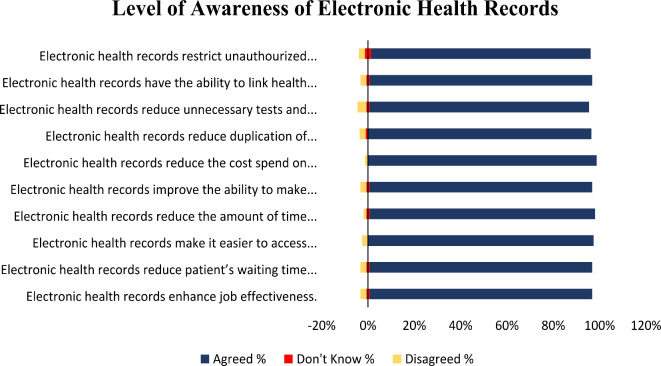
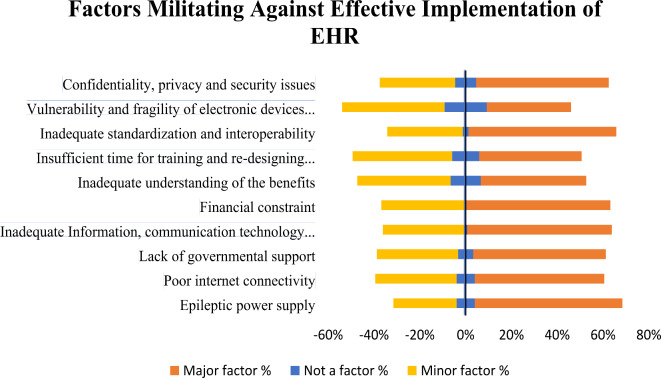
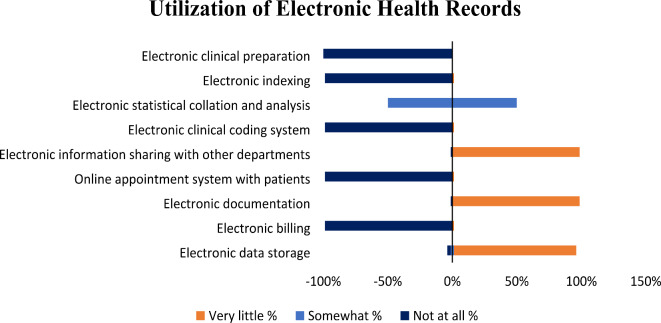
This study assessed the factors militating against the effective implementation of electronic health records (EHR) in Nigeria, the computerization of patients' health records with a lot of benefits including improved patients' satisfaction, improved care processes, reduction of patients' waiting time, and medication errors. Despite these benefits, healthcare organizations are slow to adopt the EHR system. Therefore, the study assessed the factors militating against the effective implementation of the EHR system, the level of awareness of EHR, and the utilization of electronic health records; it also investigated the factors militating against the effective implementation of EHR. This is a descriptive cross-sectional study conducted among members of staff of the University of Medical Sciences Teaching Hospital (UNIMEDTH). Purposive sampling was adopted to select the study participants, and a structured questionnaire was used for data collection. Statistical Product and Service Solutions (SPSS) version 27 was used for data analysis, R and Microsoft Excel were used for data visualization. Findings revealed that the respondents had a high level of awareness of EHR with an average mean of 1.29. The study revealed a low utilization rate for EHR (mean 3.01, SD 0.115) and data storage (mean 3.00, SD 0.231), indicating major problems with EHR implementation. Financial limitations (mean 2.63, SD 0.486) and insufficient ICT resources (mean 2.62, SD 0.516) are the main challenges. The regression analysis revealed that EHR utilization is highly impacted by awareness (F = 4.26, p < 0.008), accounting for 15.1% of the variance. Governmental assistance and financial constraints showed a statistically significant negative correlation (r=-0.04, p < 0.05), while inadequate internet connectivity and epileptic power supply showed a statistically significant positive association (r = 0.1, p < 0.05). The results show that, more government support is needed to alleviate financial constraints, and a stable power supply may enhance internet accessibility. The study concluded that epileptic power supply, poor internet connectivity, financial constraints, and other factors mentioned in the study militate against the effective implementation of electronic health records. It was recommended that the management should implement electronic health records effectively for efficient and effective health care delivery.
本研究评估了阻碍尼日利亚有效实施电子健康记录(EHR)的因素,即患者健康记录的计算机化,其具有诸多益处,包括提高患者满意度、改善护理流程、减少患者等待时间以及减少用药错误。尽管有这些益处,但医疗保健机构采用电子健康记录系统的速度却很慢。因此,本研究评估了阻碍电子健康记录系统有效实施的因素、对电子健康记录的认知水平以及电子健康记录的使用情况;还调查了阻碍电子健康记录有效实施的因素。这是一项在医科大学教学医院(UNIMEDTH)工作人员中开展的描述性横断面研究。采用目的抽样法选取研究参与者,并使用结构化问卷进行数据收集。使用统计产品与服务解决方案(SPSS)27版进行数据分析,使用R和微软Excel进行数据可视化。研究结果显示,受访者对电子健康记录的认知水平较高,平均均值为1.29。该研究表明电子健康记录的使用率较低(均值3.01,标准差0.115)以及数据存储(均值3.00,标准差0.231),这表明电子健康记录实施存在重大问题。资金限制(均值2.63,标准差0.486)和信息通信技术资源不足(均值2.62,标准差0.516)是主要挑战。回归分析显示,电子健康记录的使用受到认知的高度影响(F = 4.26,p < 0.008),占方差的15.1%。政府援助与资金限制呈现出具有统计学意义的负相关(r = -0.04,p < 0.05),而网络连接不足和电力供应不稳定呈现出具有统计学意义的正相关(r = 0.1,p < 0.05)。结果表明,需要更多政府支持以缓解资金限制,稳定的电力供应可能会提高网络可及性。该研究得出结论,电力供应不稳定、网络连接不佳、资金限制以及研究中提到的其他因素阻碍了电子健康记录的有效实施。建议管理层应有效实施电子健康记录以实现高效的医疗服务提供。