Shamsutdinova Alfiya, Kulkayeva Gulnara, Karashutova Zhadyra, Tanabayev Baimakhan, Tanabayeva Shynar, Ibrayeva Anel, Fakhradiyev Ildar
S.D.Asfendiyarov Kazakh National Medical University, Almaty, Kazakhstan.
Salidat Kairbekova National Research Center for Health Development, Astana, Kazakhstan.
Asian Pac J Cancer Prev. 2024 Dec 1;25(12):4371-4380. doi: 10.31557/APJCP.2024.25.12.4371.
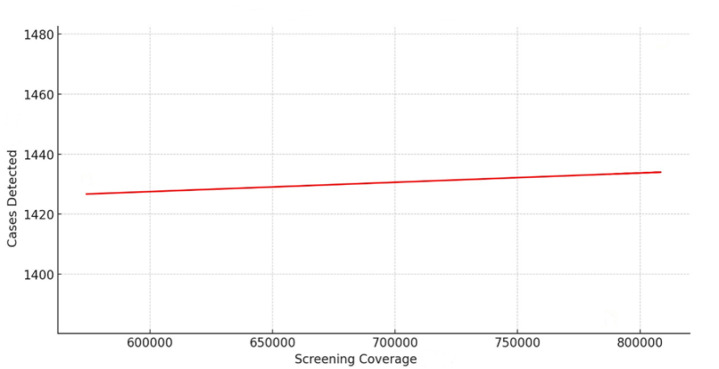
Cancer screening is a crucial component in the fight to reduce cancer incidence and mortality. Currently, the WHO recommends highly effective cancer screening programs, including screening for cervical cancer (CC), breast cancer (BC), and colorectal cancer (CRC). Despite the implementation of a cancer screening program since 2014, an evaluation of the effectiveness of BC, CC, and CRC screening in the Kazakhstan has not yet been conducted. Study aimed to assess the effectiveness and coverage of BC, CC, and CRC screening in the Republic of Kazakhstan during the period from 2021 to 2023.
Data for the retrospective analysis were extracted from the "Healthcare Statistics" database. Data on participants eligible for screening (n=8,167,184) for BC, CC, and CRC were included in the analysis.
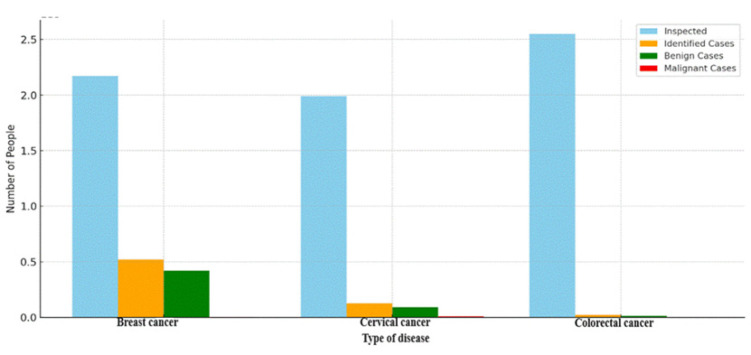
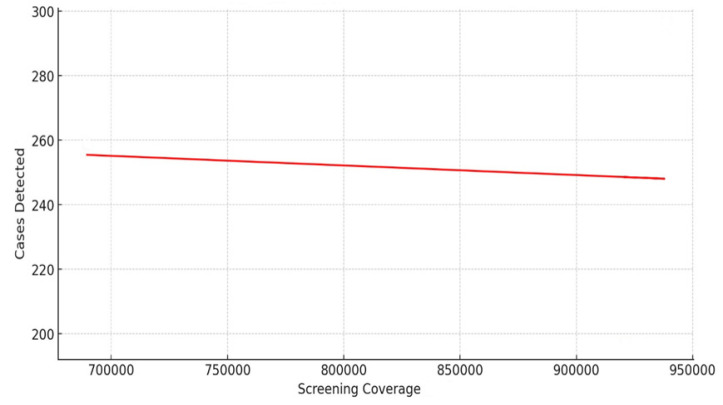
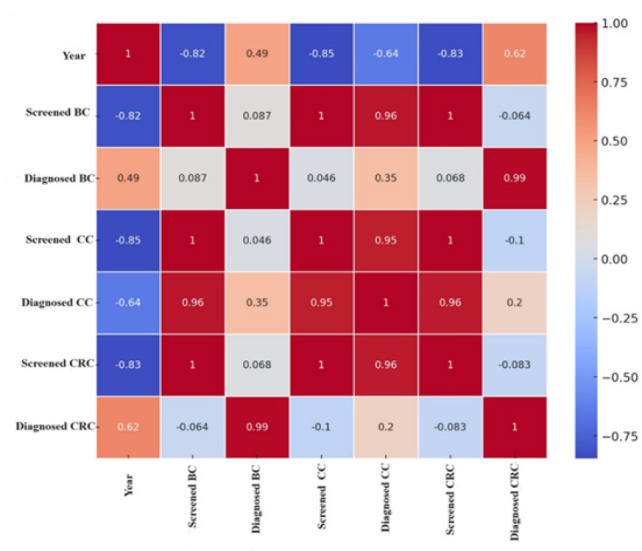
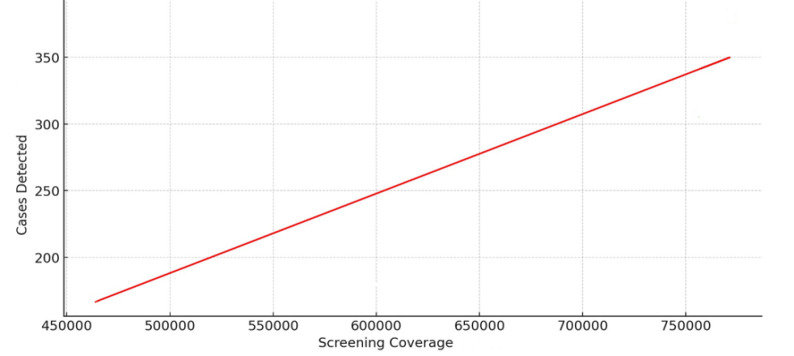
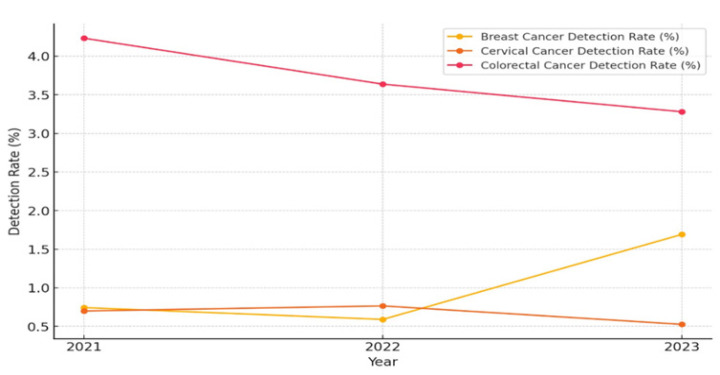
In 2023, there was a noticeable decrease in the number of detected cases of CC (1.7) compared to previous years. The detection rates for BC (14) and CRC (around 1) per 100,000 population in 2023 remained almost at the same level as in previous years. The detection rate for BC was 0.74% in 2021, followed by a decline to 0.59% in 2022. In 2023, there was an increase to 1.69%. As for CC, the detection rate was 0.70% in 2021, it increased to 0.77% in 2022, but then decreased again to 0.53% in 2023. CRC shows a steady decline in detection rates. In 2021, the detection rate was 4.23%, then it dropped to 3.64% in 2022, and continued to decrease to 3.28% in 2023.
The data for 2021-2023 underscore the necessity for continuous monitoring, analysis, and adaptation of screening strategies, taking into account regional peculiarities and new challenges, such as the pandemic. Ensuring high screening coverage for BC, CC, and CRC is a key factor for the early detection and effective treatment of these diseases.
癌症筛查是降低癌症发病率和死亡率斗争中的关键组成部分。目前,世界卫生组织推荐了高效的癌症筛查项目,包括宫颈癌(CC)、乳腺癌(BC)和结直肠癌(CRC)筛查。尽管自2014年起实施了癌症筛查项目,但尚未对哈萨克斯坦的乳腺癌、宫颈癌和结直肠癌筛查效果进行评估。本研究旨在评估2021年至2023年期间哈萨克斯坦共和国乳腺癌、宫颈癌和结直肠癌筛查的效果及覆盖率。
用于回顾性分析的数据从“医疗保健统计”数据库中提取。纳入分析的是符合乳腺癌、宫颈癌和结直肠癌筛查条件的参与者(n = 8,167,184)的数据。
2023年,宫颈癌的检出病例数(1.7)与前几年相比显著下降。2023年,每10万人口中乳腺癌(14)和结直肠癌(约1)的检出率与前几年基本持平。2021年乳腺癌的检出率为0.74%,2022年降至0.59%。2023年又升至1.69%。至于宫颈癌,2021年的检出率为0.70%,2022年升至0.77%,但2023年又降至0.53%。结直肠癌的检出率呈稳步下降趋势。2021年检出率为4.23%,2022年降至3.64%,2023年继续降至3.28%。
2021 - 2023年的数据强调了持续监测、分析和调整筛查策略的必要性,要考虑到地区特点和新挑战,如疫情。确保乳腺癌、宫颈癌和结直肠癌的高筛查覆盖率是这些疾病早期发现和有效治疗的关键因素。