Correa-Navarro Viridiana Abigail, Romo-Morales Gloria Del Carmen, Sánchez-Palafox Jaime Eduardo, Rodríguez-Ríos Dalia, Molina-Torres Jorge, Ramírez-Chávez Enrique, Zaina Silvio, Lund Gertrud
Department of Medical Sciences, Division of Health Sciences, Leon Campus, University of Guanajuato, 20 de Enero 929, Leon, Guanajuato, Mexico.
Department of Genetic Engineering, CINVESTAV Irapuato Unit, Km 9.6 Libramiento Norte, Carretera Irapuato-León, Irapuato, Guanajuato 36824, Mexico.
J Lipids. 2024 Dec 19;2024:3351340. doi: 10.1155/jl/3351340. eCollection 2024.
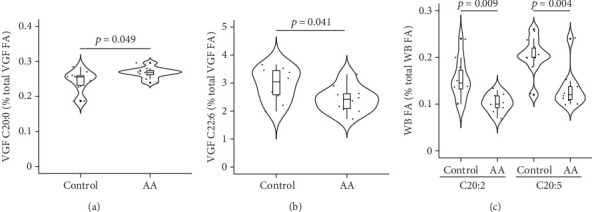
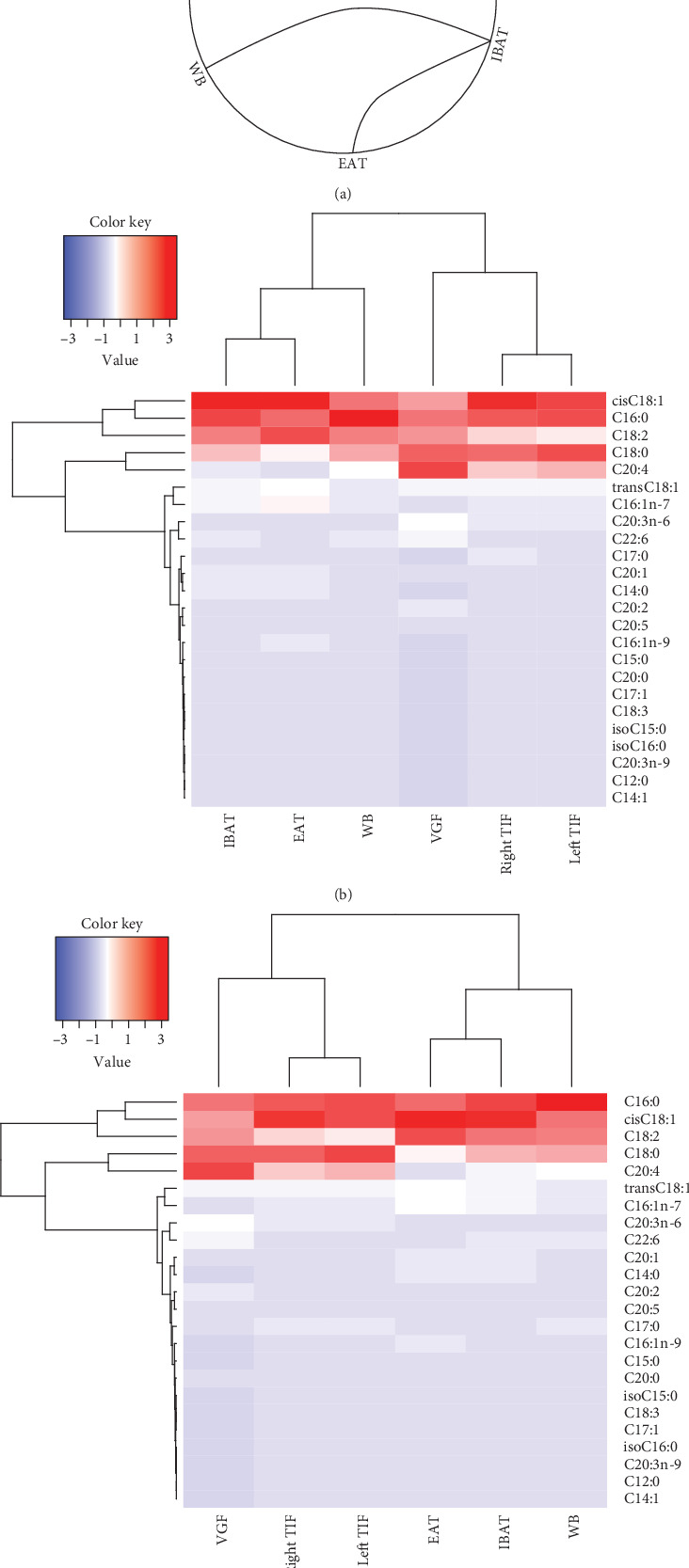
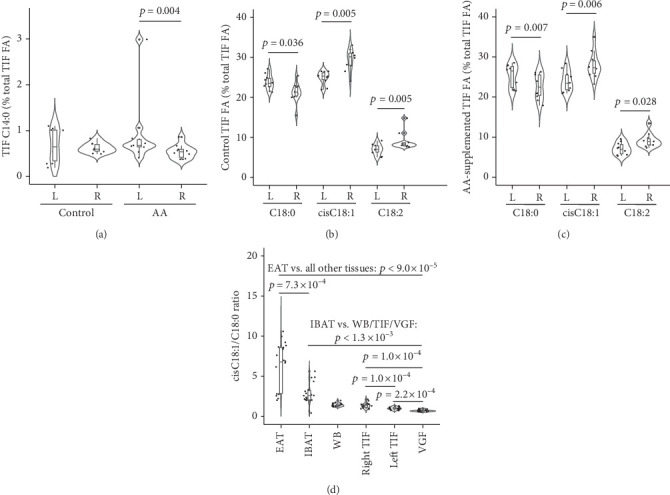
Paternal exposure to high-fat diets or individual fatty acids (FAs) including arachidonic acid (AA) modifies progeny traits by poorly understood mechanisms. Specific male reproductive system FAs may be involved in paternal inheritance, as they can modify a range of cellular components, including the epigenome. Our objective was to determine FAs in compartments of the male reproductive system that potentially affect ejaculate composition-right and left testicular interstitial fluid (TIF), vesicular gland fluid (VGF), and epididymal adipose tissue (EAT)-in mice exposed to AA or vehicle daily for 10 days ( = 9-10/group). Whole blood (WB) and interscapular brown adipose tissue (IBAT) FA profiles were used as reference. AA significantly affected only VGF FAs relative to vehicle, that is, increased and decreased levels of arachidic and docosahexaenoic acid, respectively, versus vehicle (0.28% ± 0.01% and 0.23% ± 0.03%, respectively, = 0.049, and 2.42% ± 0.47% and 3.00% ± 0.58%, respectively, = 0.041). AA affected distinct FAs in WB. Additionally, we uncovered AA-dependent and AA-independent FA laterality. Myristic acid was higher in AA-exposed left versus right TIF (0.68% ± 0.35% and 0.60% ± 0.11%, respectively, = 0.004). Right TIF contained higher oleic and linoleic acid and lower stearic acid than left TIF (29.01% ± 3.07% and 24.00% ± 2.18%, respectively, = 0.005; 9.14% ± 1.88% and 7.05% ± 1.36%, respectively, = 0.005; and 21.90% ± 2.92% and 26.01% ± 2.46%, respectively, = 0.036), irrespective of exposure to AA. The TIF oleic/stearic acid ratio suggested higher Stearoyl-CoA Desaturase 1 activity in the right versus the left testis (1.35 ± 0.32 and 1.00 ± 0.17, respectively, = 1.0 × 10). Multitissue comparisons revealed that TIF and VGF FA profiles were distinct from WB, EAT, or IBAT counterparts, suggesting tissue-specific FA fingerprints. In conclusion, AA modulated selected VGF long-chain FAs that may impact on uterine inflammation and subsequent embryonic development. AA altered local FA synthesis or selective uptake, rather than eliciting passive uptake from WB. Additionally, we uncover a significant laterality of testis FAs that may result in asymmetric sperm cell phenotypes.
父本暴露于高脂饮食或包括花生四烯酸(AA)在内的单一脂肪酸(FAs)会通过尚不清楚的机制改变子代性状。特定的雄性生殖系统脂肪酸可能参与父本遗传,因为它们可以改变一系列细胞成分,包括表观基因组。我们的目标是确定雄性生殖系统各部分中可能影响射精成分的脂肪酸——即左右睾丸间质液(TIF)、精囊腺液(VGF)和附睾脂肪组织(EAT)——在每天暴露于AA或赋形剂10天的小鼠中(每组n = 9 - 10)。全血(WB)和肩胛间棕色脂肪组织(IBAT)的脂肪酸谱用作参考。与赋形剂相比,AA仅显著影响VGF脂肪酸,即相对于赋形剂,花生酸水平升高,二十二碳六烯酸水平降低(分别为0.28% ± 0.01%和0.23% ± 0.03%,P = 0.049;以及分别为2.42% ± 0.47%和3.00% ± 0.58%,P = 0.041)。AA影响WB中不同的脂肪酸。此外,我们发现了AA依赖性和AA非依赖性脂肪酸的左右差异。暴露于AA的小鼠左侧TIF中的肉豆蔻酸高于右侧(分别为0.68% ± 0.35%和0.60% ± 0.11%,P = 0.004)。右侧TIF中的油酸和亚油酸含量高于左侧TIF,而硬脂酸含量低于左侧TIF(分别为29.01% ± 3.07%和24.00% ± 2.18%,P = 0.005;9.14% ± 1.88%和7.05% ± 1.36%,P = 0.005;以及21.90% ± 2.92%和26.01% ± 2.46%,P = 0.036),与是否暴露于AA无关。TIF中的油酸/硬脂酸比值表明右侧睾丸中硬脂酰辅酶A去饱和酶1的活性高于左侧(分别为1.35 ± 0.32和1.00 ± 0.17,P = 1.0×10⁻⁴)。多组织比较显示,TIF和VGF的脂肪酸谱与WB、EAT或IBAT的对应物不同,表明存在组织特异性脂肪酸指纹。总之,AA调节了选定的VGF长链脂肪酸,这些脂肪酸可能影响子宫炎症和随后胚胎发育。AA改变了局部脂肪酸合成或选择性摄取,而不是从WB中被动摄取。此外,我们发现睾丸脂肪酸存在显著的左右差异,这可能导致精子细胞表型不对称。