Department of Genetic Engineering, CINVESTAV Irapuato Unit, Irapuato 36500, Mexico.
Department of Biotechnology and Biochemistry, CINVESTAV Irapuato Unit, Irapuato 36500, Mexico.
Cells. 2022 Mar 21;11(6):1057. doi: 10.3390/cells11061057.
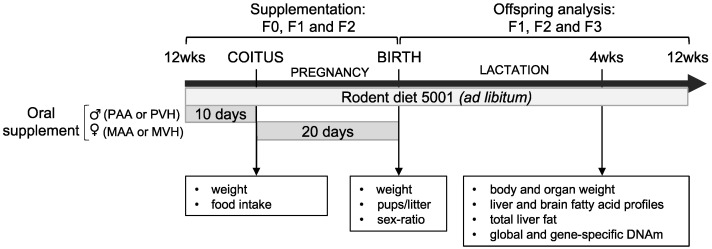
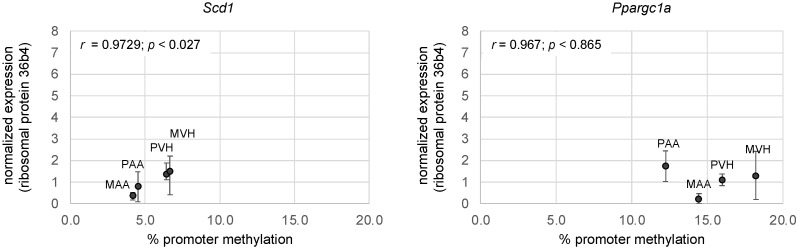
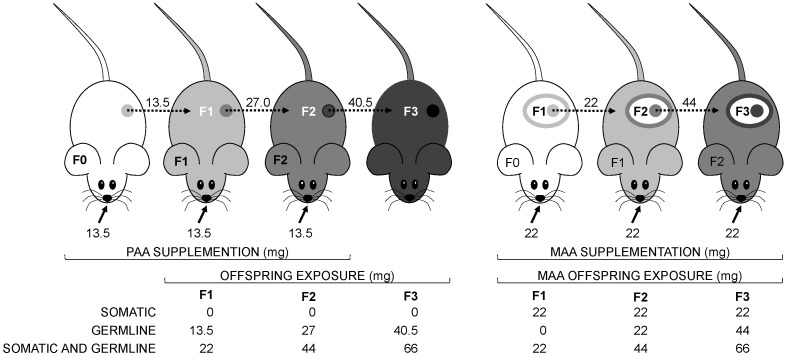
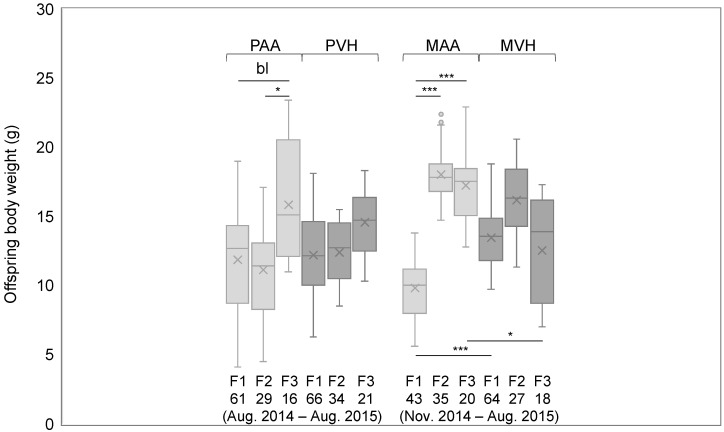
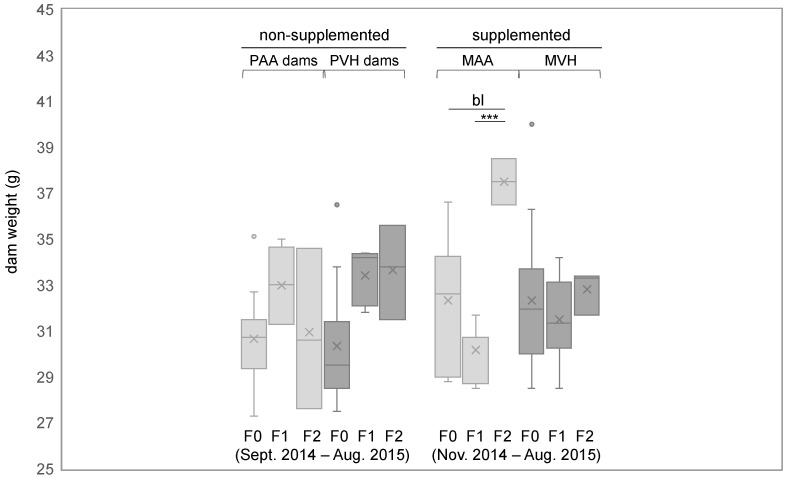
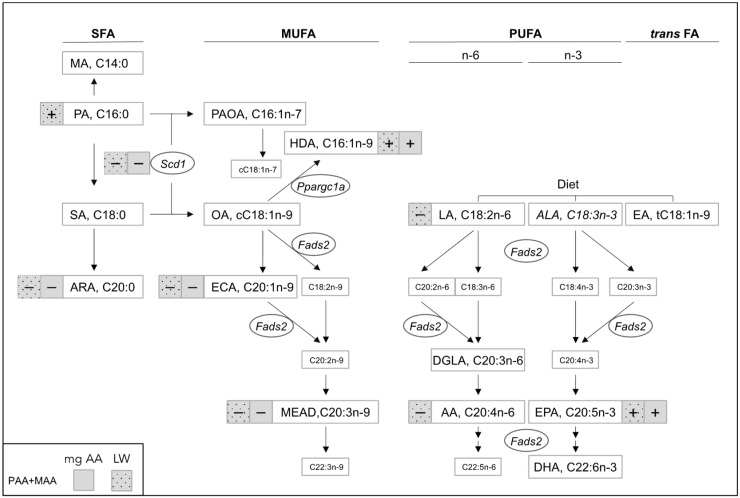
Apart from the known associations between arachidonic acid (AA), weight gain, and neurological and immune function, AA exposure leads to alterations in global and gene-specific DNA methylation (DNAm) and fatty acid (FA) content in human cultured cells. However, it is unknown as to whether the latter effects occur in vivo and are maintained over extended periods of time and across generations. To address this issue, we asked whether AA supplementation for three consecutive generations (prior to coitus in sires or in utero in dams) affected offspring growth phenotypes, in addition to liver DNAm and FA profiles in mice. Twelve-week-old BALB/c mice were exposed daily to AA dissolved in soybean oil (vehicle, VH), or VH only, for 10 days prior to mating or during the entire pregnancy (20 days). On average, 15 mice were supplemented per generation, followed by analysis of offspring body weight and liver traits (x average = 36 and 10 per generation, respectively). Body weight cumulatively increased in F2 and F3 offspring generations and positively correlated with milligrams of paternal or maternal offspring AA exposure. A concomitant increase in liver weight was observed. Notably, akin to AA-challenged cultured cells, global DNAm and cis-7-hexadecenoic acid (16:1n-9), an anti-inflammatory FA that is dependent on stearoyl-CoA desaturase 1 (SCD1) activity, increased with milligrams of AA exposure. In accordance, liver promoter methylation decreased with milligrams of germline AA exposure and was negatively correlated with liver weight. Our results show that mice retain cellular memories of AA exposure across generations that could potentially be beneficial to the innate immune system.
除了已知的花生四烯酸(AA)与体重增加和神经及免疫功能之间的关联外,AA 暴露会导致人类培养细胞中的全基因组和基因特异性 DNA 甲基化(DNAm)和脂肪酸(FA)含量发生改变。然而,尚不清楚这些后续影响是否会在体内发生,并在较长时间内和跨代中得以维持。为了解决这个问题,我们询问了 AA 连续三代补充(在父代交配前或在母代子宫内)是否会影响后代的生长表型,以及是否会影响小鼠肝脏的 DNAm 和 FA 图谱。12 周龄 BALB/c 小鼠每天暴露于溶解在大豆油中的 AA(载体,VH)或仅 VH 中 10 天,然后进行交配或在整个怀孕期间(20 天)进行暴露。每一代平均有 15 只小鼠接受补充,随后分析后代的体重和肝脏特征(x 平均值分别为每代 36 只和 10 只)。F2 和 F3 后代的体重逐渐增加,并与父代或母代后代 AA 暴露的毫克数呈正相关。同时观察到肝脏重量增加。值得注意的是,与 AA 挑战的培养细胞类似,全基因组 DNAm 和顺-7-十六碳烯酸(16:1n-9),一种依赖于硬脂酰辅酶 A 去饱和酶 1(SCD1)活性的抗炎 FA,随着 AA 暴露的毫克数增加而增加。相应地,肝脏启动子甲基化随着生殖系 AA 暴露的毫克数减少而减少,并且与肝脏重量呈负相关。我们的结果表明,小鼠在跨代过程中保留了对 AA 暴露的细胞记忆,这可能对先天免疫系统有益。