Tharek Zahirah, Ramli Anis Safura, Whitford David Leonard, Ismail Zaliha, Mohd Zulkifli Maryam, Ahmad Sharoni Siti Khuzaimah, Shafie Asrul Akmal, Jayaraman Thevaraajan
Discipline of Primary Care Medicine, Faculty of Medicine, Universiti Teknologi MARA (UiTM), Selayang Campus, Jalan Prima Selayang 7, 68100, Batu Caves, Selangor, Malaysia.
Institute of Pathology, Laboratory and Forensic Medicine (I-PPerForM), Universiti Teknologi MARA (UiTM), Sungai Buloh Campus, Jalan Hospital, 47000, Sungai Buloh, Selangor, Malaysia.
BMC Fam Pract. 2018 Mar 9;19(1):39. doi: 10.1186/s12875-018-0725-6.
Self-efficacy has been shown to be positively correlated with self-care behaviour and glycaemic control among patients with type 2 diabetes mellitus. However, such evidence is lacking in the Malaysian primary care setting. The objectives of this study were to i) determine the levels of self-efficacy, self-care behaviour and glycaemic control among patients with type 2 diabetes mellitus in the Malaysian primary care setting ii) determine the relationship between self-efficacy, self-care behaviour and glycaemic control iii) determine the factors associated with glycaemic control.
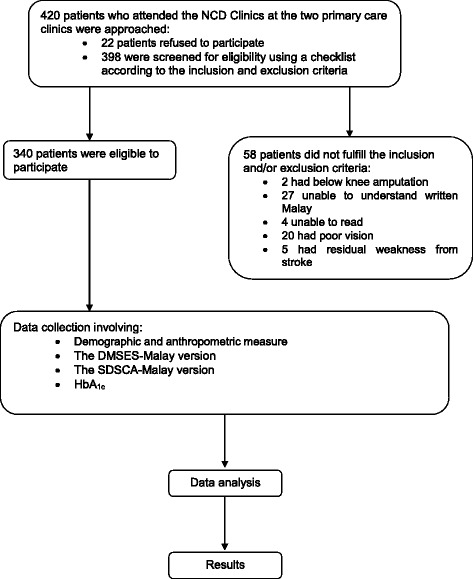
This was a cross-sectional study involving patients with type 2 diabetes mellitus from two public primary care clinics in Malaysia. Self-efficacy and self-care behaviour levels were measured using previously translated and validated DMSES and SDSCA questionnaires in Malay versions, respectively. Glycaemic control was measured using HbA RESULTS: A total of 340 patients with type 2 diabetes mellitus were recruited. The total mean (±SD) of self-efficacy and self-care behaviour scores were 7.33 (±2.25) and 3.76 (±1.87), respectively. A positive relationship was found between self-efficacy and self-care behaviour (r 0.538, P < 0.001). Higher self-efficacy score was shown to be correlated with lower HbA (r - 0.41, P < 0.001). Multiple linear regression analysis demonstrated that higher self-efficacy scores (b - 0.398; 95% CI: -0.024, - 0.014; P < 0.001), shorter duration of diabetes (b 0.177; 95% CI: 0.002, 0.007; P < 0.001) and smaller waist circumference (b 0.135; 95% CI: 0.006, 0.035; P = 0.006), were significantly associated with good glycaemic control.
This study demonstrated that higher self-efficacy was correlated with improved self-care behaviour and better glycaemic control. Findings of this study suggest the importance of including routine use of self-efficacy measures in the management of type 2 diabetes mellitus in primary care.
自我效能已被证明与2型糖尿病患者的自我护理行为和血糖控制呈正相关。然而,在马来西亚基层医疗环境中缺乏此类证据。本研究的目的是:i)确定马来西亚基层医疗环境中2型糖尿病患者的自我效能、自我护理行为和血糖控制水平;ii)确定自我效能、自我护理行为和血糖控制之间的关系;iii)确定与血糖控制相关的因素。
这是一项横断面研究,涉及马来西亚两家公立基层医疗诊所的2型糖尿病患者。自我效能和自我护理行为水平分别使用先前翻译并验证的马来语版DMSES和SDSCA问卷进行测量。血糖控制使用糖化血红蛋白(HbA)进行测量。结果:共招募了340名2型糖尿病患者。自我效能和自我护理行为得分的总平均值(±标准差)分别为7.33(±2.25)和3.76(±1.87)。自我效能与自我护理行为之间存在正相关(r = 0.538,P < 0.001)。较高的自我效能得分与较低的糖化血红蛋白(HbA)相关(r = -0.41,P < 0.001)。多元线性回归分析表明,较高的自我效能得分(b = -0.398;95%置信区间:-0.024,-0.014;P < 0.001)、较短的糖尿病病程(b = 0.177;95%置信区间:0.002,0.007;P < 0.001)和较小的腰围(b = 0.135;95%置信区间:0.006,0.035;P = 0.006)与良好的血糖控制显著相关。
本研究表明,较高的自我效能与改善的自我护理行为和更好的血糖控制相关。本研究结果表明在基层医疗中对2型糖尿病管理常规使用自我效能测量的重要性。