Karnati Ranjit, Parida Sabyasachi, Sahoo Saroj R, Mishra Amaresh, Panda Bandita, Madhavnarayan Totadri Varsha, Mohanty Subrat
General Surgery, Kalinga Institute of Medical Sciences, Kalinga Institute of Industrial Technology (Deemed to be University), Bhubaneswar, IND.
Surgical Oncology, Kalinga Institute of Medical Sciences, Kalinga Institute of Industrial Technology (Deemed to be University), Bhubaneswar, IND.
Cureus. 2024 Nov 27;16(11):e74628. doi: 10.7759/cureus.74628. eCollection 2024 Nov.
The present study aims to observe the efficacy of submandibular gland excision vs. preservation during supraomohyoid neck dissection (SOHND) based on the postoperative outcomes for early oral squamous cell carcinoma (OSCC) with clinically N0 neck and xerostomia.
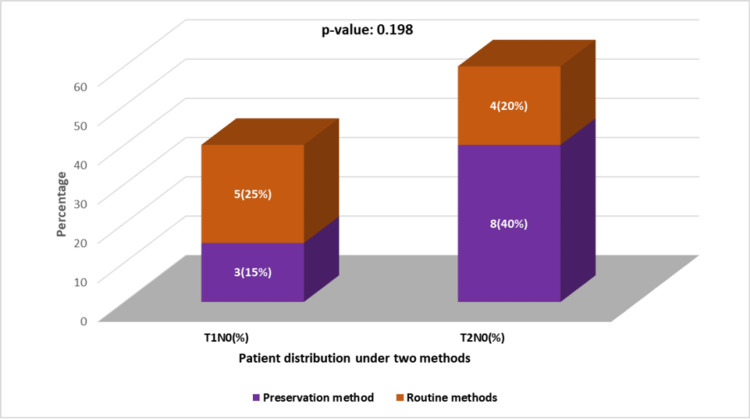
A pilot study was conducted to observe the efficacy of preservation vs. excision of the submandibular gland in early OSCC in 20 cases with an age range of 18-75 years. Intraoperative blood loss and time taken for level Ib lymph node dissection were compared. Histopathologically, lymph node yield (level Ib) was also compared. Postoperative follow-up up to four weeks and xerostomia assessment were done in both groups by using the Xerostomia Inventory score and Clinical Oral Dryness Score (CODS). Continuous and categorical data and their significance level were analyzed statistically.
Routine submandibular gland excision and preservation methods were used for level Ib lymph node dissection during SOHND. Comparative assessment between the two methods revealed that surgery duration and blood loss in the test group were significantly higher (p-value < 0.001) as compared to the control group. The incidence of xerostomia in both groups did not reveal any statistical difference.
Submandibular gland preservation during SOHND in early OSCC leads to a slight increase in the time of dissection and blood loss is negligible and appears oncologically safer. No recurrence of intraglandular lymph nodes and zero incidence of xerostomia were the follow-up conclusions of the preservation method.
本研究旨在基于临床N0颈部及口干的早期口腔鳞状细胞癌(OSCC)的术后结果,观察在肩胛舌骨上颈部清扫术(SOHND)期间,下颌下腺切除与保留的疗效。
进行了一项前瞻性研究,以观察20例年龄在18 - 75岁的早期OSCC患者中,保留与切除下颌下腺的疗效。比较术中失血量和Ib区淋巴结清扫所需时间。在组织病理学上,也比较了淋巴结收获量(Ib区)。两组均采用口干量表评分和临床口腔干燥评分(CODS)进行术后四周的随访及口干评估。对连续和分类数据及其显著性水平进行统计学分析。
在SOHND期间,对Ib区淋巴结清扫采用常规下颌下腺切除和保留方法。两种方法的比较评估显示,试验组的手术时间和失血量均显著高于对照组(p值<0.001)。两组口干发生率未显示出任何统计学差异。
早期OSCC患者在SOHND期间保留下颌下腺会导致清扫时间略有增加,失血量可忽略不计,且在肿瘤学上似乎更安全。保留方法的随访结论是腺内淋巴结无复发且口干发生率为零。