Wu You, Cao Zijian, Yang Jing, Bi Xinran, Xiong Weiqing, Feng Xiaoru, Yan Yue, Zhang Zeyu, Zhang Zongjiu
School of Healthcare Management, Tsinghua Medicine Tsinghua University Beijing China.
School of Basic Medical Sciences, Tsinghua Medicine Tsinghua University Beijing China.
Health Care Sci. 2024 Dec 18;3(6):383-408. doi: 10.1002/hcs2.122. eCollection 2024 Dec.
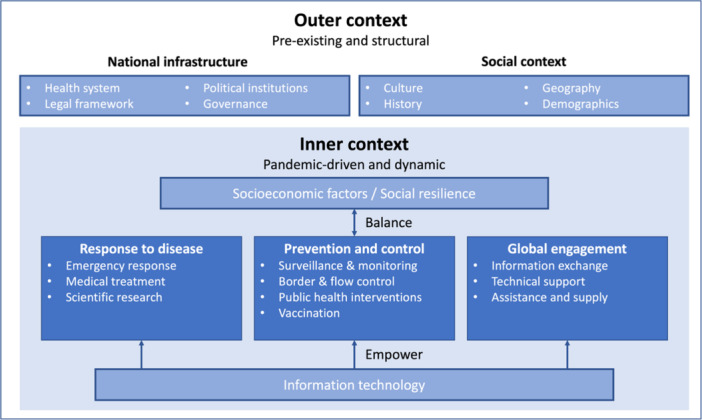
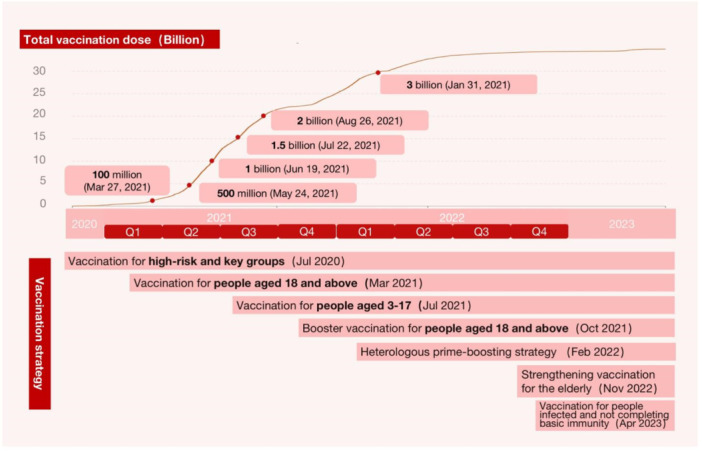
The COVID-19 pandemic presented unparalleled challenges to prompt and adaptive responses from nations worldwide. This review examines China's multifaceted approach to the crisis, focusing on five key areas of response: infrastructure and system design, medical care and treatment, disease prevention and control, economic and social resilience, and China's engagement in global health. This review demonstrates the effectiveness of a top-down command system at the national level, intersectoral coordination, a legal framework, and public social governance. This study also examines medical care and treatment strategies, highlighting the importance of rapid emergency response, evidence-based treatment, and well-planned vaccination rollout. Further discussion on disease prevention and control measures emphasizes the importance of adaptive measures, timely infection control, transmission interruption, population herd immunity, and technology applications. Socioeconomic impact was also assessed, detailing strategies for disease prevention, material supply, livelihood preservation, and social economy revival. Lastly, we examine China's contributions to the global health community, with a focus on knowledge-sharing, information exchange, and multilateral assistance. While it is true that each nation's response must be tailored to its own context, there are universal lessons to be drawn from China's approach. These insights are pivotal for enhancing global health security, especially as the world navigates evolving health crises.
新冠疫情给全球各国迅速做出适应性应对带来了前所未有的挑战。本综述考察了中国应对这场危机的多方面举措,重点关注五个关键应对领域:基础设施与体系设计、医疗救治、疾病防控、经济社会韧性以及中国在全球卫生领域的参与。本综述展示了国家层面自上而下指挥系统、跨部门协调、法律框架及公共社会治理的有效性。本研究还考察了医疗救治策略,强调了快速应急响应、循证治疗以及精心规划的疫苗接种推广的重要性。对疾病防控措施的进一步讨论强调了适应性措施、及时感染控制、传播阻断、群体免疫以及技术应用的重要性。还评估了社会经济影响,详细阐述了疾病预防、物资供应、民生保障及社会经济复苏的策略。最后,我们考察了中国对全球卫生界的贡献,重点是知识共享、信息交流和多边援助。诚然,每个国家的应对措施都必须因地制宜,但中国的做法有一些普遍经验可供借鉴。这些见解对于加强全球卫生安全至关重要,尤其是在世界应对不断演变的卫生危机之际。