Chen Zongcun, Fu Shasha, Lai Shuchang, Fu Maoxiong, Du Guankui
Department of Endocrinology, The Second Affiliated Hospital of Hainan Medical University, Haikou, China.
Key Laboratory of Tropical Translational Medicine of Ministry of Education, School of Basic Medicine and Life Sciences, Hainan Medical University, Haikou, China.
Front Endocrinol (Lausanne). 2024 Dec 13;15:1505082. doi: 10.3389/fendo.2024.1505082. eCollection 2024.
Adipokines have been implicated in the pathogenesis of type 2 diabetes mellitus (T2DM) and related complications due to their roles in metabolic regulation and inflammation. However, the relationship between these adipokines and diabetic peripheral neuropathy (DPN) remains unclear.
A case-control study was performed with 198 patients with DPN and 205 T2DM patients without DPN from the Endocrinology Department at the Second Affiliated Hospital of Hainan Medical University. Circulating adiponectin and leptin levels were quantified via enzyme-linked immunosorbent assays. Logistic regression models, adjusting for age, sex, BMI, smoking status, and diabetes duration, were applied to evaluate the associations between adiponectin and leptin levels and DPN risk.
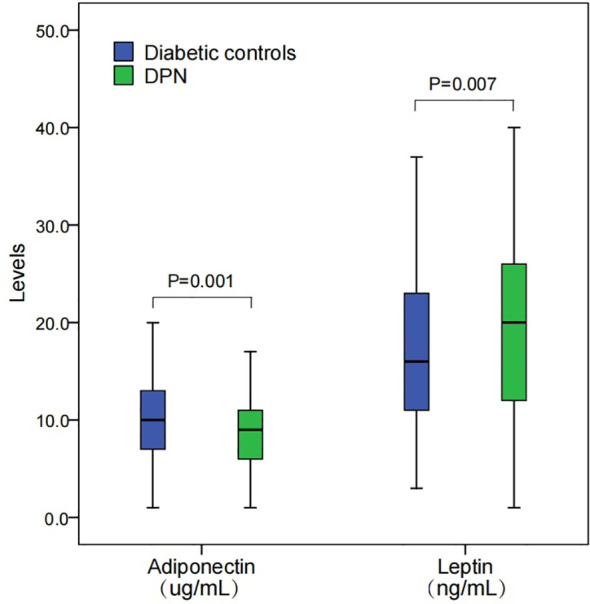
DPN patients exhibited lower adiponectin (P=0.001) and higher leptin (P=0.007) levels than diabetic controls. Confounders-adjusted analyses revealed that higher adiponectin levels correlated with reduced DPN risk (OR, tertile 3 vs. tertile 1: 0.52; 95% CI: 0.30-0.90), whereas elevated leptin levels were linked to increased DPN risk (OR, tertile 3 vs. tertile 1: 1.91; 95% CI: 1.10-3.32). Stratified analyses confirmed consistent findings across subgroups without statistically significant interactions.
Circulating adiponectin and leptin levels correlate with DPN risk in diabetic patients, suggesting their potential as biomarkers for high-risk DPN identification and guiding targeted prevention and management.
脂肪因子因其在代谢调节和炎症中的作用,已被认为与2型糖尿病(T2DM)及其相关并发症的发病机制有关。然而,这些脂肪因子与糖尿病周围神经病变(DPN)之间的关系仍不清楚。
对海南医学院第二附属医院内分泌科的198例DPN患者和205例无DPN的T2DM患者进行了病例对照研究。通过酶联免疫吸附测定法定量循环脂联素和瘦素水平。应用逻辑回归模型,对年龄、性别、体重指数、吸烟状况和糖尿病病程进行校正,以评估脂联素和瘦素水平与DPN风险之间的关联。
与糖尿病对照组相比,DPN患者的脂联素水平较低(P=0.001),瘦素水平较高(P=0.007)。校正混杂因素后的分析显示,较高的脂联素水平与降低的DPN风险相关(OR,三分位数3与三分位数1:0.52;95%CI:0.30-0.90),而升高的瘦素水平与增加的DPN风险相关(OR,三分位数3与三分位数1:1.91;95%CI:1.10-3.32)。分层分析证实各亚组的结果一致,且无统计学显著的相互作用。
糖尿病患者循环脂联素和瘦素水平与DPN风险相关,提示它们有可能作为识别DPN高危人群以及指导针对性预防和管理的生物标志物。