Angwenyi Vibian, Fletcher Richard, Mwangi Paul Murimi, Kabue Margaret, Odhiambo Rachel, Mulupi Stephen, Obulemire Emmanuel Kepha, Njoroge Eunice, Ombech Eunice, Mokaya Mercy Moraa, Wesala Moses, Marangu Joyce, Abubakar Amina
Institute for Human Development, Aga Khan University, Nairobi, Kenya.
School of Health Sciences, College of Health, Medicine, and Wellbeing, The University of Newcastle, Callaghan, Australia.
BMC Public Health. 2024 Dec 30;24(1):3603. doi: 10.1186/s12889-024-21057-9.
Engaging fathers(to-be) can improve maternal, newborn, and child health outcomes. However, father-focused interventions in low-resource settings are under-researched. As part of an integrated early childhood development pilot cluster randomised trial in Nairobi's informal settlements, this study aimed to test the feasibility of a text-only intervention for fathers (SMS4baba) adapted from one developed in Australia (SMS4dads).
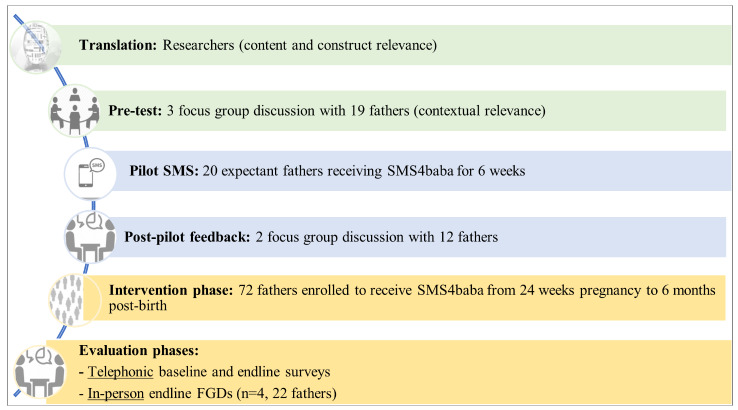
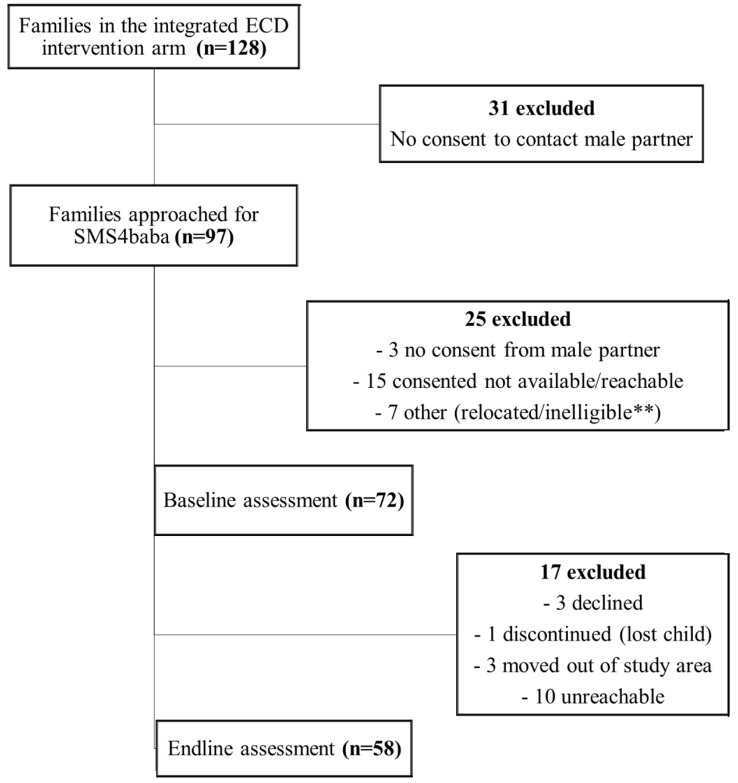
A multi-phased mixed-methods study, which included an exploratory qualitative phase and pre-post evaluation of the adapted SMS4baba text-only intervention was conducted between 2019 and 2022. Three focus-group discussions (FGDs) with 19 fathers were conducted at inception to inform SMS4baba content development; two post-pilot FGDs with 12 fathers explored the acceptability and feasibility of SMS4baba implementation; and 4 post-intervention FGDs with 22 fathers evaluated SMS4baba programme experiences. In the intervention phase, 72 fathers were recruited to receive SMS4baba messages thrice weekly from late pregnancy until over six months postpartum. A pre-enrolment questionnaire captured fathers' socio-demographic characteristics. Pre-post surveys were administered telephonically, and outcome measures evaluated using a paternal antenatal attachment scale, generalised anxiety disorder scale (GAD-7), patient health questionnaire (PHQ-9), and researcher-developed questionnaire items assessing paternal involvement, childcare and parenting practices. Qualitative data were analysed using a thematic approach. Statistical analysis performed included descriptive statistics, tests of association, and mixed model regression to evaluate outcomes.
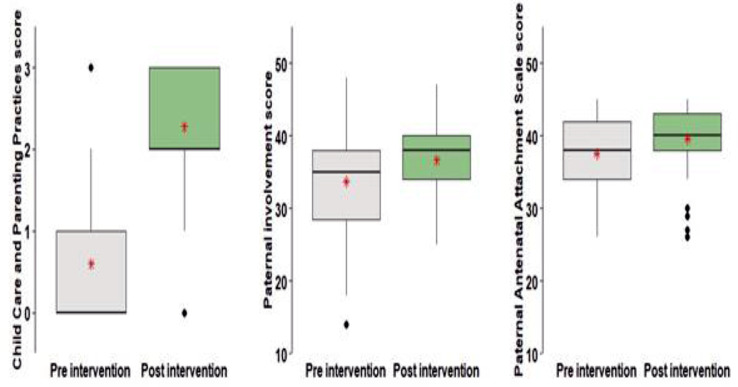
Fathers perceived SMS4baba messages as educational, instilling new knowledge and reinforcing positive parenting, and helped fathers cope with fatherhood transition. High levels of engagement by reading and sharing the texts was reported, and fathers expressed strong approval of the SMS4baba messages. SMS4baba's acceptability was attributed to modest message frequency and utilising familiar language. Fathers reported examples of behaviour change in their parenting and spousal support, which challenged gendered parenting norms. Pre-post measures showed increased father involvement in childcare (Cohen's d = 2.17, 95%CI [1.7, 2.62]), infant/child attachment (Cohen's d = 0.33, 95%CI [-0.03, 0.69]), and partner support (Cohen's d = 0.5, 95%CI [0.13, 0.87]).
Our findings provide support for father-specific interventions utilising digital technologies to reach and engage fathers from low-resource settings such as urban informal settlements. Exploration of text messaging channels targeting fathers, to address family wellbeing in the perinatal period is warranted.
This study was part of the integrated early childhood development pilot cluster randomised trial, registered in the Pan African Clinical Trial Registry on 26/03/2021, registration number PACTR202103514565914.
让准父亲参与进来可改善孕产妇、新生儿和儿童的健康状况。然而,在资源匮乏地区针对父亲的干预措施研究不足。作为在内罗毕非正式定居点开展的一项综合幼儿发展试点整群随机试验的一部分,本研究旨在测试一项仅通过短信的干预措施(短信育儿法)对父亲的可行性,该措施改编自澳大利亚开发的一项措施(短信育爸法)。
2019年至2022年期间开展了一项多阶段混合方法研究,其中包括一个探索性定性阶段以及对改编后的仅通过短信的短信育儿法干预措施进行前后评估。在开始阶段与19位父亲进行了三次焦点小组讨论,为短信育儿法的内容开发提供信息;在试点后与12位父亲进行了两次焦点小组讨论,探讨短信育儿法实施的可接受性和可行性;在干预后与22位父亲进行了4次焦点小组讨论,评估短信育儿法项目体验。在干预阶段,招募了72位父亲,从妊娠晚期到产后六个月以上,每周三次接收短信育儿法信息。一份入学前问卷收集了父亲的社会人口特征。通过电话进行前后调查,并使用父亲产前依恋量表、广泛性焦虑症量表(GAD-7)、患者健康问卷(PHQ-9)以及研究人员编制的评估父亲参与度、育儿和养育方式的问卷项目来评估结果指标。使用主题分析法对定性数据进行分析。进行的统计分析包括描述性统计、关联性检验和混合模型回归以评估结果。
父亲们认为短信育儿法信息具有教育意义,能灌输新知识并强化积极的育儿方式,还帮助父亲应对父亲角色的转变。据报告,通过阅读和分享短信的参与度很高,父亲们对短信育儿法信息表示强烈认可。短信育儿法的可接受性归因于适度的信息频率和使用熟悉的语言。父亲们报告了他们在育儿和配偶支持方面行为改变的例子,这挑战了性别化的育儿规范。前后测量显示父亲在育儿方面的参与度增加(科恩d值 = 2.17,95%置信区间[1.7, 2.62])、与婴儿/儿童的依恋增加(科恩d值 = 0.33,95%置信区间[-0.03, 0.69])以及配偶支持增加(科恩d值 = 0.5,95%置信区间[0.13, 0.87])。
我们的研究结果为利用数字技术针对父亲开展特定干预措施以接触和吸引来自城市非正式定居点等资源匮乏地区的父亲提供了支持。有必要探索针对父亲的短信渠道,以解决围产期的家庭福祉问题。
本研究是综合幼儿发展试点整群随机试验的一部分,于2021年3月26日在泛非临床试验注册中心注册,注册号为PACTR202103514565914。