Wang Hanqing, Sun Hongli
Training and Research Center of Ideological and Political Work Team of Ministry of Education (Shaanxi Normal University), Xi'an, China.
Psychological Health Education and Counseling Center, Sanda University, Shanghai, China.
Front Psychol. 2024 Dec 16;15:1504890. doi: 10.3389/fpsyg.2024.1504890. eCollection 2024.
Non-suicidal self-injury (NSSI) is a high-risk factor for suicide, which is widespread among college students and is closely associated with psychological issues. Insomnia tends to cause mental instability, and chronic insomnia can trigger severe mood swings, including anxiety, depression, and irritability. It can also lead to memory loss and metabolic disorders. College students are in a critical period of self-development, with significant vulnerability to insomnia and NSSI. This study investigated the influence of insomnia on NSSI among college students and examined the significance of rumination as a mediating factor.
Using random cluster sampling, we selected 667 college students from Jiangsu, China, and evaluated them using the Athens Insomnia Scale (AIS), Adolescent Self-Injury Scale (ASIS), and Ruminative Responses Scale (RRS). The significance of the mediating effect of rumination on the relationship between insomnia and NSSI among college students was tested using Bootstrap methods.
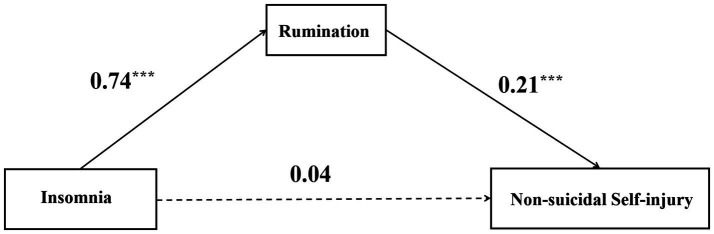
The fact that the students were only children was statistically significant for rumination scores ( < 0.05). The results showed a significant positive correlation among insomnia, NSSI, and rumination ( = 0.198, 0.737, 0.243, respectively; < 0.001). Insomnia of college students affects NSSI directly and indirectly through rumination.
Rumination fully mediated the relationship between insomnia and NSSI among college students, indicating an indirect influence of insomnia on NSSI. Total effect value is 0.192. Rumination plays a complete mediating role in the relationship between insomnia and NSSI among college students, with a mediating effect of 84.21%.
非自杀性自伤(NSSI)是自杀的高危因素,在大学生中普遍存在,且与心理问题密切相关。失眠往往会导致心理不稳定,慢性失眠会引发严重的情绪波动,包括焦虑、抑郁和易怒。它还可能导致记忆力减退和代谢紊乱。大学生正处于自我发展的关键时期,极易受到失眠和NSSI的影响。本研究调查了失眠对大学生NSSI的影响,并检验了沉思作为中介因素的意义。
采用随机整群抽样方法,从中国江苏选取667名大学生,使用雅典失眠量表(AIS)、青少年自伤量表(ASIS)和沉思反应量表(RRS)对他们进行评估。采用Bootstrap方法检验沉思在大学生失眠与NSSI关系中的中介作用的显著性。
学生是否为独生子女对沉思得分有统计学意义(<0.05)。结果显示失眠、NSSI和沉思之间存在显著正相关(分别为=0.198、0.737、0.243;<0.001)。大学生的失眠通过沉思直接和间接地影响NSSI。
沉思完全中介了大学生失眠与NSSI之间的关系,表明失眠对NSSI有间接影响。总效应值为0.192。沉思在大学生失眠与NSSI之间的关系中起完全中介作用,中介效应为84.21%。