Zeng Rushuang, Han Dang, Du Wei, Wen Jing, Zhang Youxian, Li Zongyu, Du Qun, Qi Yan, Li Yu, He Jia
Key Laboratory of Xinjiang Endemic and Ethnic Diseases of the Ministry of Education, Department of Public Health, Shihezi University School of Medicine, Xinjiang, China.
Key Laboratory for Prevention and Control of Emerging Infectious Diseases and Public Health Security, The Xinjiang Production and Construction Corps, Xinjiang, China.
Front Psychol. 2024 Dec 16;15:1417960. doi: 10.3389/fpsyg.2024.1417960. eCollection 2024.
Adolescents who suffer from school bullying are often accompanied by problems such as sleep disorders and depression. However, it remains unclear how depressive symptoms and sleep assessments such as sleep duration interact in the specific mechanisms of exposure to school bullying.
To understand the role of sleep duration, depressive symptoms on school bullying in adolescents and the mediating role of sleep duration in this context.
A total of 1730 adolescents were selected from Xinjiang province, China by stratified cluster random sampling in 2020, and their demographic characteristics, exposure to school bullying, depressive symptoms, and sleep duration were investigated by questionnaire. Multifactorial logistics regression analyses were performed to examine the effects of sleep duration and depressive symptoms on school bullying. Furthermore, the bootstrap method was used to explore the mediating effect and masking effect of depressive symptoms between sleep duration and school bullying by PROCESS macro in SPSS 26.0.
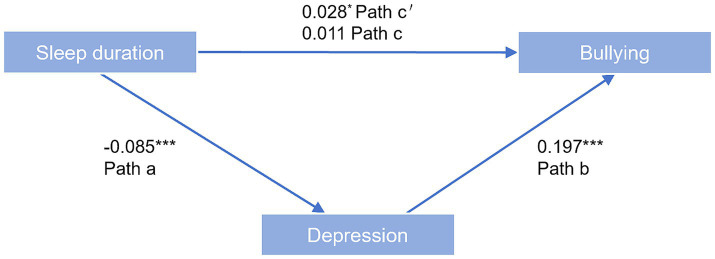
A total of 16.42% of adolescents suffered from school bullying and 12.25% showed depressive symptoms. Multifactorial logistics regression analyses revealed that possible depression and depression increase the risk of exposure to school bullying compared to normal group. Sleep duration less than 8 h and between 8 and 10 h are protective factors for exposure to three types of school bullying relative to those who sleep more than 10 h. Additionally, sleep duration affected exposure to school bullying through depressive symptoms ( = 0.011) and depressive symptoms masked the effect between sleep duration and exposure to school bullying with an effect of 60.17%. The masking effect remained stable after adjusting for gender, age, ethnicity, body mass index, and exercise intensity (indirect effect = -0.017, 95%CI: -0.026 to -0.009).
Depressive symptoms may be a risk factor for exposure to school bullying, while moderate and inadequate sleep duration may be protective factors for exposure to all three types of school bullying simultaneously. The effect of sleep duration on adolescents' exposure to school bullying was affected by the masking effect of depressive symptoms, and appropriate sleep duration and a positive and healthy mindset were beneficial in reducing the occurrence of school bullying.
遭受校园欺凌的青少年常伴有睡眠障碍和抑郁等问题。然而,在遭受校园欺凌的具体机制中,抑郁症状与睡眠时长等睡眠评估指标之间如何相互作用仍不清楚。
了解睡眠时长、抑郁症状在青少年校园欺凌中的作用以及睡眠时长在此背景下的中介作用。
2020年通过分层整群随机抽样从中国新疆选取1730名青少年,采用问卷调查其人口学特征、遭受校园欺凌情况、抑郁症状及睡眠时长。进行多因素logistic回归分析以检验睡眠时长和抑郁症状对校园欺凌的影响。此外,使用Bootstrap法通过SPSS 26.0中的PROCESS宏来探索抑郁症状在睡眠时长与校园欺凌之间的中介效应和遮掩效应。
共有16.42%的青少年遭受校园欺凌,12.25%表现出抑郁症状。多因素logistic回归分析显示,与正常组相比,可能抑郁和抑郁增加了遭受校园欺凌的风险。相对于睡眠时长超过10小时的青少年,睡眠时长小于8小时以及8至10小时是遭受三种校园欺凌类型的保护因素。此外,睡眠时长通过抑郁症状影响遭受校园欺凌的情况(β = 0.011),抑郁症状遮掩了睡眠时长与遭受校园欺凌之间的效应,遮掩效应为60.17%。在调整性别、年龄、民族、体重指数和运动强度后,遮掩效应仍然稳定(间接效应 = -0.017,95%CI:-0.026至-0.009)。
抑郁症状可能是遭受校园欺凌的危险因素,而适度和不足的睡眠时长可能是同时遭受三种校园欺凌类型的保护因素。睡眠时长对青少年遭受校园欺凌的影响受到抑郁症状遮掩效应的影响,适当的睡眠时长和积极健康的心态有利于减少校园欺凌的发生。