Feng Yixue, Chandio Bramsh Q, Villalon-Reina Julio E, Thomopoulos Sophia I, Nir Talia M, Benavidez Sebastian, Laltoo Emily, Chattopadhyay Tamoghna, Joshi Himanshu, Venkatasubramanian Ganesan, John John P, Jahanshad Neda, Reid Robert I, Jack Clifford R, Weiner Michael W, Thompson Paul M
Imaging Genetics Center, Mark and Mary Stevens Neuroimaging and Informatics Institute, Keck School of Medicine, University of Southern California, Marina del Rey, California, USA.
Multimodal Brain Image Analysis Laboratory, National Institute of Mental Health and Neuro Sciences (NIMHANS), Bangalore, India.
Alzheimers Dement. 2025 Jan;21(1):e14371. doi: 10.1002/alz.14371. Epub 2024 Dec 30.
Diffusion-weighted magnetic resonance imaging (dMRI) is sensitive to the microstructural properties of brain tissues and shows great promise in detecting the effects of degenerative diseases. However, many approaches analyze single measures averaged over regions of interest without considering the underlying fiber geometry.
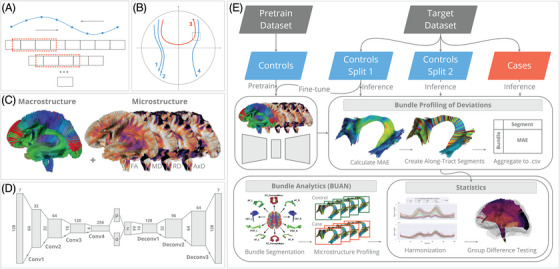
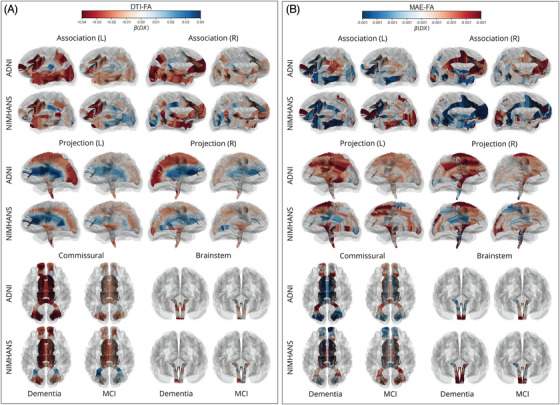
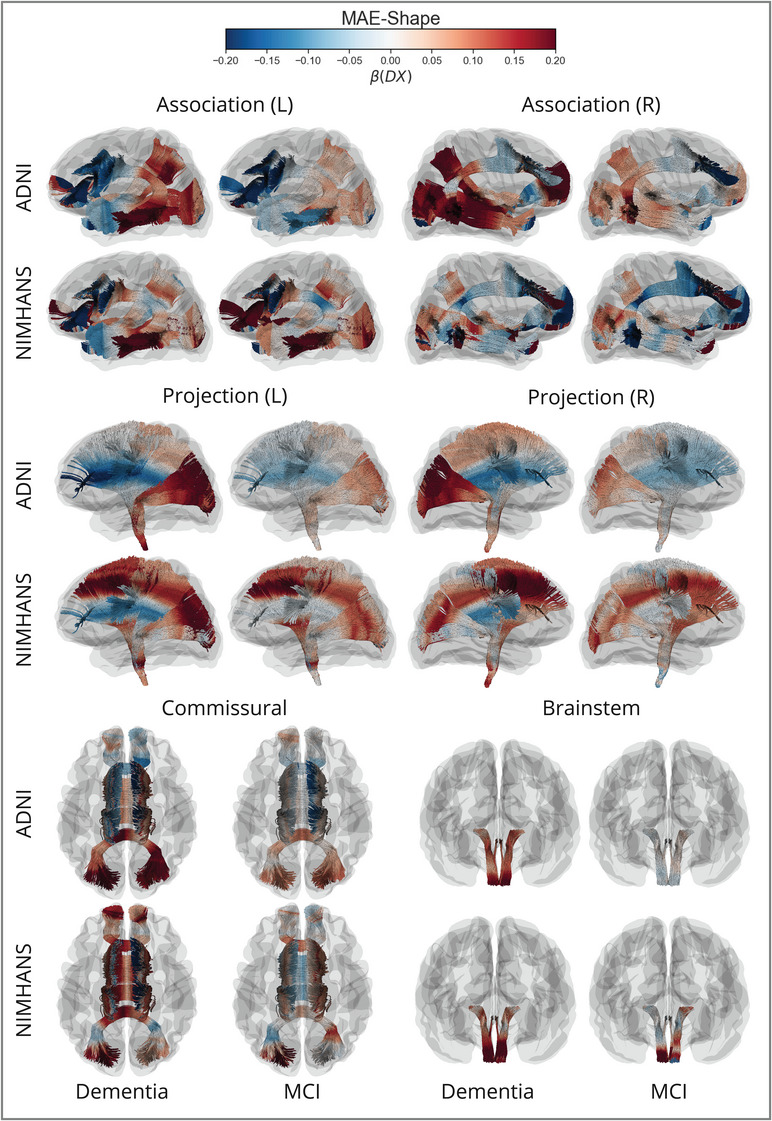
We propose a novel macrostructure-informed normative tractometry (MINT) framework to investigate how white matter (WM) microstructure and macrostructure are jointly altered in mild cognitive impairment (MCI) and dementia. We compared MINT-derived metrics with univariate diffusion tensor imaging (DTI) metrics to examine how fiber geometry may impact the interpretation of microstructure.
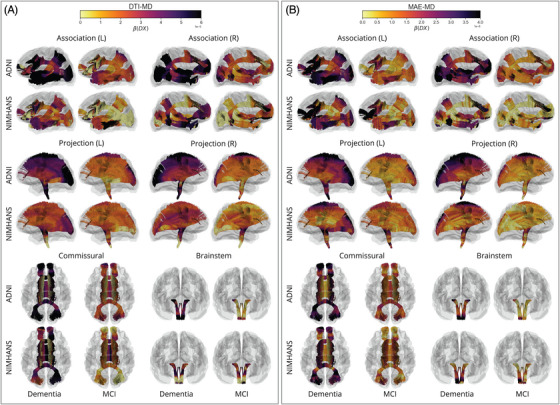
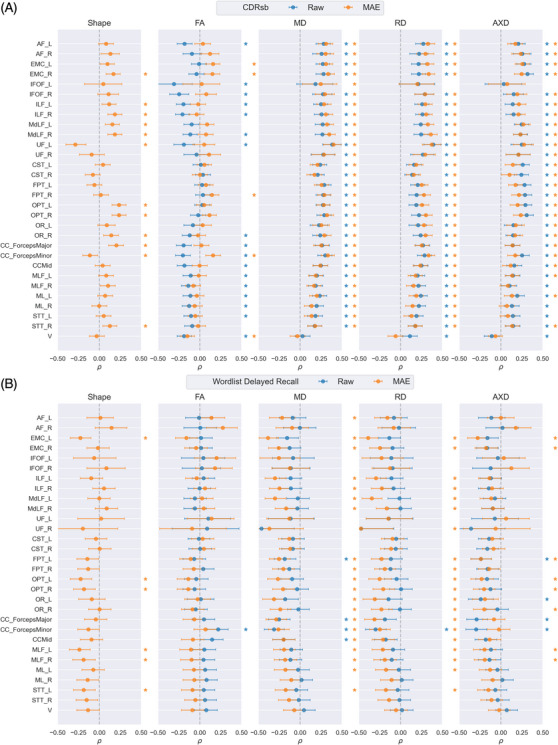
In two multisite cohorts from North America and India, we find consistent patterns of microstructural and macrostructural anomalies implicated in MCI and dementia; we also rank diffusion metrics' sensitivity to dementia.
We show that MINT, by jointly modeling tract shape and microstructure, has the potential to disentangle and better interpret the effects of degenerative disease on the brain's neural pathways.
Changes in diffusion tensor imaging metrics may be due to macroscopic changes. Normative models encode normal variability of diffusion metrics in healthy controls. Variational autoencoder applied on tractography can learn patterns of fiber geometry. WM microstructure and macrostructure are modeled with multivariate methods. Transfer learning uses pretraining and fine-tuning for increased efficiency.
扩散加权磁共振成像(dMRI)对脑组织的微观结构特性敏感,在检测退行性疾病的影响方面显示出巨大潜力。然而,许多方法分析的是感兴趣区域的平均单一测量值,而未考虑潜在的纤维几何形状。
我们提出了一种新颖的基于宏观结构的规范纤维束测量(MINT)框架,以研究轻度认知障碍(MCI)和痴呆症中白质(WM)微观结构和宏观结构是如何共同改变的。我们将MINT得出的指标与单变量扩散张量成像(DTI)指标进行比较,以检验纤维几何形状如何影响微观结构的解释。
在来自北美和印度的两个多中心队列中,我们发现了与MCI和痴呆症相关的微观结构和宏观结构异常的一致模式;我们还对扩散指标对痴呆症的敏感性进行了排名。
我们表明,MINT通过联合对纤维束形状和微观结构进行建模,有可能解开并更好地解释退行性疾病对大脑神经通路的影响。
扩散张量成像指标的变化可能是由于宏观变化。规范模型编码了健康对照中扩散指标的正常变异性。应用于纤维束成像的变分自编码器可以学习纤维几何形状的模式。WM微观结构和宏观结构用多变量方法建模。迁移学习使用预训练和微调以提高效率。