Kim Tong-Yoon, Kim Tae-Jung, Han Eun Ji, Min Gi June, Park Sung-Soo, Park Silvia, Yoon Jae-Ho, Lee Sung-Eun, Cho Byung-Sik, Eom Ki-Seong, Kim Yoo-Jin, Kim Hee-Je, Lee Seok, Min Chang-Ki, Lee Jong-Wook, Jeon Youngwoo, Cho Seok-Goo
Department of Hematology, Yeouido St. Mary's Hospital, College of Medicine, The Catholic University of Korea, Seoul, Korea.
Lymphoma and Cell Therapy Research Center, Yeouido St. Mary's Hospital, College of Medicine, The Catholic University of Korea, Seoul, Korea.
Cancer Med. 2025 Jan;14(1):e70565. doi: 10.1002/cam4.70565.
The prognostic significance of extranodal sites in stage IV diffuse large B-cell lymphoma (DLBCL) remains uncertain, making it challenging to select appropriate treatment strategies for individual patients. In this study, we aimed to evaluate the influence of different extranodal sites on prognosis in young patients with stage IV DLBCL who achieved complete remission (CR) following initial chemo-immunotherapy and to explore the potential of autologous hematopoietic stem cell transplantation (ASCT) as a consolidation treatment for specific patient subgroups.
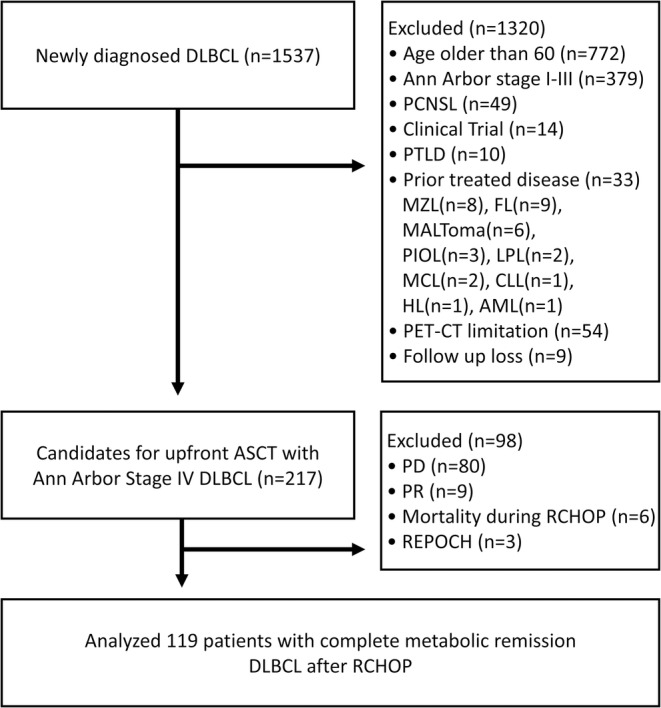
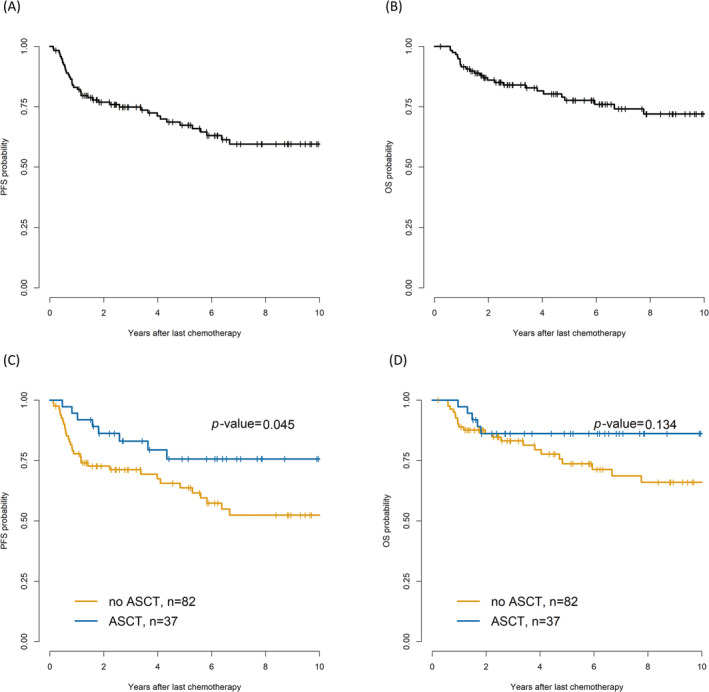
We retrospectively reviewed data from 119 patients with DLBCL aged < 60 years who achieved CR after chemo-immunotherapy between 2008 and 2020. Patient survival rates were analyzed in correlation with different extranodal sites using univariate and multivariate models. Additionally, we assessed the effect of ASCT on 5-year progression-free survival (PFS) and overall survival (OS) in patients with different extranodal sites involved.
A retrospective bicenter study.
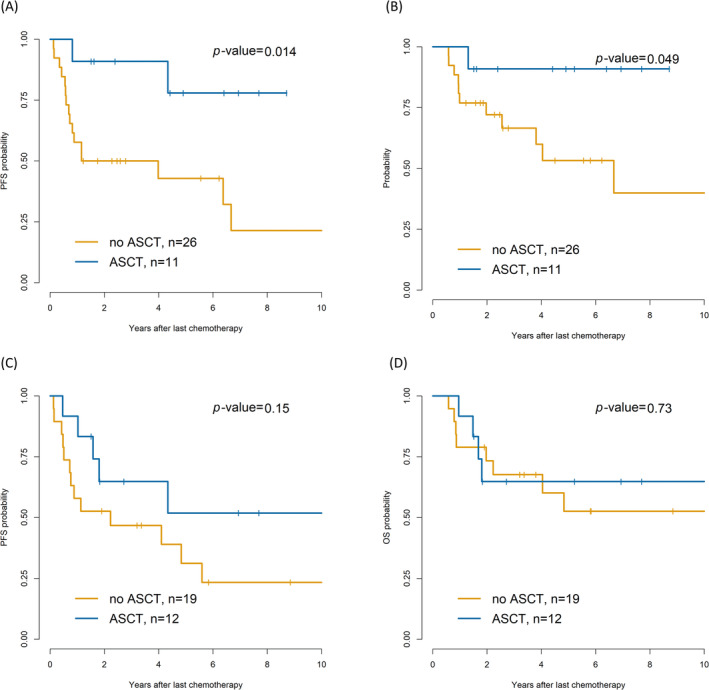
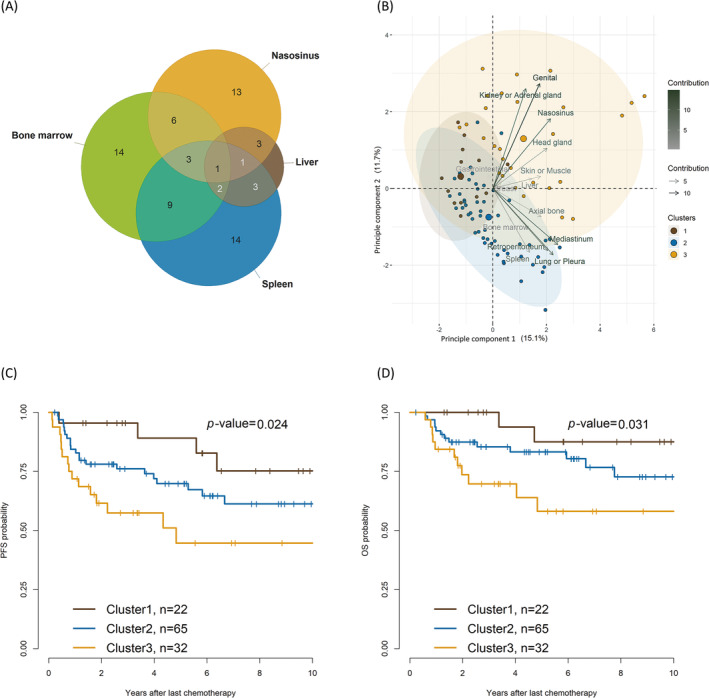
Univariate analysis revealed a significant decrease in survival rates in patients with a Deauville score of 3 and those with extranodal DLBCL affecting the spleen, bone marrow, nasosinus, and liver. In multivariate analysis, only nasosinusal involvement remained a significant predictor of reduced OS. Patients with spleen involvement benefited significantly from ASCT in terms of 5-year PFS and OS, whereas those with nasosinusal involvement did not demonstrate any survival advantage with ASCT.
Our findings highlight the influence of specific extranodal sites on the prognosis of patients with stage IV DLBCL. The data indicate a clear need for precise patient stratification based on extranodal involvement for more effective treatment planning. Notably, patients with spleen involvement appear to benefit from ASCT, suggesting that this strategy could be useful in this subgroup. Further prospective studies are needed to confirm and incorporate these findings into clinical practice.
IV期弥漫性大B细胞淋巴瘤(DLBCL)结外部位的预后意义仍不明确,这使得为个体患者选择合适的治疗策略具有挑战性。在本研究中,我们旨在评估不同结外部位对IV期DLBCL年轻患者预后的影响,这些患者在初始化疗免疫治疗后达到完全缓解(CR),并探讨自体造血干细胞移植(ASCT)作为特定患者亚组巩固治疗的潜力。
我们回顾性分析了2008年至2020年间119例年龄<60岁、化疗免疫治疗后达到CR的DLBCL患者的数据。使用单变量和多变量模型分析患者生存率与不同结外部位的相关性。此外,我们评估了ASCT对不同结外部位受累患者5年无进展生存期(PFS)和总生存期(OS)的影响。
一项回顾性双中心研究。
单变量分析显示,Deauville评分为3分的患者以及结外DLBCL累及脾脏、骨髓、鼻窦和肝脏的患者生存率显著降低。在多变量分析中,只有鼻窦受累仍然是总生存期降低的显著预测因素。脾脏受累的患者在5年PFS和OS方面从ASCT中显著获益,而鼻窦受累的患者在接受ASCT后未显示出任何生存优势。
我们的研究结果突出了特定结外部位对IV期DLBCL患者预后的影响。数据表明,为了更有效的治疗规划,显然需要根据结外受累情况对患者进行精确分层。值得注意的是,脾脏受累的患者似乎从ASCT中获益,这表明该策略可能对这一亚组有用。需要进一步的前瞻性研究来证实这些发现并将其纳入临床实践。