Division of Pediatric Nephrology, Department of Pediatrics, Dr. v. Hauner Children's Hospital, University Hospital, LMU Munich, Lindwurmstr. 4, 80337, Munich, Germany.
Department of Radiation Oncology, University Hospital, LMU Munich, Munich, Germany.
Radiat Oncol. 2021 Feb 25;16(1):43. doi: 10.1186/s13014-021-01764-y.
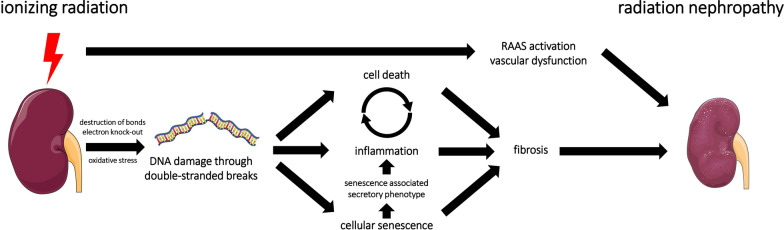
Radiation nephropathy (RN) is a kidney injury induced by ionizing radiation. In a clinical setting, ionizing radiation is used in radiotherapy (RT). The use and the intensity of radiation therapy is limited by normal-tissue damage including kidney toxicity. Different thresholds for kidney toxicity exist for different entities of RT. Histopathologic features of RN include vascular, glomerular and tubulointerstitial damage. The different molecular and cellular pathomechanisms involved in RN are not fully understood. Ionizing radiation causes double-stranded breaks in the DNA, followed by cell death including apoptosis and necrosis of renal endothelial, tubular and glomerular cells. Especially in the latent phase of RN oxidative stress and inflammation have been proposed as putative pathomechanisms, but so far no clear evidence was found. Cellular senescence, activation of the renin-angiotensin-aldosterone-system and vascular dysfunction might contribute to RN, but only limited data is available. Several signalling pathways have been identified in animal models of RN and different approaches to mitigate RN have been investigated. Drugs that attenuate cell death and inflammation or reduce oxidative stress and renal fibrosis were tested. Renin-angiotensin-aldosterone-system blockade, anti-apoptotic drugs, statins, and antioxidants have been shown to reduce the severity of RN. These results provide a rationale for the development of new strategies to prevent or reduce radiation-induced kidney toxicity.
放射性肾病(RN)是由电离辐射引起的肾脏损伤。在临床环境中,电离辐射用于放射治疗(RT)。放射治疗的使用和强度受到包括肾毒性在内的正常组织损伤的限制。不同的 RT 实体存在不同的肾毒性阈值。RN 的组织病理学特征包括血管、肾小球和小管间质损伤。涉及 RN 的不同分子和细胞发病机制尚未完全了解。电离辐射会导致 DNA 双链断裂,随后发生细胞死亡,包括肾内皮细胞、肾小管和肾小球细胞的凋亡和坏死。特别是在 RN 的潜伏期,氧化应激和炎症被认为是潜在的发病机制,但迄今为止没有发现明确的证据。细胞衰老、肾素-血管紧张素-醛固酮系统的激活和血管功能障碍可能导致 RN,但只有有限的数据可用。已经在 RN 的动物模型中鉴定出几种信号通路,并研究了不同的方法来减轻 RN。已经测试了减轻细胞死亡和炎症或减少氧化应激和肾纤维化的药物。肾素-血管紧张素-醛固酮系统阻断剂、抗凋亡药物、他汀类药物和抗氧化剂已被证明可降低 RN 的严重程度。这些结果为开发预防或减少放射性肾毒性的新策略提供了依据。