Turkistani Alaa, Sonbul Helal M, Almarzouki Mai
Departement of Restorative Dentistry, Faculty of Dentistry, King Abdulaziz University, Jeddah, Saudi Arabia.
PLoS One. 2024 Dec 31;19(12):e0315036. doi: 10.1371/journal.pone.0315036. eCollection 2024.
This study aimed to investigate the effect of chlorhexidine (CHX) cavity disinfectant on interfacial microleakage and micro-tensile bond strength (μTBS) of a universal adhesive bonded to dentin in both self-etch (SE) and etch-and-rinse (ER) modes.
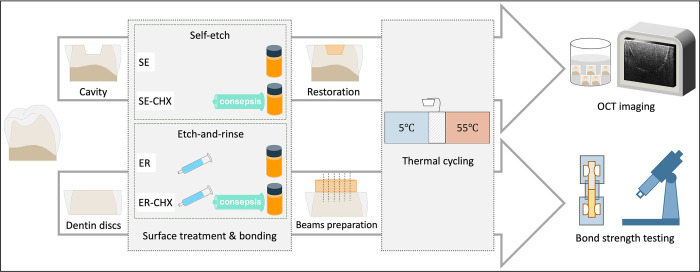
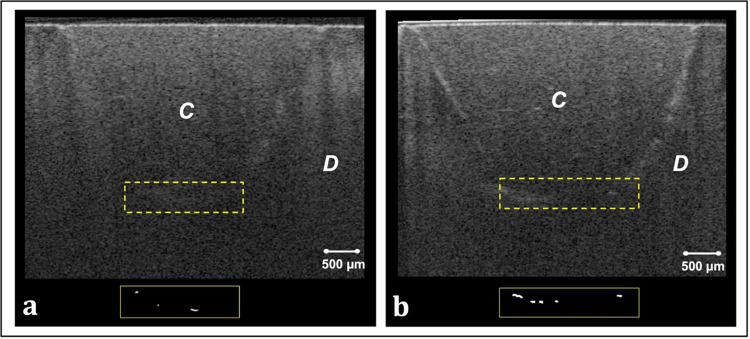
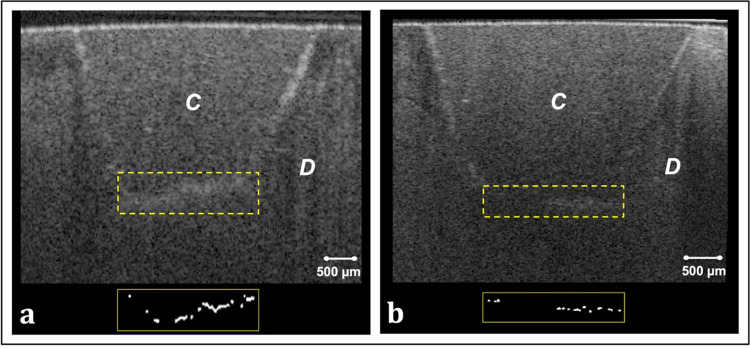
Class I cavities were prepared in the coronal dentin of extracted human teeth and assigned to two etching modes (SE or ER), then subdivided by disinfection with or without CHX (n = 5). Cavities were restored using Single Bond Universal Adhesive and Filtek Z350 XT composite. After 10,000 thermal cycles, interfacial microleakage was assessed on serial B-scans obtained for each specimen using cross-polarization optical coherence tomography. For μTBS testing, resin composite was bonded to dentin discs, sectioned into beams, and subjected to tensile load until failure using a universal testing machine. Failure modes in fractured beams were analyzed under a stereomicroscope and categorized as adhesive, cohesive, or mixed. ANOVA with Bonferroni post-hoc at a significance level of 0.05 was used to compare the groups.
Microleakage was not significantly influenced by the etching mode or CHX disinfection (p-value = 0.068). For μTBS, the ER group exhibited the highest values, and CHX disinfection did not significantly alter these results (p-value = 1.000). In contrast, the SE-CHX group displayed significantly lower μTBS than the ER, ER-CHX, and SE groups (p-values of <0.001, <0.001 and 0.012, respectively). ER mode primarily resulted in adhesive failures, regardless of CHX. SE group exhibited both adhesive and cohesive failures, while SE-CHX mostly showed adhesive failures.
The use of CHX disinfectant influences the bonding performance of universal adhesive differently depending on the application mode. Specifically, in the SE mode, CHX adversely affects bond strength to dentin. This suggests that when using universal adhesives in SE mode, clinicians should carefully consider the use of CHX disinfectants, as they may interfere with the adhesive's effectiveness.
本研究旨在探讨洗必泰(CHX)窝洞消毒剂对通用型粘结剂在自酸蚀(SE)和酸蚀冲洗(ER)模式下与牙本质粘结的界面微渗漏和微拉伸粘结强度(μTBS)的影响。
在拔除的人牙冠部牙本质制备I类洞,分为两种酸蚀模式(SE或ER),再根据是否使用CHX消毒细分(n = 5)。窝洞用单键通用粘结剂和Filtek Z350 XT复合树脂修复。经过10000次热循环后,使用交叉偏振光学相干断层扫描对每个样本获取的系列B扫描图像评估界面微渗漏情况。对于μTBS测试,将树脂复合材料粘结到牙本质圆盘上,切成小梁,使用万能试验机施加拉伸载荷直至破坏。在体视显微镜下分析断裂小梁的破坏模式,并分为粘结、内聚或混合破坏。采用显著性水平为0.05的Bonferroni事后检验的方差分析比较各组。
微渗漏不受酸蚀模式或CHX消毒的显著影响(p值 = 0.068)。对于μTBS,ER组的值最高,CHX消毒未显著改变这些结果(p值 = 1.000)。相比之下,SE-CHX组的μTBS显著低于ER组、ER-CHX组和SE组(p值分别<0.001、<0.001和0.012)。无论是否使用CHX,ER模式主要导致粘结破坏。SE组表现出粘结和内聚破坏,而SE-CHX组大多表现为粘结破坏。
CHX消毒剂的使用根据应用模式对通用型粘结剂的粘结性能有不同影响。具体而言,在SE模式下,CHX会对与牙本质的粘结强度产生不利影响。这表明在SE模式下使用通用粘结剂时,临床医生应仔细考虑CHX消毒剂的使用,因为它们可能会干扰粘结剂的有效性。