Zhang Yuxi, Mazal Hisham, Mandala Venkata Shiva, Pérez-Mitta Gonzalo, Sondoghdar Vahid, Haselwandter Christoph A, MacKinnon Roderick
Laboratory of Molecular Neurobiology and Biophysics, The Rockefeller University, New York, NY 10065.
HHMI, The Rockefeller University, New York, NY 10065.
Proc Natl Acad Sci U S A. 2025 Jan 7;122(1):e2421275121. doi: 10.1073/pnas.2421275121. Epub 2024 Dec 31.
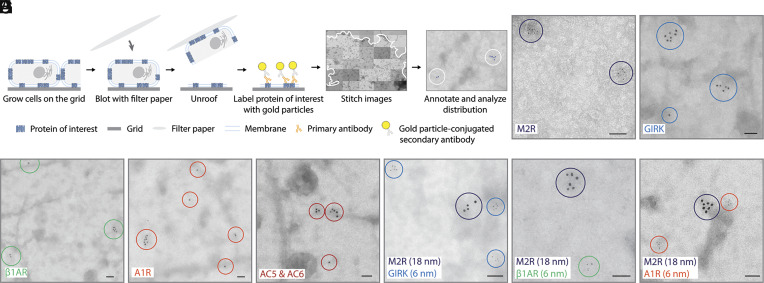
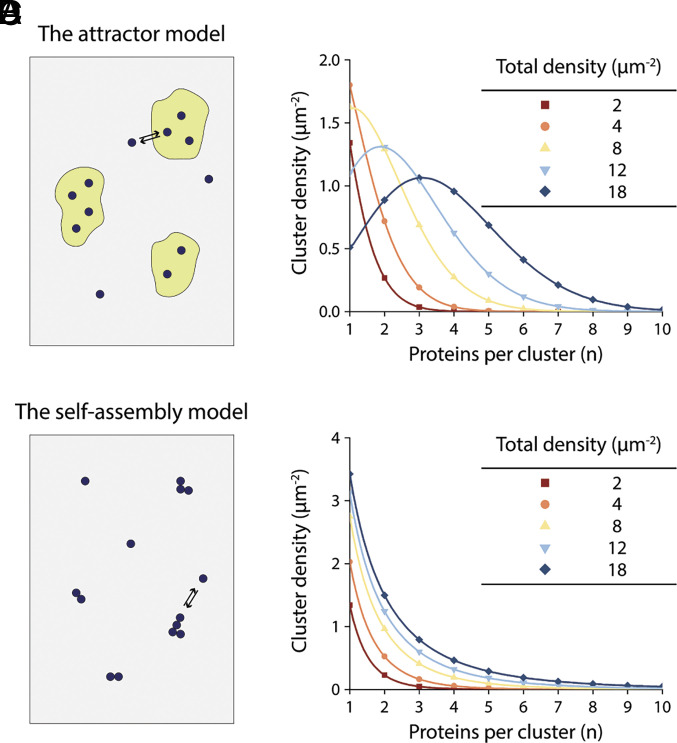
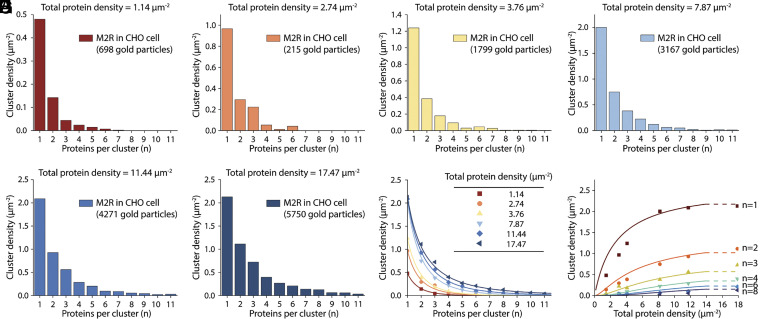
This study shows that five membrane proteins-three GPCRs, an ion channel, and an enzyme-form self-clusters under natural expression levels in a cardiac-derived cell line. The cluster size distributions imply that these proteins self-oligomerize reversibly through weak interactions. When the concentration of the proteins is increased through heterologous expression, the cluster size distributions approach a critical distribution at which point a phase transition occurs, yielding larger bulk phase clusters. A thermodynamic model like that explaining micellization of amphiphiles and lipid membrane formation accounts for this behavior. We propose that many membrane proteins exist as oligomers that form through weak interactions, which we call higher-order transient structures (HOTS). The key characteristics of HOTS are transience, molecular specificity, and a monotonically decreasing size distribution that may become critical at high concentrations. Because molecular specificity invokes self-recognition through protein sequence and structure, we propose that HOTS are genetically encoded supramolecular units.
本研究表明,在一种心脏来源的细胞系中,五种膜蛋白——三种G蛋白偶联受体(GPCR)、一种离子通道和一种酶——在自然表达水平下会形成自我聚集体。聚集体大小分布表明这些蛋白通过弱相互作用可逆地自我寡聚化。当通过异源表达增加蛋白浓度时,聚集体大小分布接近临界分布,此时会发生相变,产生更大的体相聚集体。一种类似于解释两亲分子胶束化和脂质膜形成的热力学模型可以解释这种行为。我们提出,许多膜蛋白以通过弱相互作用形成的寡聚体形式存在,我们将其称为高阶瞬态结构(HOTS)。HOTS的关键特征是瞬态性、分子特异性以及在高浓度下可能变得临界的单调递减大小分布。由于分子特异性通过蛋白质序列和结构引发自我识别,我们提出HOTS是基因编码的超分子单元。