Petrov Konstantin, Lenina Oksana, Leroy Jacqueline, Bernard Véronique, Germain Thibaut, Truong Charles, Nurullin Leniz, Sibgatullina Guzel, Ohno Kinji, Samigullin Dmitry, Krejci Eric
Arbuzov Institute of Organic and Physical Chemistry, FRC Kazan Scientific Center of RAS, Kazan, Russia.
Kazan Institute of Biochemistry and Biophysics, FRC Kazan Scientific Center of RAS, Kazan, Russia.
J Physiol. 2025 Jan;603(2):507-527. doi: 10.1113/JP287243. Epub 2024 Dec 30.
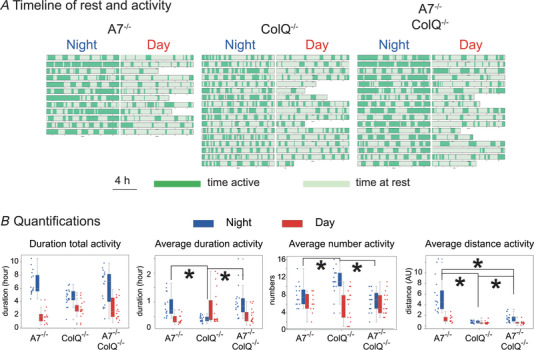
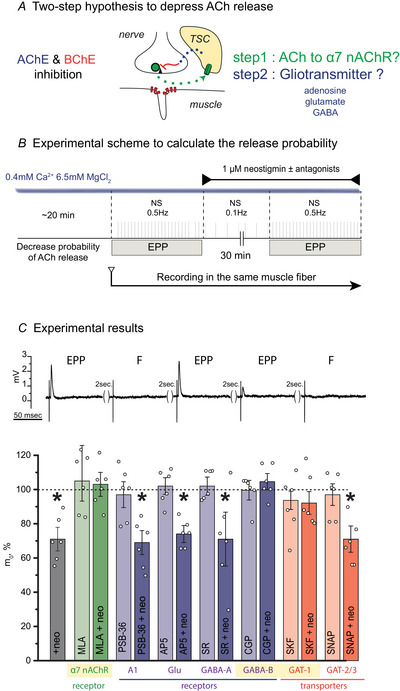
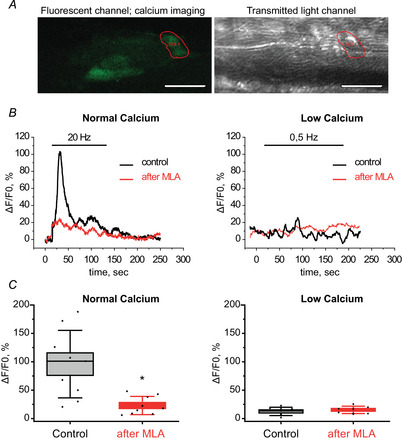
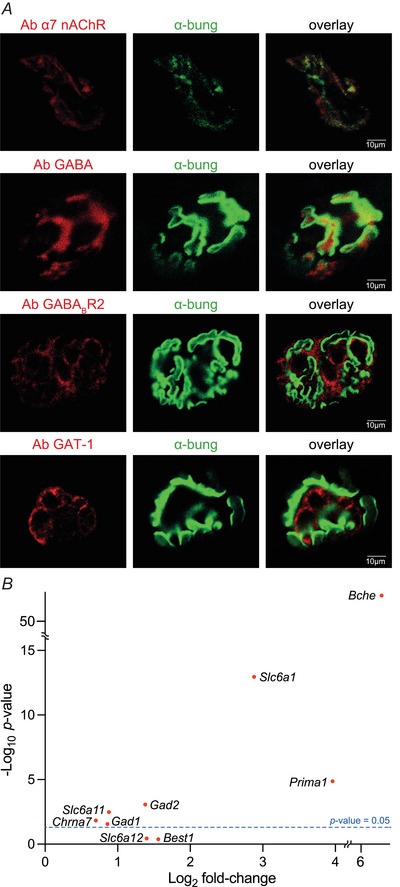
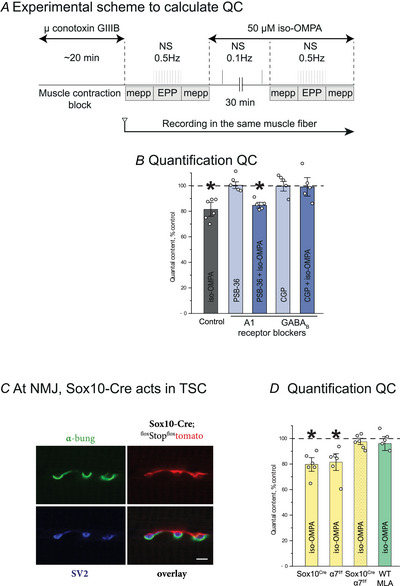
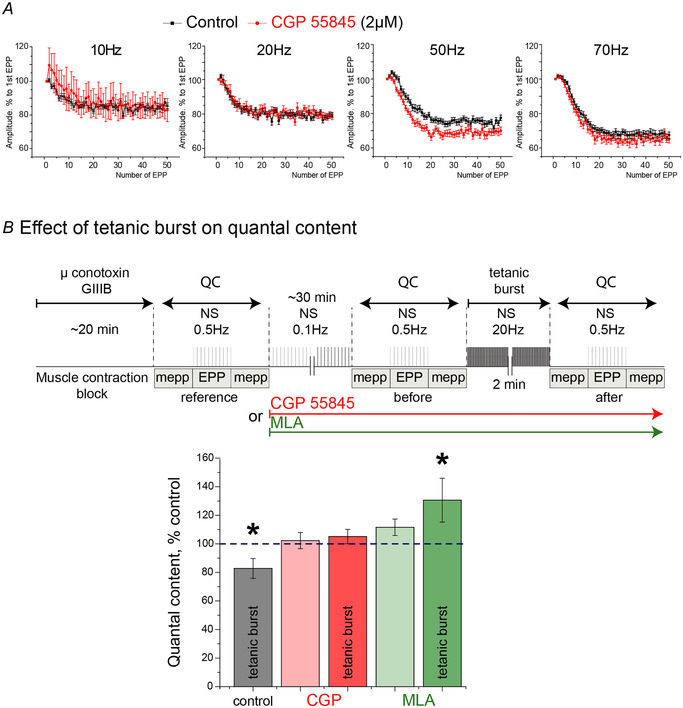
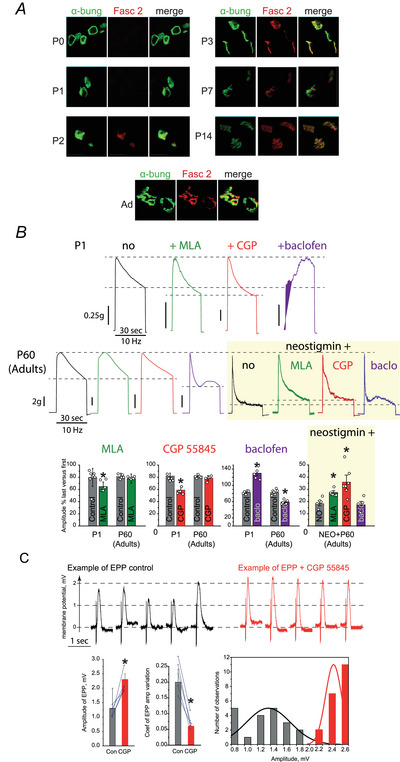
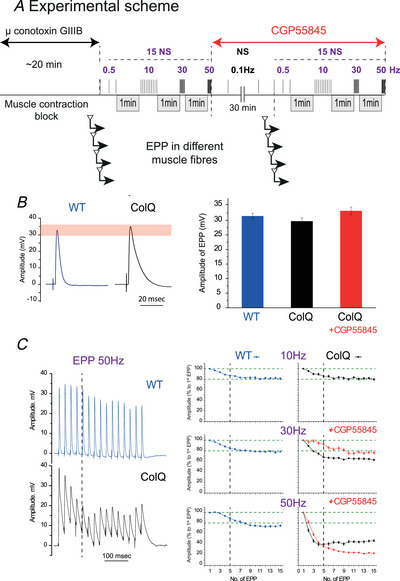
Terminal Schwann cells (TSCs) are capable of regulating acetylcholine (ACh) release at the neuromuscular junction (NMJ). We have identified GABA as a gliotransmitter at mouse NMJs. When ACh activates α7 nicotinic ACh receptor (nAChRs) on TSCs, GABA is released and activates GABA receptors on the nerve terminal that subsequently reduce ACh release. Indeed, specific deletion of the α7 nAChR in TSCs or inhibition of the metabotropic GABA receptor prevents the reduction in the quantal content of the end-plate potential induced by cholinesterase inhibitors. The α7/GABA receptor-mediated pathway is activated when ACh that escapes from collagen Q (ColQ) anchored AChE in the synaptic cleft and from PRiMA-anchored butyrylcholinesterase on the TSC activates α7 nAChRs on the TSC. Consequently, prolonged tetanic stimulation of isolated muscle activates the α7/GABA receptor pathway, which reduces post-tetanic ACh release. When AChE levels are low in neonatal mice, the α7/GABA receptor-mediated pathway decreases ACh release and reduces ex vivo muscle fatigue. For ColQ-deficient mice where AChE is not clustered, the decrease in AСh release following activation of this pathway contributes to mouse fatigue in vivo. KEY POINTS: Acetylcholine (ACh) released from the nerve terminal at the neuromuscular junction (NMJ) can activate α7 nicotinic ACh receptor (nAChR) on terminal Schwann cells, releasing gamma-aminobutyric acid (GABA) that activates metabotropic GABA receptors on the nerve terminal which then reduces further ACh release from the nerve. At the mature NMJ, before reaching α7 nAChRs on terminal Schwann cells ACh is normally hydrolyzed by AChE clustered in the synaptic cleft and by BChE anchored to the TSC. ACh can activate the α7/GABAB receptor-mediated pathway and depress subsequent ACh release when AChE at the NMJ is low, either during development or in congenital myasthenic syndrome. In the latter case, this pathway contributes to muscle fatigue.
终末施万细胞(TSCs)能够调节神经肌肉接头(NMJ)处乙酰胆碱(ACh)的释放。我们已确定γ-氨基丁酸(GABA)是小鼠神经肌肉接头处的一种胶质递质。当ACh激活终末施万细胞上的α7烟碱型ACh受体(nAChRs)时,GABA被释放并激活神经末梢上的GABA受体,随后减少ACh的释放。实际上,特异性敲除终末施万细胞中的α7 nAChR或抑制代谢型GABA受体会阻止胆碱酯酶抑制剂诱导的终板电位量子含量的降低。当从突触间隙中胶原Q(ColQ)锚定的乙酰胆碱酯酶(AChE)以及终末施万细胞上PRiMA锚定的丁酰胆碱酯酶逸出的ACh激活终末施万细胞上的α7 nAChRs时,α7/GABA受体介导的途径被激活。因此,对分离肌肉的长时间强直刺激会激活α7/GABA受体途径,从而减少强直刺激后的ACh释放。当新生小鼠中AChE水平较低时,α7/GABA受体介导的途径会减少ACh释放并减轻离体肌肉疲劳。对于AChE未聚集的ColQ缺陷小鼠,激活该途径后ACh释放的减少会导致小鼠体内疲劳。要点:神经肌肉接头(NMJ)处神经末梢释放的乙酰胆碱(ACh)可激活终末施万细胞上的α7烟碱型ACh受体(nAChR),释放γ-氨基丁酸(GABA),后者激活神经末梢上的代谢型GABA受体,进而减少神经进一步释放ACh。在成熟的神经肌肉接头处,在到达终末施万细胞上的α7 nAChRs之前,ACh通常会被聚集在突触间隙中的AChE以及锚定在终末施万细胞上的丁酰胆碱酯酶(BChE)水解。当神经肌肉接头处的AChE水平较低时,无论是在发育过程中还是在先天性肌无力综合征中,ACh都可以激活α