Schober J M, Wesley S, Taylor I, Ault B, Plue C, Bergman M M, Lucas J R, Fraley G S
Animal Sciences, Purdue University, West Lafayette, IN, USA.
Purdue University Animal Science Research and Education Center, West Lafayette, IN, USA.
Poult Sci. 2025 Feb;104(2):104735. doi: 10.1016/j.psj.2024.104735. Epub 2024 Dec 26.
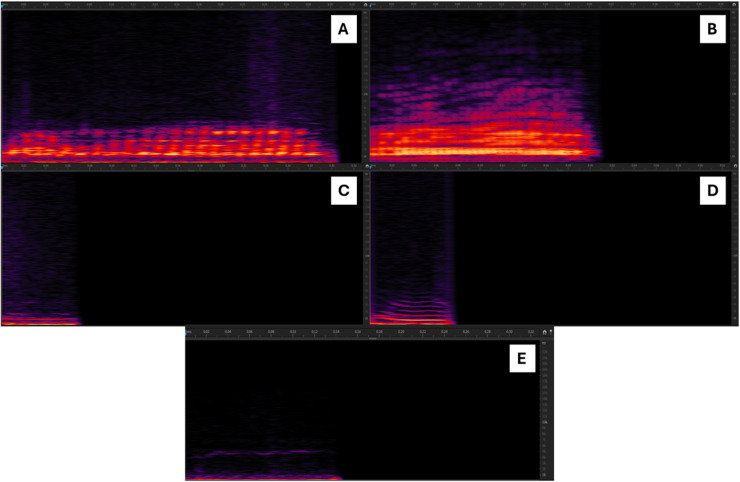
We tested Pekin ducks with playbacks of 5 different vocalizations plus a no noise and white noise stimulus as our controls (N = 15 ducks/sex/treatment). The "AM long" call is a common vocalization made by both sexes. "Honk" is also produced by both sexes and is thought to be an alarm or distress call. "Pips" and "harmonics" are common vocalizations made only by hens. The "egg laying squiggle" is also only made by hens. Trials consisted of an initial recording in a quiet condition with 5 consecutive measurements of heart rate, blood pressure and respiratory rate. A specific vocalization was then played on repeat while 8 more measurements of blood pressure, heart rate and respiratory rate were taken. Finally, 5 measurements of heart rate and blood pressure were taken post playback along with a final recording of respiratory rate. Data from all blood pressure measurements (systolic, diastolic and mean arterial pressure [MAP]), heart rate (HR) and respiratory rate (RR) were subject to a principal component analysis (Proc Princomp in SAS 9.4). The significant principal components (Prin 1 loaded strongly on blood pressure and Prin 2 loaded strongly on HR and RR) were then analyzed by ANOVA with repeated measures (Proc Mixed, SAS 9.4, subject=duck ID). Our results showed there was a significant main effect of playback type on the blood pressure of ducks during the playbacks (P = 0.0276). Ducks experienced an increase in blood pressure when played back the honk vocalization, as well as the white noise control. Additionally, there was a significant interaction between sex and treatment on the after-stimulus blood pressure (P = 0.0008): after the harmonic vocalization was played, the drakes still experienced an increase in blood pressure, but the hens experienced a decrease. The drakes, but not the hens, experienced a decrease in blood pressure after the AM long vocalization was played. Our data show that there are sex differences when it comes to vocalization playbacks in Pekin ducks, but overall, the honk vocalization and white noise control significantly increased ducks' blood pressure. This study represents a critical steppingstone toward understanding how Pekin duck vocalizations affect conspecific physiology.
我们用5种不同发声的回放以及无噪声和白噪声刺激作为对照(每种性别/处理方式有15只鸭子)来测试北京鸭。“AM长叫”是雌雄两性都发出的常见叫声。“嘎嘎叫”也是雌雄两性都会发出的,被认为是一种警报或遇险叫声。“尖声”和“和声”是只有母鸡才会发出的常见叫声。“产蛋蠕动声”也只有母鸡会发出。试验包括在安静条件下进行初始记录,连续测量5次心率、血压和呼吸频率。然后重复播放特定的叫声,同时再测量8次血压、心率和呼吸频率。最后,在播放后测量5次心率和血压,并对呼吸频率进行最终记录。所有血压测量数据(收缩压、舒张压和平均动脉压[MAP])、心率(HR)和呼吸频率(RR)都进行了主成分分析(使用SAS 9.4中的Proc Princomp)。然后,通过重复测量方差分析(使用Proc Mixed,SAS 9.4,个体为鸭子ID)对显著的主成分(主成分1主要加载在血压上,主成分2主要加载在心率和呼吸频率上)进行分析。我们的结果表明,在播放过程中,回放类型对鸭子的血压有显著的主效应(P = 0.0276)。播放“嘎嘎叫”叫声以及白噪声对照时,鸭子的血压会升高。此外,刺激后血压在性别和处理方式之间存在显著的交互作用(P = 0.0008):播放“和声”叫声后,公鸭的血压仍然升高,但母鸭的血压下降。播放“AM长叫”后,公鸭的血压下降,但母鸭没有。我们的数据表明,北京鸭在发声回放方面存在性别差异,但总体而言,“嘎嘎叫 ”叫声和白噪声对照显著提高了鸭子的血压。这项研究是理解北京鸭叫声如何影响同种个体生理机能的关键一步。