Whittle Rosemary H, Karcher Darrin M, Erasmus Marisa A, Weimer Shawna L
Department of Poultry Science, University of Arkansas, Fayetteville, Arkansas, USA 72701.
Department of Animal Sciences, Purdue University, West Lafayette, Indiana, USA 47907.
Poult Sci. 2025 Feb;104(2):104723. doi: 10.1016/j.psj.2024.104723. Epub 2024 Dec 24.
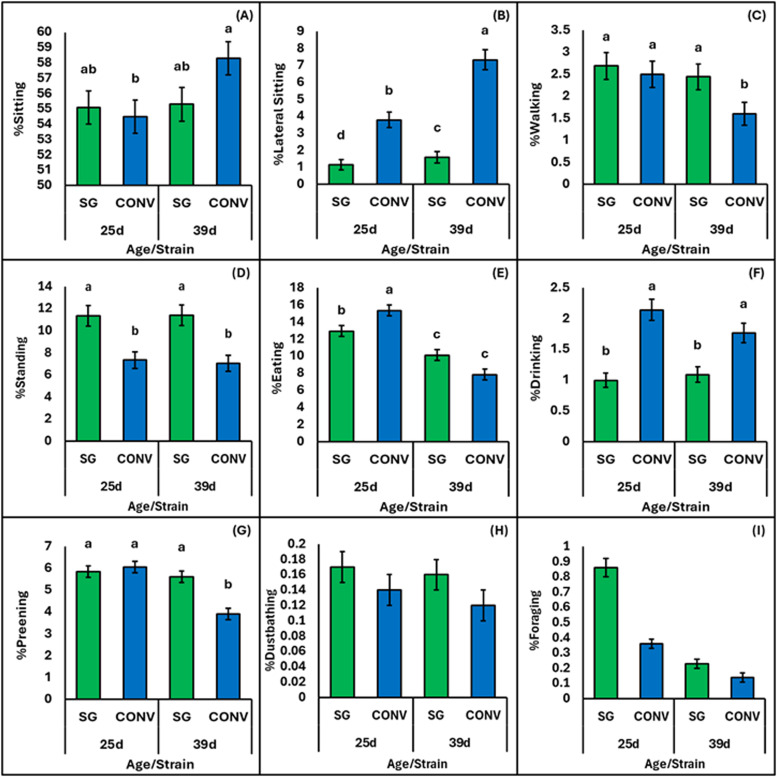
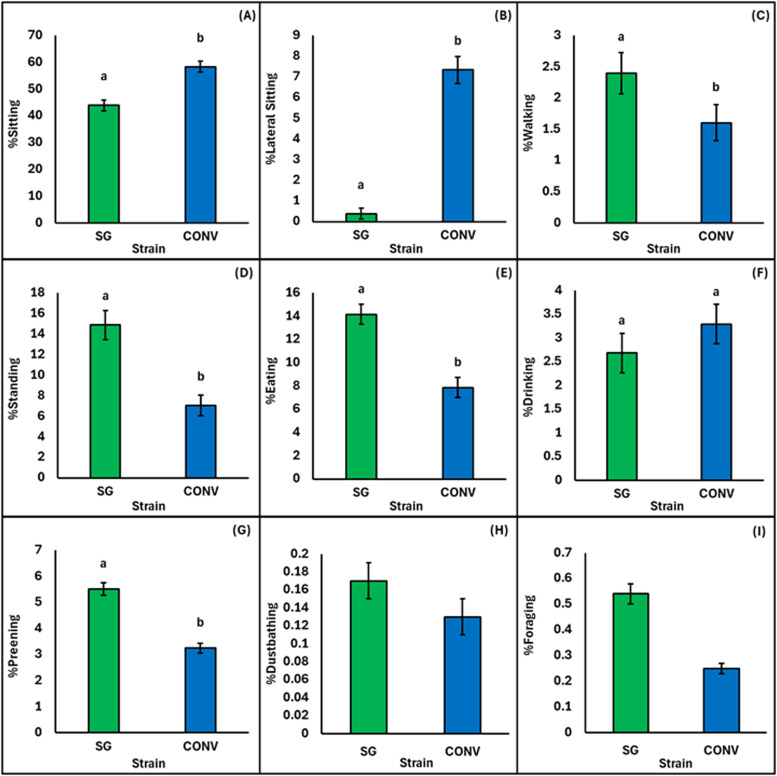
Fast growth rate and stocking density are global animal welfare concerns for broiler chickens. The objective of this study was to evaluate the effect of genetic strain and stocking density on the behavior of broilers. In a 2 × 2 randomized complete block design, conventional (CONV) and slow-growing (SG) broilers were stocked at either 29 kg/m (LO, n = 31 birds/pen) or 37 kg/m (HI, n = 40 birds/pen) in 16 pens (n = 4 pens/treatment). On days 25 and 39 (CONV and SG), and 60 (SG only), behavior was observed from video recorded in the morning and afternoon each day. The percentage (%) of all birds in each pen was categorized as either walking, standing, sitting, lateral sitting, eating, drinking, or preening. Two data sets were generated to compare the effect of age (25, 39d) and market body weight (39d CONV, 60d SG). Linear mixed effects models were fitted in R to analyze data. Sitting behavior differed between broiler strains and ages. At 39d, more CONV sat compared to 25d (58.3 % vs 54.5 %, p < 0.0001) and compared to SG at market weight (58.3 % vs 43.9 %, p < 0.0001). CONV broilers sat in a lateral posture more than SG at both ages (5.4 % vs 1.4 %, p < 0.0001) and at market weight (7.4 % vs 0.4 %, p < 0.0001). Standing and walking behaviors were observed more in SG broilers. SG broilers walked more than CONV at 39d and at market weight (2.4 % vs 1.6, p ≤ 0.01). Further, SG broilers stood more than CONV at both ages (11.4 % vs. 7.2 %, p = 0.0004) and market weight (14.9 % vs. 7.1 %, p < 0.0001). While preening behavior did not differ at 25d, more SG broilers preened than CONV at 39d (5.6 % vs 3.9 %, p < 0.0001) and market weight (5.5 % vs 3.3 %, p < 0.0001). LO-stocked broilers preened more at both ages than at HI (5.6 % vs 5.1 %, p = 0.041). These results suggest that conventional broilers exhibit more sitting behaviors, slow-growing broilers exhibit more active behaviors, and chronological and physiological age differences should be considered when making comparisons.
快速生长速度和饲养密度是全球肉鸡养殖中动物福利方面所关注的问题。本研究的目的是评估遗传品系和饲养密度对肉鸡行为的影响。在一个2×2随机完全区组设计中,将传统型(CONV)和慢速生长型(SG)肉鸡分别以29千克/平方米(低密度,每栏31只鸡)或37千克/平方米(高密度,每栏40只鸡)的密度饲养在16个栏中(每个处理4个栏)。在第25天和39天(CONV和SG)以及第60天(仅SG),每天上午和下午从视频记录中观察行为。每个栏中所有鸡的百分比被分类为行走、站立、坐着、侧卧、进食、饮水或梳理羽毛。生成了两个数据集以比较年龄(25、39日龄)和上市体重(39日龄CONV、60日龄SG)的影响。在R软件中拟合线性混合效应模型来分析数据。肉鸡品系和年龄之间的坐姿行为存在差异。在39日龄时,与25日龄相比,CONV品系坐着的鸡更多(58.3%对54.5%,p<0.0001),与上市体重时的SG品系相比也更多(58.3%对43.9%,p<0.0001)。在两个年龄阶段,CONV品系肉鸡侧卧的姿势都比SG品系更多(5.4%对1.4%,p<0.0001),在上市体重时也是如此(7.4%对0.4%,p<0.0001)。在SG品系肉鸡中观察到更多的站立和行走行为。在39日龄和上市体重时,SG品系肉鸡行走比CONV品系更多(2.4%对1.6,p≤0.01)。此外,在两个年龄阶段以及上市体重时,SG品系肉鸡站立都比CONV品系更多(11.4%对7.2%,p = 0.0004)(14.9%对7.1%,p<0.0001)。虽然在25日龄时梳理羽毛行为没有差异,但在39日龄时,SG品系肉鸡梳理羽毛的比CONV品系更多(5.6%对3.9%,p<0.0001),在上市体重时也是如此(5.5%对3.3%,p<0.0001)。低密度饲养的肉鸡在两个年龄阶段梳理羽毛都比高密度饲养的更多(5.6%对5.1%,p = 0.041)。这些结果表明,传统型肉鸡表现出更多的坐姿行为,慢速生长型肉鸡表现出更多的活跃行为,并且在进行比较时应考虑年龄和生理年龄的差异。