Mohamed Twaha, Kozinski Janusz, Ramos-Pallares Francisco
Department of Chemical Engineering, Lakehead University, 955 Oliver Road, Thunder Bay, ON P7B 5E1, Canada.
ACS Omega. 2024 Dec 10;9(51):50385-50402. doi: 10.1021/acsomega.4c07037. eCollection 2024 Dec 24.
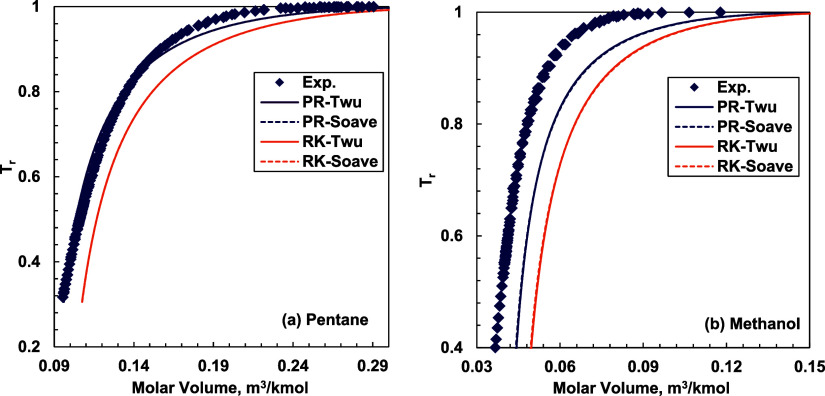
This study tested the accuracy and thermodynamic consistency of four CEoS/α-function models. The objective was to find the most suitable CEoS/α-function combo for producing accurate and consistent physical and derivative properties for nonpolar, polar and hydrogen bonding components at subcritical conditions. The models tested were PR-Twu, PR-Soave, RK-Twu, and RK-Soave. The first term in the model's name refers to the CEoS used: Peng-Robinson (PR) or Redlich-Kwong (RK). The second term indicates the α-function used, i.e., Twu's or Soave's. The models were tested on a data set containing saturation pressure, enthalpy of vaporization and saturated liquid heat capacity of 147 pure components classified as polar, nonpolar, and hydrogen bonding. The three Twu α-function parameters were fitted to data and constrained to produce thermodynamic consistent values across the phase diagram; and, the Soave α-function parameter was predicted from a well-known correlation. The thermodynamic consistency of the models was assessed by calculating the Waring number and the saturated liquid speed of sound of 147 and 79 pure components, respectively. The results showed that PR-Twu and RK-Twu produced more accurate pure component properties compared to those from PR-Soave and RK-Soave. However, there was not a significant difference between the performance of PR-Twu and RK-Twu for calculating pure component properties. The same result was obtained when comparing PR-Soave and RK-Soave. Interestingly, the consistency analysis showed that only PR-Twu and PR-Soave produced consistent Waring number trends for components with acentric factors below 0.7. It was also observed that the saturated liquid speed of sound calculated from all four models tested was not accurate as the models cannot produce precise -(∂∂ and liquid volumes. Besides, using volume translation is detrimental to the accuracy of the calculated saturated liquid speed of sound. The most accurate and consistent model was PR-Twu; however, caution should be exercised when modeling the saturated liquid heat capacity of hydrogen bonding components.
本研究测试了四种立方型状态方程(CEoS)/α函数模型的准确性和热力学一致性。目的是找到最合适的CEoS/α函数组合,以便在亚临界条件下为非极性、极性和氢键组分生成准确且一致的物理性质和导数性质。所测试的模型有PR-Twu、PR-Soave、RK-Twu和RK-Soave。模型名称中的第一个术语指所使用的立方型状态方程:彭-罗宾逊(PR)或瑞德利希-邝(RK)。第二个术语表示所使用的α函数,即Twu的或Soave的。这些模型在一个数据集上进行了测试,该数据集包含147种被分类为极性、非极性和氢键型的纯组分的饱和压力、汽化焓和饱和液体热容。对Twu的三个α函数参数进行了数据拟合,并进行约束以在整个相图上产生热力学一致的值;并且,Soave的α函数参数是根据一个著名的关联式预测的。通过分别计算147种和79种纯组分的沃林数和饱和液体声速来评估模型的热力学一致性。结果表明,与PR-Soave和RK-Soave相比,PR-Twu和RK-Twu产生的纯组分性质更准确。然而,PR-Twu和RK-Twu在计算纯组分性质方面的性能没有显著差异。比较PR-Soave和RK-Soave时也得到了相同的结果。有趣的是,一致性分析表明,对于偏心因子低于0.7的组分,只有PR-Twu和PR-Soave产生了一致的沃林数趋势。还观察到,从所有四个测试模型计算得到的饱和液体声速都不准确,因为这些模型无法产生精确的-(∂∂和液体体积。此外,使用体积平移不利于计算饱和液体声速的准确性。最准确且一致的模型是PR-Twu;然而,在对氢键组分的饱和液体热容进行建模时应谨慎。