Sharma Pratibha, Gupta Rakesh Kumar, Aittan Simran, Anthwal Divya, Dass Manisha, Yadav Rakesh, Behera Ashish, Dhiman Abhijeet, Dhooria Sahajal, Sethi Sunil, Singhal Ritu, Arora Puneet, Aggarwal Ashutosh Nath, Sharma Tarun Kumar, Haldar Sagarika
Translational Research Laboratory, Department of Experimental Medicine and Biotechnology, Post Graduate Institute of Medical Education and Research (PGIMER), Chandigarh, India.
Department of Medical Microbiology, PGIMER, Chandigarh, India.
Nanotheranostics. 2025 Jan 1;9(1):20-30. doi: 10.7150/ntno.95332. eCollection 2025.
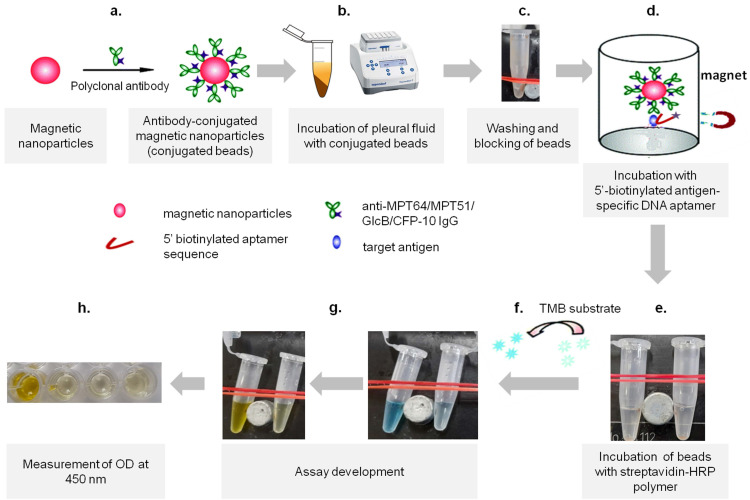
Pleural tuberculosis (pTB) is a diagnostic challenge because of its non-specific clinical features, lack of accurate diagnostic tools and paucibacillary nature of the disease. We, here describe the development of a novel magnetic nanoparticle antibody-conjugate and aptamer-based assay (MNp-Ab-Ap assay) targeting 4 different (. ) antigens (GlcB, MPT51, MPT64 and CFP-10) for pTB diagnosis. The MNp-Ab-Ap assay was developed by conjugating polyclonal antibodies on the surface of magnetic nanoparticles (MNPs) by using EDC-NHS chemistry. These conjugated MNPs were used to capture antigens present in the pleural fluid samples. The resulting antigen-antibody complex was detected by antigen-specific 5'-biotinylated aptamers. All assays were standardized using samples of the 'Development set' (n=17) and evaluated in the 'Validation set' (n=114) in a blinded manner. Patient categorization was done using a 'Composite Reference Standard'. Assay cut-offs were determined from the 'Development set' (n=17; 'Definite & Probable' pTB; n=9 and 'Non-TB'; n=8) by calculating mean+3SD of OD values of the 'Non-TB' group and applied to 'Validation set' (n=114; 'Definite' pTB; n=8, 'Probable' pTB; n=34, 'Possible' pTB; n=28 and 'Non-TB'; n=44). Out of the 4 assays, MPT51-based MNp-Ab-Ap assay performed the best with 66.6% (95%CI;50.4-80.4) sensitivity and 95.4% (95%CI;85.1-99.4) specificity in the combined 'Definite and Probable' pTB group. Xpert MTB/RIF assay detected only six samples in the 'Validation set'. Binary logistic regression analysis indicated that MPT51-based MNp-Ab-Ap assay provided an incremental advantage over the existing diagnostic algorithm for pTB. We conclude that MPT51-based MNp-Ab-Ap assay is a novel technique that can pave the way towards rapid and accurate diagnosis of pTB.
胸膜结核(pTB)是一项诊断难题,因其临床特征不具特异性、缺乏准确的诊断工具且疾病菌量少。在此,我们描述了一种新型的基于磁性纳米颗粒抗体偶联物和适配体的检测方法(MNp-Ab-Ap检测法),该方法针对4种不同的(.)抗原(GlcB、MPT51、MPT64和CFP-10)用于pTB诊断。MNp-Ab-Ap检测法是通过使用EDC-NHS化学方法将多克隆抗体偶联在磁性纳米颗粒(MNPs)表面而开发的。这些偶联的MNPs用于捕获胸腔积液样本中存在的抗原。通过抗原特异性的5'-生物素化适配体检测所得的抗原-抗体复合物。所有检测均使用“开发集”(n = 17)的样本进行标准化,并以盲法在“验证集”(n = 114)中进行评估。使用“综合参考标准”对患者进行分类。通过计算“非结核”组OD值的均值+3SD,从“开发集”(n = 17;“确诊和疑似”pTB;n = 9和“非结核”;n = 8)确定检测临界值,并应用于“验证集”(n = 114;“确诊”pTB;n = 8,“疑似”pTB;n = 34,“可能”pTB;n = 28和“非结核”;n = 44)。在这4种检测方法中,基于MPT51的MNp-Ab-Ap检测法表现最佳,在“确诊和疑似”pTB合并组中的灵敏度为66.6%(95%CI;50.4 - 80.4),特异性为95.4%(95%CI;85.1 - 99.4)。Xpert MTB/RIF检测法在“验证集”中仅检测到6个样本。二元逻辑回归分析表明,基于MPT51的MNp-Ab-Ap检测法相对于现有的pTB诊断算法具有增量优势。我们得出结论,基于MPT51的MNp-Ab-Ap检测法是一种新技术,可为pTB的快速准确诊断铺平道路。