Gilley Kristen N, Fenton Jenifer I, Zick Suzanna M, Li Kexin, Wang Lu, Marder Wendy, McCune W Joseph, Jain Raghav, Herndon-Fenton Sidney, Hassett Afton L, Barbour Kamil E, Pestka James J, Somers Emily C
University of Michigan, Department of Internal Medicine, Ann Arbor, MI, United States.
University of Michigan, Department of Epidemiology, Ann Arbor, MI, United States.
Front Immunol. 2024 Dec 18;15:1459297. doi: 10.3389/fimmu.2024.1459297. eCollection 2024.
Despite progress in systemic lupus erythematosus (SLE) treatment, challenges persist in medication adherence due to side effects and costs. Precision nutrition, particularly adjusting fatty acid intake, offers a cost-effective strategy for enhancing SLE management. Prior research, including our own, indicates that increased consumption of omega-3 polyunsaturated fatty acids (PUFAs) correlates with improved outcomes in SLE patients. Here we build upon these findings by investigating associations between serum fatty acids-grouped as PUFAs, monounsaturated fatty acids (MUFAs), and saturated fatty acids (SFAs)-and lupus activity, pain, and sleep disturbance.
Using data from 418 participants with SLE in the Michigan Lupus Epidemiology and Surveillance (MILES) Cohort, we examined associations between serum levels of 25 fatty acids determined by GC-MS and patient-reported outcomes. Disease activity, pain, and sleep quality were assessed using standardized questionnaires. Generalized additive models and partial residual plots were utilized to examine the linearity of fatty acid effects. Variable selection was performed using Least Absolute Shrinkage and Selection Operator (LASSO), followed by multiple linear regression adjusting for sociodemographic factors.
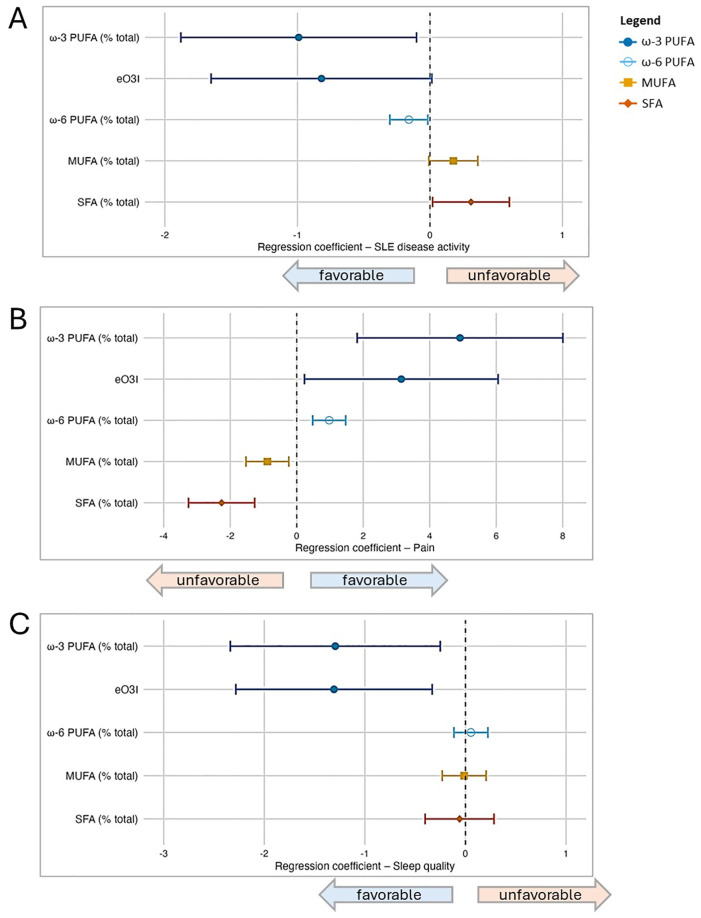
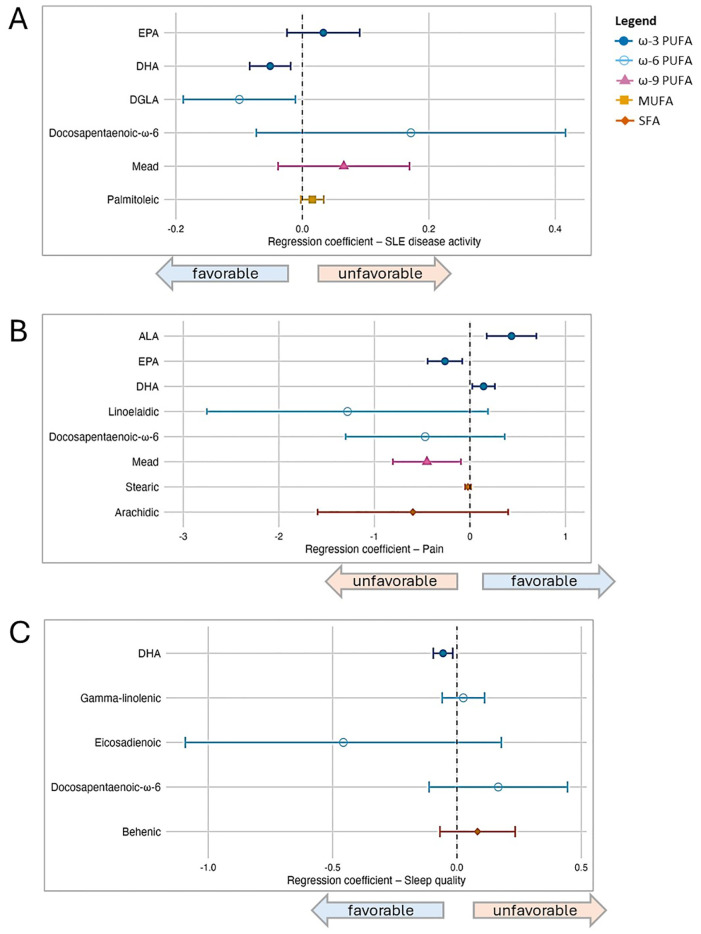
Findings indicated favorable associations between ω-3 PUFAs-and, to a lesser extent, ω-6 PUFAs-and patient-reported outcomes, while MUFAs and SFAs showed unfavorable associations. Docosahexaenoic acid (DHA), an omega-3 PUFA, exhibited the most robust favorable associations across all outcomes. Additionally, the omega-3 α-linolenic acid (ALA) was linked to reduced pain, whereas eicosapentaenoic acid (EPA), another omega-3, was associated with worsened disease activity and pain. Among omega-6 PUFAs, dihomo-γ-linolenic acid (DGLA) was favorably associated with disease activity, while the omega-9 PUFA Mead acid was linked to increased pain.
These findings underscore the prospect that increased tissue levels of long-chain omega-3 PUFAs, particularly DHA, are favorably associated with SLE outcomes. Although further research is needed to establish causal relationships, existing evidence supports the role of omega-3 PUFAs in managing cardiovascular and chronic kidney disease, common SLE comorbidities. Most study participants exhibited low omega-3 PUFA status, suggesting substantial potential for improvement through targeted dietary interventions and supplementation. This study supports a potential role for precision nutrition in comprehensive SLE management, considering the impact of PUFAs, SFAs and MUFAs.
尽管系统性红斑狼疮(SLE)治疗取得了进展,但由于副作用和成本,药物依从性方面的挑战依然存在。精准营养,特别是调整脂肪酸摄入量,为加强SLE管理提供了一种具有成本效益的策略。先前的研究,包括我们自己的研究,表明增加ω-3多不饱和脂肪酸(PUFA)的摄入量与SLE患者的改善结果相关。在此,我们通过研究血清脂肪酸(分为PUFA、单不饱和脂肪酸(MUFA)和饱和脂肪酸(SFA))与狼疮活动、疼痛和睡眠障碍之间的关联,进一步拓展这些发现。
利用密歇根狼疮流行病学与监测(MILES)队列中418名SLE患者的数据,我们研究了通过气相色谱 - 质谱法测定的25种脂肪酸血清水平与患者报告结果之间的关联。使用标准化问卷评估疾病活动、疼痛和睡眠质量。采用广义相加模型和偏残差图来检验脂肪酸效应的线性。使用最小绝对收缩和选择算子(LASSO)进行变量选择,然后进行多线性回归,并对社会人口学因素进行调整。
研究结果表明,ω-3 PUFA以及在较小程度上ω-6 PUFA与患者报告结果呈良好关联,而MUFA和SFA则呈不良关联。二十二碳六烯酸(DHA),一种ω-3 PUFA,在所有结果中表现出最强的良好关联。此外,ω-3α-亚麻酸(ALA)与疼痛减轻有关,而另一种ω-3二十碳五烯酸(EPA)与疾病活动和疼痛加剧有关。在ω-6 PUFA中,二高 - γ - 亚麻酸(DGLA)与疾病活动呈良好关联,而ω-9 PUFA 玛德酸与疼痛增加有关。
这些发现强调了组织中长链ω-3 PUFA水平升高,特别是DHA,与SLE结果呈良好关联的前景。尽管需要进一步研究来建立因果关系,但现有证据支持ω-3 PUFA在管理心血管疾病和慢性肾病(SLE常见合并症)中的作用。大多数研究参与者的ω-3 PUFA水平较低,这表明通过有针对性的饮食干预和补充有很大的改善潜力。考虑到PUFA、SFA和MUFA的影响,本研究支持精准营养在全面SLE管理中的潜在作用。