Research Institute, Suntory Global Innovation Center Ltd, Seika, Kyoto, Japan.
Department of Innovative Food Sciences, School of Food Sciences and Nutrition, Mukogawa Women's University, Nishinomiya, Hyogo, Japan.
Lipids Health Dis. 2023 Oct 14;22(1):172. doi: 10.1186/s12944-023-01937-6.
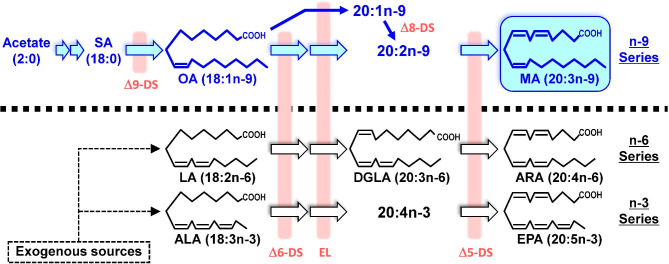
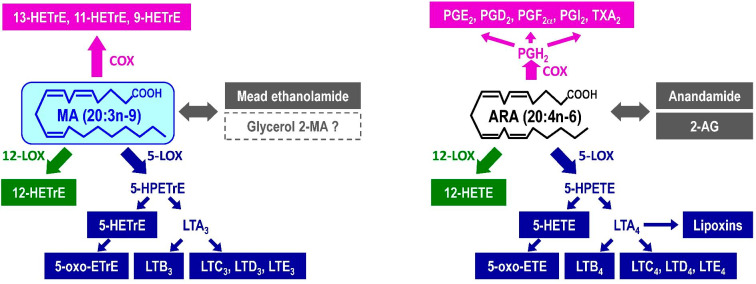
Mead acid (MA, 5,8,11-eicosatrienoic acid) is an n-9 polyunsaturated fatty acid (PUFA) and a marker of essential fatty acid deficiency, but nonetheless generally draws little attention. MA is distributed in various normal tissues and can be converted to several specific lipid mediators by lipoxygenase and cyclooxygenase. Recent pathological and epidemiological studies on MA raise the possibility of its effects on inflammation, cancer, dermatitis and cystic fibrosis, suggesting it is an endogenous multifunctional PUFA. This review summarizes the biosynthesis, presence, metabolism and physiological roles of MA and its relation to various diseases, as well as the significance of MA in PUFA metabolism.
二十碳三烯酸(MA,5,8,11-二十碳三烯酸)是一种 n-9 多不饱和脂肪酸(PUFA),也是必需脂肪酸缺乏的标志物,但通常很少受到关注。MA 分布于各种正常组织中,并可通过脂氧合酶和环加氧酶转化为几种特定的脂质介质。最近关于 MA 的病理学和流行病学研究提出了其对炎症、癌症、皮炎和囊性纤维化的影响的可能性,表明它是一种内源性多功能 PUFA。本综述总结了 MA 的生物合成、存在、代谢和生理作用及其与各种疾病的关系,以及 MA 在 PUFA 代谢中的意义。