Li Mo, Zhang Qianyu, Wu Tong, Ma Lanfang, Hu Dianxing, Yuan Zixuan, Wang Shixuan, Luo Aiyue, Zhang Jinjin
Department of Obstetrics and Gynecology, Tongji Hospital, Tongji Medical College, Huazhong University of Science and Technology, Wuhan, Hubei, China.
National Clinical Research Center for Obstetrical and Gynecological Diseases, Wuhan, Hubei, China.
Microbiol Spectr. 2025 Feb 4;13(2):e0226324. doi: 10.1128/spectrum.02263-24. Epub 2024 Dec 31.
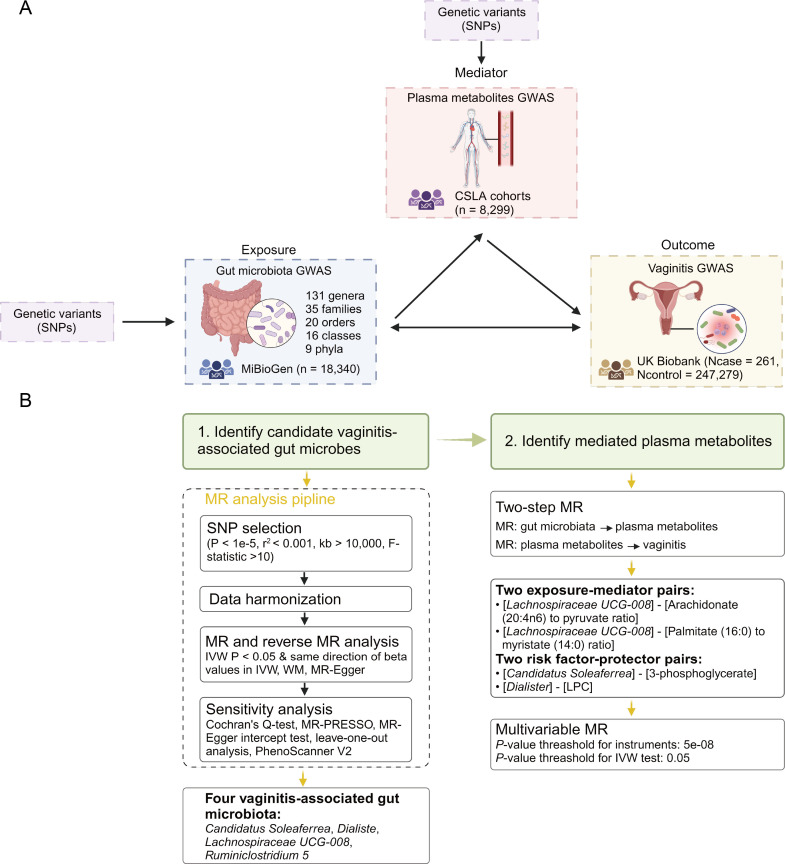
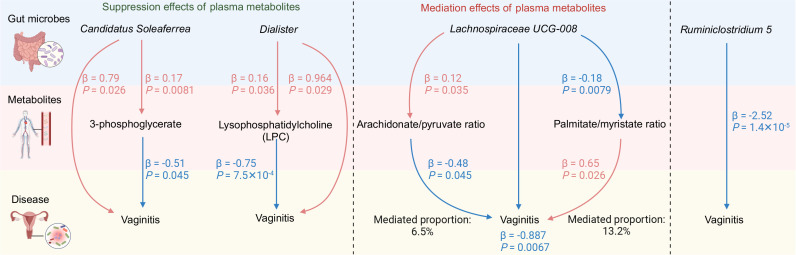
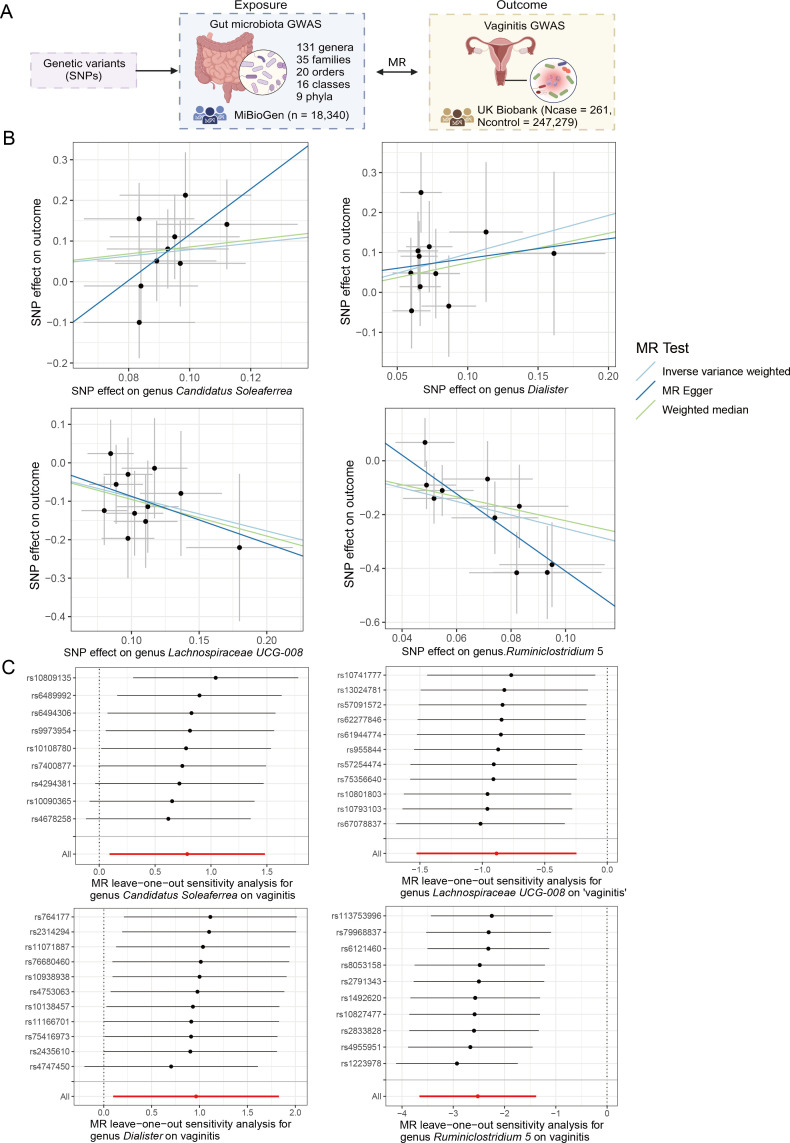
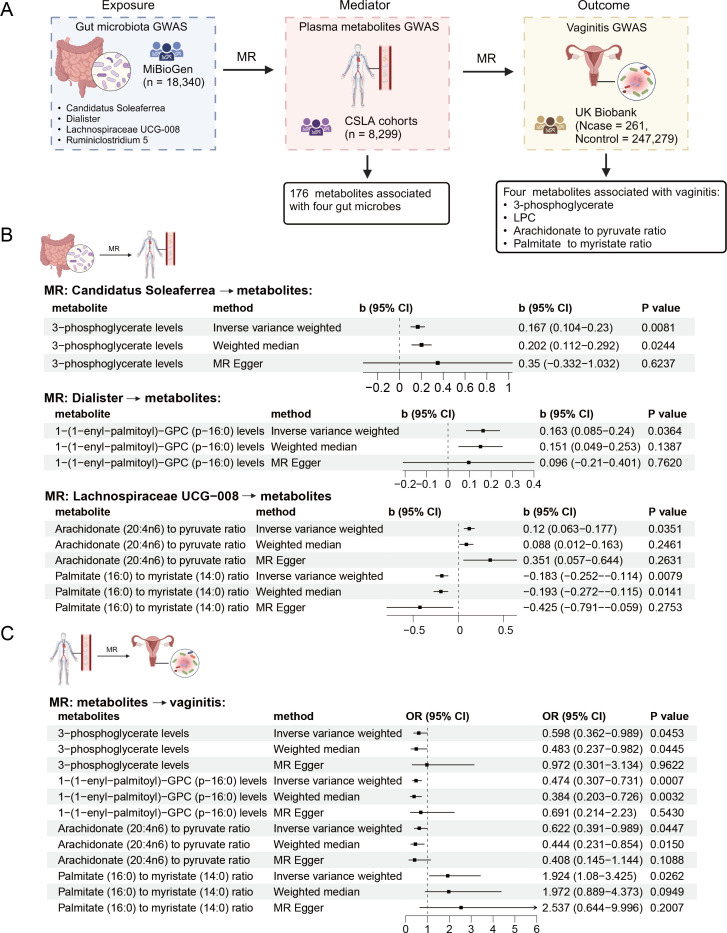
Vaginitis is the most common problem afflicting women of childbearing age. However, the underlying etiological factors remain poorly understood, leading to recurrent vaginitis and constraining clinical management. Here, we explored whether the gut microbiota influences the risk of vaginitis by performing a two-sample Mendelian randomization analysis using the largest genome-wide association studies to date. Four gut taxa in genus levels were identified related to vaginitis: (inverse-variance weighted [IVW] odds ratio [OR] = 2.20, = 0.026), (IVW OR = 2.62, = 0.029), (IVW OR = 0.41, = 0.0067), and (IVW OR = 0.080, = 1.42 × 10). We further explored the mediation effect of the plasma metabolites by two-step Mendelian randomization (MR) and multivariable MR. The findings indicated that 3-phosphoglycerate and lysophosphatidylcholine antagonistically act against the two identified risk factors ( and , respectively) of vaginitis, thus appearing to confer protective effects against vaginitis. On the contrary, the elevation of arachidonate/pyruvate ratio and reduction in palmitate/myristate ratio mediated the protective effects of against vaginitis. These findings support a potential causal role for gut microbiota in the development of vaginitis, thereby providing potential strategies for its prevention and intervention.IMPORTANCEVaginitis is the most common problem afflicting women of childbearing age. However, the underlying etiological factors remain poorly understood, leading to recurrent vaginitis and constraining clinical management. Besides, the human gut and vagina are important organs that are both colonized by thousands of microorganisms impacting human physiology and health. Whether there is an interplay between the microecosystems is intriguing and unclear. This study evaluated the potential causal relationship between the gut microbiota and vaginitis and suggested that specific types of gut microbiota may be the potential risk or protective factors of vaginitis mediated or suppressed by certain plasma metabolites. These findings provide treatment insights for vaginitis.
阴道炎是育龄期女性最常见的问题。然而,其潜在病因仍知之甚少,导致阴道炎反复发作,限制了临床治疗。在此,我们通过使用迄今为止最大规模的全基因组关联研究进行两样本孟德尔随机化分析,探讨肠道微生物群是否会影响阴道炎风险。在属水平上鉴定出四种与阴道炎相关的肠道分类群:(逆方差加权[IVW]比值比[OR]=2.20,=0.026)、(IVW OR=2.62,=0.029)、(IVW OR=0.41,=0.0067)和(IVW OR=0.080,=1.42×10)。我们通过两步孟德尔随机化(MR)和多变量MR进一步探讨了血浆代谢物的中介作用。研究结果表明,3-磷酸甘油酸和溶血磷脂酰胆碱分别对已确定的阴道炎的两个风险因素(分别为和)起拮抗作用,因此似乎对阴道炎具有保护作用。相反,花生四烯酸/丙酮酸比值的升高和棕榈酸/肉豆蔻酸比值的降低介导了对阴道炎的保护作用。这些发现支持肠道微生物群在阴道炎发生发展中具有潜在因果作用,从而为其预防和干预提供了潜在策略。重要性阴道炎是育龄期女性最常见的问题。然而,其潜在病因仍知之甚少,导致阴道炎反复发作,限制了临床治疗。此外,人类肠道和阴道是重要器官,都被数千种影响人类生理和健康的微生物所定植。这两个微生态系统之间是否存在相互作用,既引人关注又尚不清楚。本研究评估了肠道微生物群与阴道炎之间的潜在因果关系,并表明特定类型的肠道微生物群可能是由某些血浆代谢物介导或抑制的阴道炎的潜在风险或保护因素。这些发现为阴道炎的治疗提供了思路。