Li Kevin, Cho Yae In, Tran Mai Anh, Wiedemann Christoph, Zhang Shuaibing, Koweek Rebecca S, Hoàng Ngọc Khánh, Hamrick Grayson S, Bowen Margaret A, Kokona Bashkim, Stallforth Pierre, Beld Joris, Hellmich Ute A, Charkoudian Louise K
Department of Chemistry, Haverford College, Haverford, Pennsylvania 19041, United States.
Faculty of Chemistry and Earth Sciences, Institute for Organic Chemistry and Macromolecular Chemistry, Friedrich Schiller University Jena, 07743 Jena, Germany.
ACS Chem Biol. 2025 Jan 17;20(1):197-207. doi: 10.1021/acschembio.4c00678. Epub 2025 Jan 2.
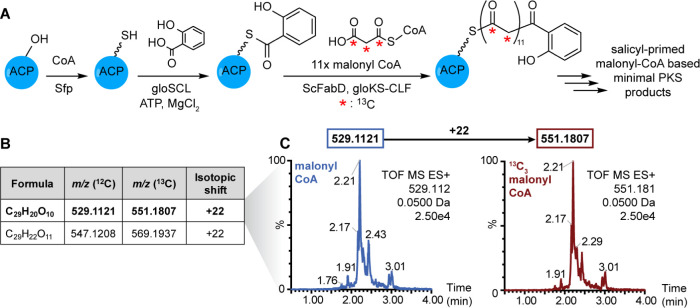
Microbial polyketides represent a structurally diverse class of secondary metabolites with medicinally relevant properties. Aromatic polyketides are produced by type II polyketide synthase (PKS) systems, each minimally composed of a ketosynthase-chain length factor (KS-CLF) and a phosphopantetheinylated acyl carrier protein (-ACP). Although type II PKSs are found throughout the bacterial kingdom, and despite their importance to strategic bioengineering, type II PKSs have not been well-studied . In cases where the KS-CLF can be accessed via heterologous expression, often the cognate ACPs are not activatable by the broad specificity surfactin-producing phosphopantetheinyl transferase (PPTase) Sfp and, conversely, in systems where the ACP can be activated by Sfp, the corresponding KS-CLF is typically not readily obtained. Here, we report the high-yield heterologous expression of both cyanobacterial sp. PCC 7428 minimal type II PKS (gloPKS) components in , which allowed us to study this minimal type II PKS . Initially, neither the cognate PPTase nor Sfp converted gloACP to its active state. However, by examining sequence differences between Sfp-compatible and -incompatible ACPs, we identified two conserved residues in gloACP that, when mutated, enabled high-yield phosphopantetheinylation of gloACP by Sfp. Using analogous mutations, other previously Sfp-incompatible type II PKS ACPs from different bacterial phyla were also rendered activatable by Sfp. This demonstrates the generalizability of our approach and breaks down a longstanding barrier to type II PKS studies and the exploration of complex biosynthetic pathways.
微生物聚酮化合物是一类结构多样的次生代谢产物,具有与医学相关的特性。芳香族聚酮化合物由II型聚酮合酶(PKS)系统产生,每个系统至少由一个酮合成酶-链长因子(KS-CLF)和一个磷酸泛酰巯基乙胺化的酰基载体蛋白(-ACP)组成。尽管II型PKS在整个细菌界都有发现,并且尽管它们对战略生物工程很重要,但II型PKS尚未得到充分研究。在可以通过异源表达获得KS-CLF的情况下,通常同源ACP不能被具有广泛特异性的产生表面活性素的磷酸泛酰巯基乙胺基转移酶(PPTase)Sfp激活,相反,在ACP可以被Sfp激活的系统中,相应的KS-CLF通常不容易获得。在这里,我们报告了蓝藻sp. PCC 7428最小II型PKS(gloPKS)组件在中的高产异源表达,这使我们能够研究这种最小II型PKS。最初,同源PPTase和Sfp都没有将gloACP转化为其活性状态。然而,通过检查Sfp兼容和不兼容的ACP之间的序列差异,我们在gloACP中鉴定出两个保守残基,当它们发生突变时,能够使Sfp对gloACP进行高产率的磷酸泛酰巯基乙胺化。使用类似的突变,来自不同细菌门的其他先前Sfp不兼容的II型PKS ACP也能被Sfp激活。这证明了我们方法的通用性,并打破了II型PKS研究和复杂生物合成途径探索的长期障碍。