Manchester Synthetic Biology Research Centre SYNBIOCHEM, Manchester Institute of Biotechnology, School of Chemistry, The University of Manchester, Manchester, United Kingdom.
Warwick Integrative Synthetic Biology Centre, WISB, School of Life Sciences, The University of Warwick, Coventry, United Kingdom.
PLoS Biol. 2019 Jul 18;17(7):e3000347. doi: 10.1371/journal.pbio.3000347. eCollection 2019 Jul.
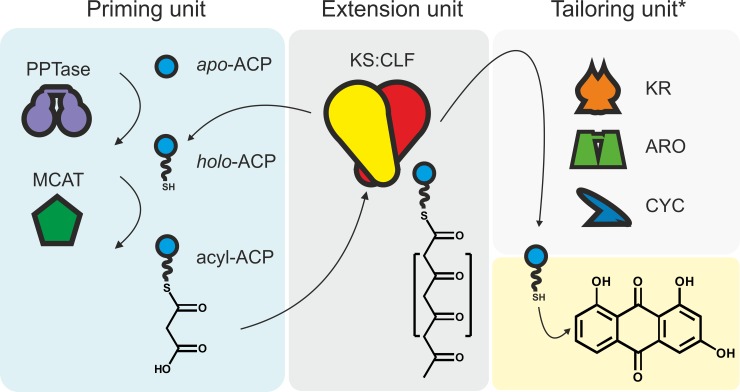
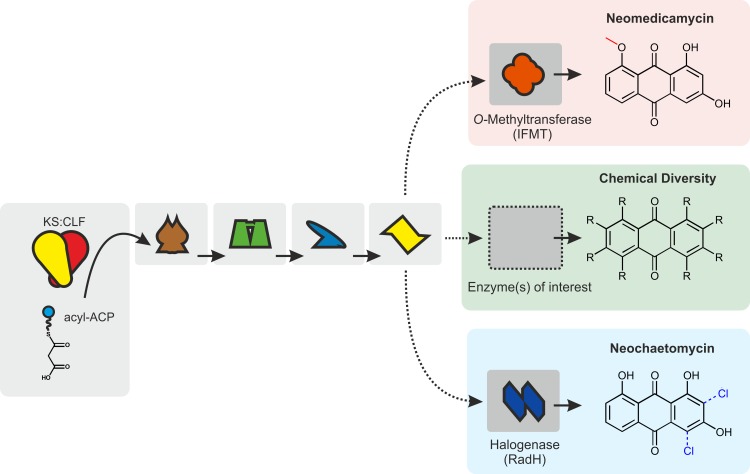
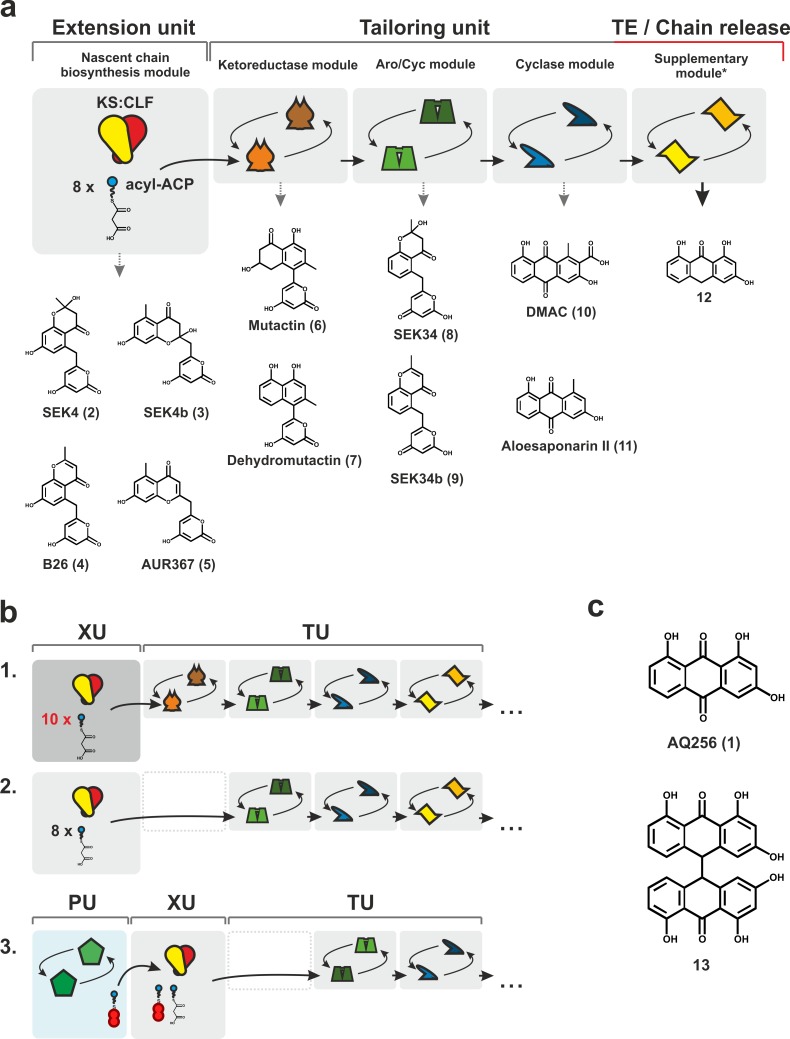
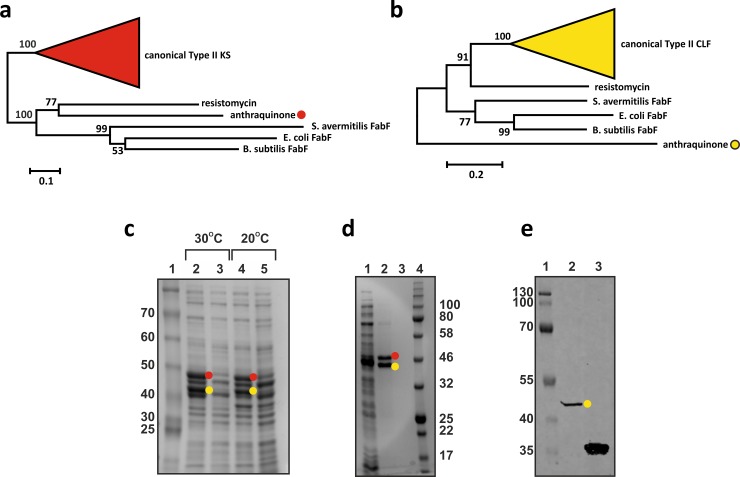
Polyketides are a class of specialised metabolites synthesised by both eukaryotes and prokaryotes. These chemically and structurally diverse molecules are heavily used in the clinic and include frontline antimicrobial and anticancer drugs such as erythromycin and doxorubicin. To replenish the clinicians' diminishing arsenal of bioactive molecules, a promising strategy aims at transferring polyketide biosynthetic pathways from their native producers into the biotechnologically desirable host Escherichia coli. This approach has been successful for type I modular polyketide synthases (PKSs); however, despite more than 3 decades of research, the large and important group of type II PKSs has until now been elusive in E. coli. Here, we report on a versatile polyketide biosynthesis pipeline, based on identification of E. coli-compatible type II PKSs. We successfully express 5 ketosynthase (KS) and chain length factor (CLF) pairs-e.g., from Photorhabdus luminescens TT01, Streptomyces resistomycificus, Streptoccocus sp. GMD2S, Pseudoalteromonas luteoviolacea, and Ktedonobacter racemifer-as soluble heterodimeric recombinant proteins in E. coli for the first time. We define the anthraquinone minimal PKS components and utilise this biosynthetic system to synthesise anthraquinones, dianthrones, and benzoisochromanequinones (BIQs). Furthermore, we demonstrate the tolerance and promiscuity of the anthraquinone heterologous biosynthetic pathway in E. coli to act as genetically applicable plug-and-play scaffold, showing it to function successfully when combined with enzymes from phylogenetically distant species, endophytic fungi and plants, which resulted in 2 new-to-nature compounds, neomedicamycin and neochaetomycin. This work enables plug-and-play combinatorial biosynthesis of aromatic polyketides using bacterial type II PKSs in E. coli, providing full access to its many advantages in terms of easy and fast genetic manipulation, accessibility for high-throughput robotics, and convenient biotechnological scale-up. Using the synthetic and systems biology toolbox, this plug-and-play biosynthetic platform can serve as an engine for the production of new and diversified bioactive polyketides in an automated, rapid, and versatile fashion.
聚酮类化合物是一类由真核生物和原核生物合成的特殊代谢物。这些化学和结构多样化的分子在临床上被广泛应用,包括一线抗菌和抗癌药物,如红霉素和多柔比星。为了补充临床医生日益减少的生物活性分子储备,一种有前途的策略旨在将聚酮生物合成途径从其天然产生菌转移到生物技术上理想的宿主大肠杆菌中。这种方法已成功应用于 I 型模块化聚酮合酶(PKS);然而,尽管经过 30 多年的研究,直到现在,大型且重要的 II 型 PKS 组在大肠杆菌中仍难以捉摸。在这里,我们报告了一种基于鉴定大肠杆菌相容的 II 型 PKS 的多功能聚酮生物合成途径。我们首次成功地在大肠杆菌中表达了 5 个酮合酶(KS)和链长因子(CLF)对,例如来自 Photorhabdus luminescens TT01、Streptomyces resistomycificus、Streptoccocus sp. GMD2S、Pseudoalteromonas luteoviolacea 和 Ktedonobacter racemifer,作为可溶性杂二聚体重组蛋白。我们定义了蒽醌最小 PKS 成分,并利用该生物合成系统合成了蒽醌、二蒽酮和苯并异色满醌(BIQ)。此外,我们证明了大肠杆菌中蒽醌异源生物合成途径的耐受性和混杂性可作为遗传上适用的即插即用支架,当与来自系统发育上遥远的物种、内生真菌和植物的酶结合使用时,该途径可以成功发挥作用,这导致了 2 种新的天然化合物,新美达霉素和新鞘氨醇霉素。这项工作使使用大肠杆菌中的细菌 II 型 PKS 进行芳香聚酮的即插即用组合生物合成成为可能,充分利用了其在遗传操作简便、快速、方便的生物技术放大等方面的诸多优势。使用合成和系统生物学工具箱,这个即插即用的生物合成平台可以作为一个引擎,以自动化、快速和多样化的方式生产新的和多样化的生物活性聚酮类化合物。