• 文献检索
  • 文档翻译
  • 深度研究
  • 学术资讯
  • Suppr Zotero 插件Zotero 插件
  • 邀请有礼
  • 套餐&价格
  • 历史记录
应用&插件
Suppr Zotero 插件Zotero 插件浏览器插件Mac 客户端Windows 客户端微信小程序
定价
高级版会员购买积分包购买API积分包
服务
文献检索文档翻译深度研究API 文档MCP 服务
关于我们
关于 Suppr公司介绍联系我们用户协议隐私条款
关注我们

Suppr 超能文献

核心技术专利:CN118964589B侵权必究
粤ICP备2023148730 号-1Suppr @ 2026

文献检索

告别复杂PubMed语法,用中文像聊天一样搜索,搜遍4000万医学文献。AI智能推荐,让科研检索更轻松。

立即免费搜索

文件翻译

保留排版,准确专业,支持PDF/Word/PPT等文件格式,支持 12+语言互译。

免费翻译文档

深度研究

AI帮你快速写综述,25分钟生成高质量综述,智能提取关键信息,辅助科研写作。

立即免费体验

与多方利益相关者共同探讨理想黑色素瘤幸存者护理计划背后的动机:一项共创研究。

Exploring Motives Behind Ideal Melanoma Survivorship Care Plans With Multiple Stakeholders: A Cocreation Study.

作者信息

Kamminga Nadia Christina Willemina, Lugtenberg Marjolein, Van den Broek Julia Annabel, Nijsten Tamar, Wakkee Marlies, Tabeau Kasia

机构信息

Department of Dermatology, Erasmus MC Cancer institute, University Medical Center Rotterdam, Rotterdam, Netherlands.

Department Tranzo, Tilburg School of Social and Behavioral Sciences, Tilburg University, Tilburg, Netherlands.

出版信息

JMIR Cancer. 2025 Jan 2;11:e55746. doi: 10.2196/55746.

DOI:10.2196/55746
PMID:39746197
原文链接:https://pmc.ncbi.nlm.nih.gov/articles/PMC11739727/
Abstract

BACKGROUND

Survivorship care plans (SCPs), ie, personalized health care plans for cancer survivors, can be used to support the growing group of melanoma survivors throughout their disease trajectory. However, implementation and effectiveness of SCPs are suboptimal and could benefit from the involvement of stakeholders in developing a user-centered design.

OBJECTIVE

The aim of this study was to identify the ideal SCP for patients with melanoma in terms of functions and features to be included according to different stakeholders and to explore their underlying motives.

METHODS

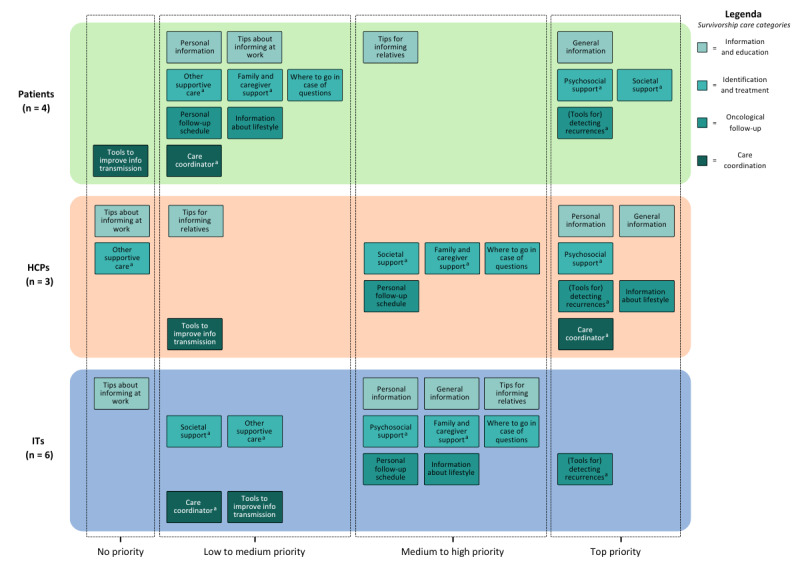
In total, 3 cocreation sessions were organized with mixed samples of stakeholders, ie, patients with (a history of) melanoma (n=4), health care providers (HCPs) active in melanoma care (n=3), and IT specialists active in hospital IT departments (n=6). They were invited to compose their ideal melanoma SCP based on potential functions and features identified from prior qualitative research. These functions and features belonged to one of the four main categories of survivorship care (SSC): (1) information and education, (2) identification and treatment, (3) oncological follow-up, and (4) coordination. Participants were invited to explain their motives for including functions and features. Ideas were shared between stakeholders, and interaction was promoted. Descriptive statistics were used to determine the ideal SCP per stakeholder group. To analyze underlying motives, all cocreation sessions were audio-taped, transcribed verbatim, and analyzed in a thematic content analysis.

RESULTS

With regard to their ideal SCPs, all stakeholders added functions from all 4 SSC categories. Patients assembled a rather compact SCP with category 2 on identification and treatment being most important. Both HCPs and IT professionals constructed a somewhat larger SCP, with category 3 on oncological follow-up being the most important aspect and HCPs also focusing on category 4 on coordination. As for the motives behind their ideal SCP compositions, patients predominantly added functions based on their personal experiences or experiences from fellow patients, whereas both HCPS and IT professionals based their compositions primarily on their respective areas of expertise: HCPs related their additions to their roles as medical practitioners; for example, in providing a complete treatment plan and obtaining informed consent, while IT professionals' contributions were mainly influenced by feasibility and privacy concerns.

CONCLUSIONS

This cocreation study provides insights into stakeholders' ideal melanoma SCP and the motivations behind them. Considering the diversity in both the preferences and underlying motives regarding SCP composition between patients, HCPs, and IT specialists, it is crucial to develop a broad SCP that extends beyond traditional SCP content, emphasizing personalization. In addition to continued stakeholder involvement, efforts should be focused on addressing potential feasibility and privacy issues to ensure the SCP meets both patients' and HCPs' needs.

摘要

背景

生存护理计划(SCPs),即针对癌症幸存者的个性化医疗保健计划,可用于在黑色素瘤幸存者的整个疾病发展过程中为不断壮大的这一群体提供支持。然而,SCPs的实施和效果并不理想,若有利益相关者参与制定以用户为中心的设计,可能会有所助益。

目的

本研究的目的是根据不同利益相关者的意见,确定黑色素瘤患者理想的SCP应包含的功能和特征,并探究其潜在动机。

方法

总共组织了3次共创会议,参会人员为利益相关者的混合样本,即有(黑色素瘤病史的)患者(n = 4)、从事黑色素瘤护理工作的医疗保健提供者(HCPs,n = 3)以及医院信息技术部门的信息技术专家(n = 6)。邀请他们根据先前定性研究确定的潜在功能和特征,构建他们理想的黑色素瘤SCP。这些功能和特征属于生存护理的四个主要类别之一:(1)信息与教育,(2)识别与治疗,(3)肿瘤学随访,以及(4)协调。邀请参与者解释他们纳入功能和特征的动机。利益相关者之间分享想法,并促进互动。使用描述性统计来确定每个利益相关者群体的理想SCP。为了分析潜在动机,所有共创会议都进行了录音,逐字转录,并进行主题内容分析。

结果

关于他们理想的SCP,所有利益相关者都添加了来自所有4个生存护理类别中的功能。患者构建了一个相对紧凑的SCP,其中第2类识别与治疗最为重要。HCPs和信息技术专业人员都构建了一个稍大的SCP,其中第3类肿瘤学随访是最重要的方面,HCPs还关注第4类协调。至于他们理想的SCP构成背后的动机,患者主要根据自己的个人经历或其他患者的经历添加功能,而HCPs和信息技术专业人员的构成主要基于他们各自的专业领域:HCPs将他们添加的内容与他们作为医生的角色相关联;例如,提供完整的治疗计划和获得知情同意,而信息技术专业人员的贡献主要受到可行性和隐私问题的影响。

结论

这项共创研究深入了解了利益相关者理想的黑色素瘤SCP及其背后的动机。考虑到患者、HCPs和信息技术专家在SCP构成方面的偏好和潜在动机存在差异,开发一个超越传统SCP内容、强调个性化的广泛SCP至关重要。除了利益相关者持续参与外,应集中精力解决潜在的可行性和隐私问题,以确保SCP满足患者和HCPs的需求。
https://cdn.ncbi.nlm.nih.gov/pmc/blobs/6075/11739727/89d13d2472f4/cancer_v11i1e55746_fig1.jpg

相似文献

1
Exploring Motives Behind Ideal Melanoma Survivorship Care Plans With Multiple Stakeholders: A Cocreation Study.与多方利益相关者共同探讨理想黑色素瘤幸存者护理计划背后的动机:一项共创研究。
JMIR Cancer. 2025 Jan 2;11:e55746. doi: 10.2196/55746.
2
Oncological healthcare providers' perspectives on appropriate melanoma survivorship care: a qualitative focus group study.肿瘤医疗保健提供者对适当黑色素瘤生存护理的看法:一项定性焦点小组研究。
BMC Cancer. 2023 Mar 28;23(1):278. doi: 10.1186/s12885-023-10759-9.
3
Survivorship care planning in skin cancer: An unbiased statistical approach to identifying patterns of care-plan use.皮肤癌的生存护理计划:一种识别护理计划使用模式的无偏统计方法。
Cancer. 2018 Jan 1;124(1):183-191. doi: 10.1002/cncr.30985. Epub 2017 Sep 8.
4
Assessing Key Stakeholders' Knowledge, Needs, and Preferences for Head and Neck Cancer Survivorship Care Plans.评估关键利益相关者对头颈癌幸存者护理计划的知识、需求和偏好。
J Cancer Educ. 2019 Jun;34(3):584-591. doi: 10.1007/s13187-018-1345-5.
5
Barriers and facilitators to implementing cancer survivorship care plans.实施癌症幸存者护理计划的障碍与促进因素。
Oncol Nurs Forum. 2013 Nov;40(6):575-80. doi: 10.1188/13.ONF.575-580.
6
Survivorship Care Plans in Cancer: A Meta-Analysis and Systematic Review of Care Plan Outcomes.癌症患者生存护理计划:护理计划结果的 Meta 分析和系统评价。
Oncologist. 2020 Feb;25(2):e351-e372. doi: 10.1634/theoncologist.2019-0184. Epub 2019 Oct 25.
7
Impact of Survivorship Care Plans and Planning on Breast, Colon, and Prostate Cancer Survivors in a Community Oncology Practice.社区肿瘤医疗实践中生存护理计划及规划对乳腺癌、结肠癌和前列腺癌幸存者的影响
J Cancer Educ. 2020 Apr;35(2):249-255. doi: 10.1007/s13187-018-1457-y.
8
Development and evaluation of a bladder Cancer specific survivorship care plan by patients and clinical care providers: a multi-methods approach.患者和临床护理提供者共同制定和评估膀胱癌特定生存护理计划:一种多方法研究。
BMC Health Serv Res. 2020 Jul 24;20(1):686. doi: 10.1186/s12913-020-05533-7.
9
After Childhood Cancer: a Qualitative Study of Family Physician, Parent/Guardian, and Survivor Information Needs and Perspectives on Long-Term Follow-up and Survivorship Care Plans.儿童癌症之后:一项关于家庭医生、家长/监护人以及幸存者对长期随访和生存护理计划的信息需求及观点的定性研究
J Cancer Educ. 2019 Aug;34(4):638-646. doi: 10.1007/s13187-018-1349-1.
10
Potential determinants of health-care professionals' use of survivorship care plans: a qualitative study using the theoretical domains framework.医疗保健专业人员使用幸存者护理计划的潜在决定因素:一项运用理论领域框架的定性研究
Implement Sci. 2014 Nov 15;9:167. doi: 10.1186/s13012-014-0167-z.

本文引用的文献

1
From decision to reflection: understanding the experiences and unmet care needs of patients treated with immunotherapy for melanoma in the adjuvant or metastatic setting.从决策到反思:了解辅助治疗或转移性黑色素瘤免疫治疗患者的经历和未满足的护理需求。
BMC Cancer. 2024 May 30;24(1):662. doi: 10.1186/s12885-024-12410-7.
2
Determining the core content of a digital survivorship care plan for melanoma survivors: a multistakeholder Delphi consensus study.确定黑色素瘤幸存者数字生存护理计划的核心内容:一项多利益相关方德尔菲共识研究。
Br J Dermatol. 2024 Feb 16;190(3):440-441. doi: 10.1093/bjd/ljad450.
3
Cocreation of Assistive Technologies for Patients With Long COVID: Qualitative Analysis of a Literature Review on the Challenges of Patient Involvement in Health and Nursing Sciences.
长新冠患者辅助技术的共创:健康和护理科学中患者参与挑战的文献综述的定性分析。
J Med Internet Res. 2023 Aug 15;25:e46297. doi: 10.2196/46297.
4
Using Human-Centered Design and Cocreation to Create the Live 5-2-1-0 Mobile App to Promote Healthy Behaviors in Children: App Design and Development.运用以人为本的设计和共同创作来打造“5-2-1-0生活”移动应用程序,以促进儿童的健康行为:应用程序的设计与开发
JMIR Pediatr Parent. 2023 May 17;6:e44792. doi: 10.2196/44792.
5
Oncological healthcare providers' perspectives on appropriate melanoma survivorship care: a qualitative focus group study.肿瘤医疗保健提供者对适当黑色素瘤生存护理的看法:一项定性焦点小组研究。
BMC Cancer. 2023 Mar 28;23(1):278. doi: 10.1186/s12885-023-10759-9.
6
Diversity in Stakeholder Groups in Generative Co-design for Digital Health: Assembly Procedure and Preliminary Assessment.数字健康生成式协同设计中利益相关者群体的多样性:组建程序与初步评估
JMIR Hum Factors. 2023 Feb 14;10:e38350. doi: 10.2196/38350.
7
Towards successful implementation of artificial intelligence in skin cancer care: a qualitative study exploring the views of dermatologists and general practitioners.人工智能在皮肤癌护理中的成功实施:探索皮肤科医生和全科医生观点的定性研究。
Arch Dermatol Res. 2023 Jul;315(5):1187-1195. doi: 10.1007/s00403-022-02492-3. Epub 2022 Dec 7.
8
A Systematic Approach in Developing Management Workforce Readiness for Digital Health Transformation in Healthcare.系统方法在培养医疗保健中数字化健康转型管理人才准备度方面的应用。
Int J Environ Res Public Health. 2022 Oct 25;19(21):13843. doi: 10.3390/ijerph192113843.
9
The Essence and Role of Nurses in the Future of Biomedical and Health Informatics.护士在生物医学和健康信息学未来中的本质和作用。
Stud Health Technol Inform. 2022 Oct 26;300:164-176. doi: 10.3233/SHTI220948.
10
Feasibility, acceptability, and utility of a nurse-led survivorship program for people with metastatic melanoma (MELCARE).护士主导的转移性黑色素瘤(MELCARE)患者生存护理计划的可行性、可接受性和实用性。
Support Care Cancer. 2022 Nov;30(11):9587-9596. doi: 10.1007/s00520-022-07360-4. Epub 2022 Sep 22.