Vandekerckhove Pieter, Timmermans Job, de Bont Antoinette, de Mul Marleen
Erasmus School of Health Policy & Management, Erasmus University Rotterdam, Rotterdam, Netherlands.
Department of Military Management Studies, Netherlands Defence Academy, Breda, Netherlands.
JMIR Hum Factors. 2023 Feb 14;10:e38350. doi: 10.2196/38350.
Diverse knowledge and ways of thinking are claimed to be important when involving stakeholders such as patients, care professionals, and care managers in a generative co-design (GCD) process. However, this claim is rather general and has not been operationalized; therefore, the influence of various stakeholders on the GCD process has not been empirically tested.
In this study, we aimed to take the first step in assessing stakeholder diversity by formulating a procedure to assemble a group of diverse stakeholders and test its influence in a GCD process.
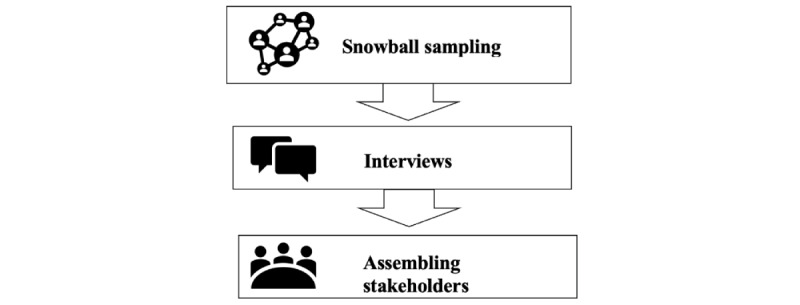
To test the procedure and assess its influence on the GCD process, a case was selected involving a foundation that planned to develop a serious game to help people with cancer return to work. The procedure for assembling a stakeholder group involves snowball sampling and individual interviews, leading to the formation of 2 groups of stakeholders. Thirteen people were identified through snowball sampling, and they were briefly interviewed to assess their knowledge, inference experience, and communication skills. Two diverse stakeholder groups were formed, with one more potent than the other. The influence of both stakeholder groups on the GCD process was qualitatively assessed by comparing the knowledge output and related knowledge processing in 2 identical GCD workshops.
Our hypothesis on diverse stakeholders was confirmed, although it also appeared that merely assessing the professional background of stakeholders was not sufficient to reach the full potential of the GCD process. The more potently diverse group had a stronger influence on knowledge output and knowledge processing, resulting in a more comprehensive problem definition and more precisely described solutions. In the less potently diverse group, none of the stakeholders had experience with abduction-2 inferencing, and this did not emerge in the GCD process, suggesting that at least one stakeholder should have previous abduction-2 experience.
A procedure to assemble a stakeholder group with specific criteria to assess the diversity of knowledge, ways of thinking, and communication can improve the potential of the GCD process and the resulting digital health.
当让患者、护理专业人员和护理管理人员等利益相关者参与生成性协同设计(GCD)过程时,不同的知识和思维方式被认为很重要。然而,这一说法较为笼统,尚未得到具体实施;因此,尚未对各利益相关者对GCD过程的影响进行实证检验。
在本研究中,我们旨在通过制定一个程序来组建一组多样化的利益相关者并测试其在GCD过程中的影响,从而迈出评估利益相关者多样性的第一步。
为了测试该程序并评估其对GCD过程的影响,我们选择了一个案例,该案例涉及一个基金会,该基金会计划开发一款严肃游戏,以帮助癌症患者重返工作岗位。组建利益相关者群体的程序包括滚雪球抽样和个人访谈,最终形成了两组利益相关者。通过滚雪球抽样确定了13人,并对他们进行了简短访谈,以评估他们的知识、推理经验和沟通技巧。形成了两个不同的利益相关者群体,其中一个比另一个更具影响力。通过比较两个相同的GCD研讨会中的知识产出和相关知识处理情况,对两个利益相关者群体对GCD过程的影响进行了定性评估。
我们关于利益相关者多样性的假设得到了证实,不过似乎仅仅评估利益相关者的专业背景不足以充分发挥GCD过程的潜力。更具多样性的群体对知识产出和知识处理的影响更大,从而产生了更全面的问题定义和更精确描述的解决方案。在多样性较低的群体中,没有一个利益相关者有溯因-2推理的经验,并且在GCD过程中也没有出现这种情况,这表明至少有一个利益相关者应该有先前的溯因-2经验。
通过特定标准组建利益相关者群体以评估知识、思维方式和沟通的多样性的程序,可以提高GCD过程以及由此产生的数字健康的潜力。