Birken Sarah A, Presseau Justin, Ellis Shellie D, Gerstel Adrian A, Mayer Deborah K
Department of Health Policy and Management, Gillings School of Global Public Health, The University of North Carolina at Chapel Hill, 1103E McGavran-Greenberg, 135 Dauer Drive, Campus Box 7411, Chapel Hill, NC, 27599-7411, USA.
Institute of Health and Society, Newcastle University, Baddiley-Clark Building, Richardson Road, NE2 4AX, Newcastle upon Tyne, UK.
Implement Sci. 2014 Nov 15;9:167. doi: 10.1186/s13012-014-0167-z.
Survivorship care plans are intended to improve coordination of care for the nearly 14 million cancer survivors in the United States. Evidence suggests that survivorship care plans (SCPs) have positive outcomes for survivors, health-care professionals, and cancer programs, and several high-profile organizations now recommend SCP use. Nevertheless, SCP use remains limited among health-care professionals in United States cancer programs. Knowledge of barriers to SCP use is limited in part because extant studies have used anecdotal evidence to identify determinants. This study uses the theoretical domains framework to identify relevant constructs that are potential determinants of SCP use among United States health-care professionals.
We conducted semi-structured interviews to assess the relevance of 12 theoretical domains in predicting SCP use among 13 health-care professionals in 7 cancer programs throughout the United States with diverse characteristics. Relevant theoretical domains were identified through thematic coding of interview transcripts, identification of specific beliefs within coded text units, and mapping of specific beliefs onto theoretical constructs.
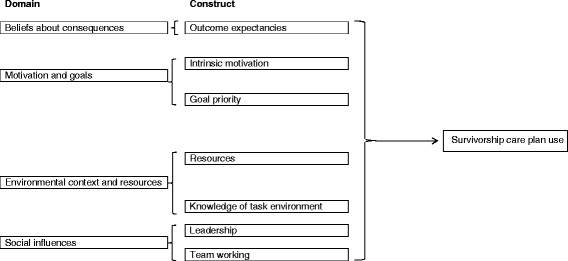
We found the following theoretical domains (based on specific beliefs) to be potential determinants of SCP use: health-care professionals' beliefs about the consequences of SCP use (benefit to survivors, health-care professionals, and the system as a whole); motivation and goals regarding SCP use (advocating SCP use; extent to which using SCPs competed for health-care professionals' time); environmental context and resources (whether SCPs were delivered at a dedicated visit and whether a system, information technology, and funding facilitated SCP use); and social influences (whether using SCPs is an organizational priority, influential people support SCP use, and people who could assist with SCP use buy into using SCPs). Specific beliefs mapped onto the following psychological constructs: outcome expectancies, intrinsic motivation, goal priority, resources, leadership, and team working.
Previous studies have explored a limited range of determinants of SCP use. Our findings suggest a more comprehensive list of potential determinants that could be leveraged to promote SCP use. These results are particularly timely as cancer programs face impending SCP use requirements. Future work should develop instruments to measure the potential determinants and assess their relative influence on SCP use.
生存护理计划旨在改善美国近1400万癌症幸存者的护理协调。有证据表明,生存护理计划(SCP)对幸存者、医疗保健专业人员和癌症项目都有积极成果,并且一些备受瞩目的组织现在推荐使用SCP。然而,在美国癌症项目中,医疗保健专业人员对SCP的使用仍然有限。对SCP使用障碍的了解有限,部分原因是现有研究使用轶事证据来确定决定因素。本研究使用理论领域框架来识别相关结构,这些结构是美国医疗保健专业人员使用SCP的潜在决定因素。
我们进行了半结构化访谈,以评估12个理论领域在预测美国7个具有不同特征的癌症项目中的13名医疗保健专业人员使用SCP方面的相关性。通过对访谈记录进行主题编码、识别编码文本单元中的特定信念以及将特定信念映射到理论结构上来确定相关的理论领域。
我们发现以下理论领域(基于特定信念)是SCP使用的潜在决定因素:医疗保健专业人员对SCP使用后果的信念(对幸存者、医疗保健专业人员和整个系统的益处);SCP使用的动机和目标(倡导使用SCP;使用SCP在多大程度上与医疗保健专业人员的时间相竞争);环境背景和资源(SCP是否在专门的就诊时提供,以及系统、信息技术和资金是否促进SCP的使用);以及社会影响(使用SCP是否是组织的优先事项、有影响力的人是否支持SCP的使用以及可以协助使用SCP的人是否认可使用SCP)。特定信念映射到以下心理结构上:结果预期、内在动机、目标优先级、资源、领导力和团队合作。
先前的研究探索了SCP使用的有限范围的决定因素。我们的研究结果表明了一份更全面的潜在决定因素清单,可用于促进SCP的使用。随着癌症项目面临即将到来的SCP使用要求,这些结果尤为及时。未来的工作应该开发工具来衡量潜在决定因素,并评估它们对SCP使用的相对影响。