Miao Yu, Cheng Yuxiao, Xia Yushi, Hei Yongzhen, Wang Wenjuan, Dai Qionghai, Suo Jinli, Chen Chunlai
State Key Laboratory of Membrane Biology, Beijing Frontier Research Center for Biological Structure, School of Life Sciences, Tsinghua University, Beijing, China.
Department of Automation, Tsinghua University, Beijing, China.
Nat Commun. 2025 Jan 2;16(1):74. doi: 10.1038/s41467-024-54652-w.
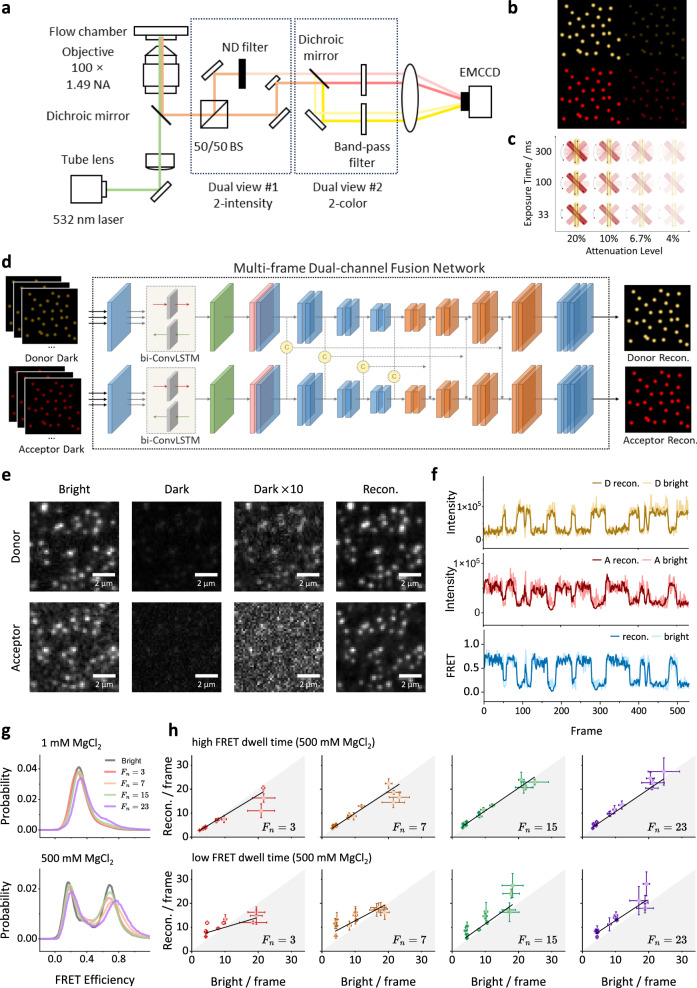
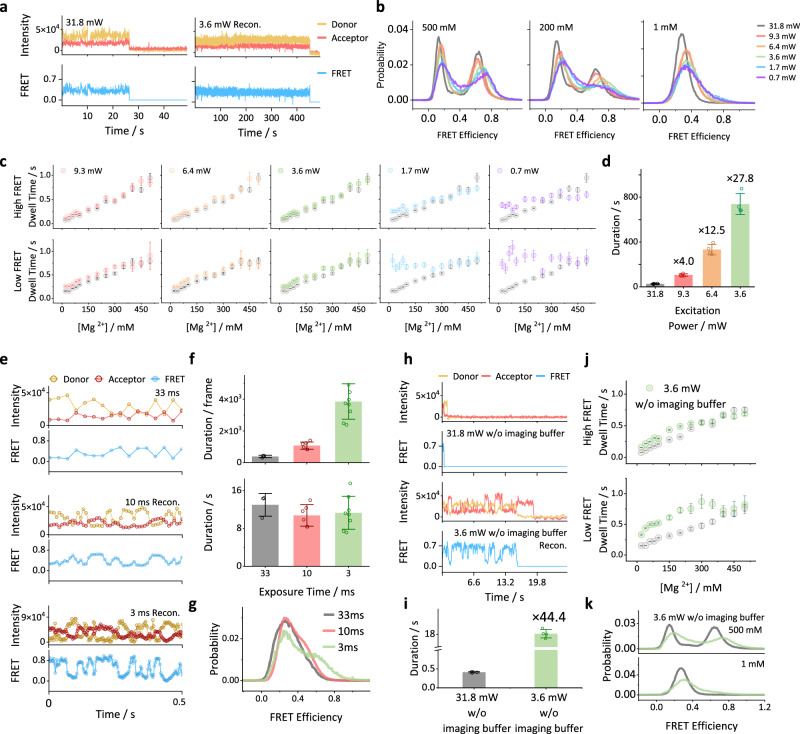
Camera-based single-molecule techniques have emerged as crucial tools in revolutionizing the understanding of biochemical and cellular processes due to their ability to capture dynamic processes with high precision, high-throughput capabilities, and methodological maturity. However, the stringent requirement in photon number per frame and the limited number of photons emitted by each fluorophore before photobleaching pose a challenge to achieving both high temporal resolution and long observation times. In this work, we introduce MUFFLE, a supervised deep-learning denoising method that enables single-molecule FRET with up to 10-fold reduction in photon requirement per frame. In practice, MUFFLE extends the total number of observation frames by a factor of 10 or more, greatly relieving the trade-off between temporal resolution and observation length and allowing for long-term measurements even without the need for oxygen scavenging systems and triplet state quenchers.
基于相机的单分子技术已成为变革对生化和细胞过程理解的关键工具,因为它们能够以高精度、高通量能力和方法成熟度捕捉动态过程。然而,对每帧光子数的严格要求以及每个荧光团在光漂白前发射的光子数量有限,对实现高时间分辨率和长观测时间构成了挑战。在这项工作中,我们引入了MUFFLE,一种有监督的深度学习去噪方法,它能实现单分子荧光共振能量转移,使每帧光子需求减少多达10倍。在实际应用中,MUFFLE将观测帧数总数扩展了10倍或更多,极大地缓解了时间分辨率和观测长度之间的权衡,甚至无需氧气清除系统和三重态猝灭剂就能进行长期测量。