DuPlissis Andrew, Medewar Abhishri, Hegarty Evan, Laing Adam, Shen Amber, Gomez Sebastian, Mondal Sudip, Ben-Yakar Adela
vivoVerse, LLC, Austin, TX, 78731, USA.
Department of Mechanical Engineering, The University of Texas at Austin, Austin, TX, 78712, USA.
Sci Rep. 2025 Jan 2;15(1):15. doi: 10.1038/s41598-024-84842-x.
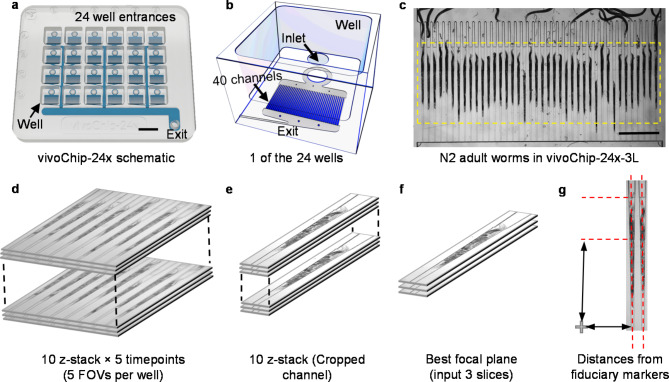
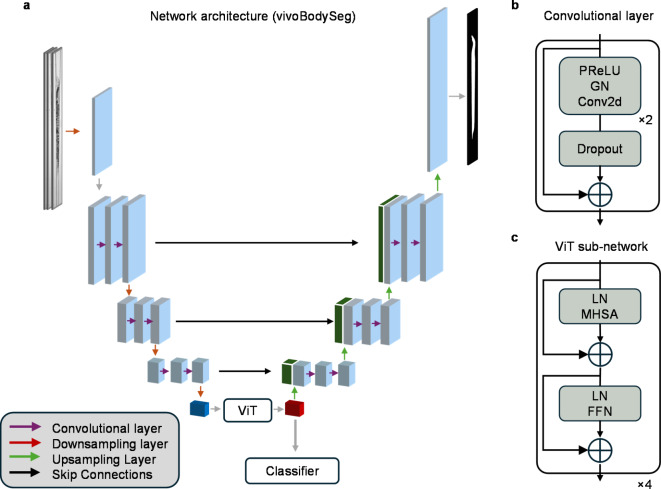
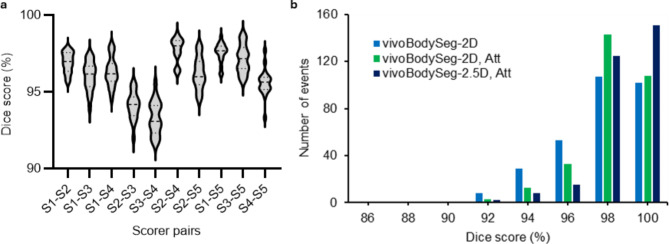
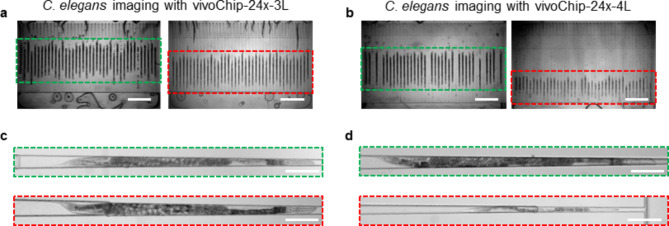
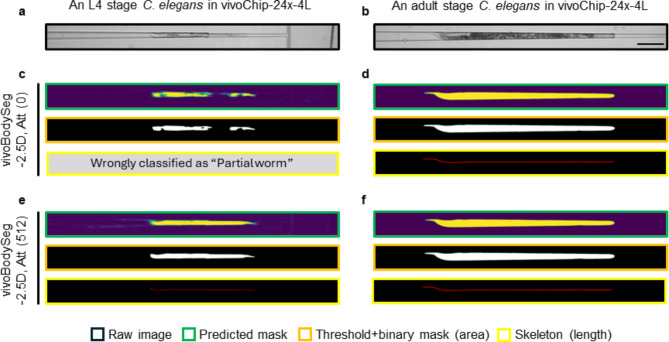
Developmental toxicity (DevTox) tests evaluate the adverse effects of chemical exposures on an organism's development. Although current testing primarily relies on large mammalian models, the emergence of new approach methodologies (NAMs) is encouraging industries and regulatory agencies to evaluate novel assays. C. elegans have emerged as NAMs for rapid toxicity testing because of its biological relevance and suitability to high throughput studies. However, current low-resolution and labor-intensive methodologies prohibit its application for sub-lethal DevTox studies at high throughputs. With the recent advent of the large-scale microfluidic device, vivoChip, we can now rapidly collect 3D high-resolution images of ~ 1000 C. elegans from 24 different populations. While data collection is rapid, analyzing thousands of images remains time-consuming. To address this challenge, we developed a machine-learning (ML)-based image analysis platform using a 2.5D U-Net architecture (vivoBodySeg) that accurately segments C. elegans in images obtained from vivoChip devices, achieving a Dice score of 97.80%. vivoBodySeg processes 36 GB data per device, phenotyping multiple body parameters within 35 min on a desktop PC. This analysis is ~ 140 × faster than the manual analysis. This ML approach delivers highly reproducible DevTox parameters (4-8% CV) to assess the toxicity of chemicals with high statistical power.
发育毒性(DevTox)测试评估化学物质暴露对生物体发育的不利影响。尽管目前的测试主要依赖大型哺乳动物模型,但新方法学(NAMs)的出现促使行业和监管机构评估新型检测方法。秀丽隐杆线虫因其生物学相关性和适用于高通量研究而成为用于快速毒性测试的新方法学。然而,当前低分辨率且劳动密集型的方法阻碍了其在高通量亚致死DevTox研究中的应用。随着大规模微流控设备vivoChip的出现,我们现在可以快速从24个不同群体中收集约1000条秀丽隐杆线虫的3D高分辨率图像。虽然数据收集很快,但分析数千张图像仍然很耗时。为应对这一挑战,我们使用2.5D U-Net架构(vivoBodySeg)开发了一个基于机器学习(ML)的图像分析平台,该平台能准确分割从vivoChip设备获得的图像中的秀丽隐杆线虫,骰子系数达到97.80%。vivoBodySeg每个设备处理36GB数据,在台式电脑上35分钟内对多个身体参数进行表型分析。这种分析比手动分析快约140倍。这种机器学习方法能提供高度可重复的DevTox参数(变异系数4 - 8%),以高统计效能评估化学物质的毒性。