Kumazu Yuta, Kobayashi Nao, Senya Seigo, Negishi Yuya, Kinoshita Kazuya, Fukui Yudai, Mita Kazuhito, Osaragi Tomohiko, Misumi Toshihiro, Shinohara Hisashi
Anaut Inc., 2-1-6-19F WeWork Hibiya Park Front, Uchisaiwaicho, Chiyodaku, Tokyo, 100-0011, Japan.
Department of Surgery, Yokohama City University, Kanagawa, Japan.
Sci Rep. 2025 Jan 2;15(1):152. doi: 10.1038/s41598-024-84044-5.
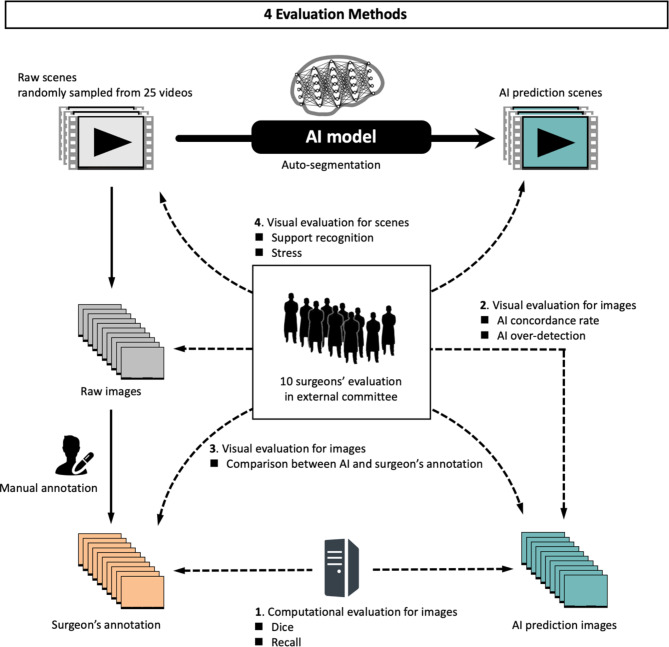
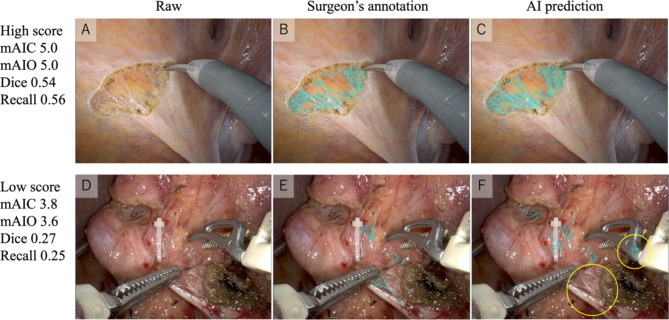
We aimed to develop an AI model that recognizes and displays loose connective tissue as a dissectable layer in real-time during gastrointestinal surgery and to evaluate its performance, including feasibility for clinical application. Training data were created under the supervision of gastrointestinal surgeons. Test images and videos were randomly sampled and model performance was evaluated visually by 10 external gastrointestinal surgeons. The mean Dice coefficient of the 50 images was 0.46. The AI model could detect at least 75% of the loose connective tissue in 91.8% of the images (459/500 responses). False positives were found for 52.6% of the images, but most were not judged significant enough to affect surgical judgment. When comparing the surgeon's annotation with the AI prediction image, 5 surgeons judged the AI image was closer to their own recognition. When viewing the AI video and raw video side-by-side, surgeons judged that in 99% of the AI videos, visualization was improved and stress levels were acceptable when viewing the AI prediction display. The AI model developed demonstrated performance at a level approaching that of a gastrointestinal surgeon. Such visualization of a safe dissectable layer may help to reduce intraoperative recognition errors and surgical complications.
我们旨在开发一种人工智能模型,该模型能够在胃肠手术期间实时识别并将疏松结缔组织显示为可解剖层,并评估其性能,包括临床应用的可行性。训练数据是在胃肠外科医生的监督下创建的。对测试图像和视频进行随机采样,并由10名外部胃肠外科医生通过视觉评估模型性能。50张图像的平均骰子系数为0.46。该人工智能模型能够在91.8%的图像(459/500个响应)中检测到至少75%的疏松结缔组织。在52.6%的图像中发现了假阳性,但大多数被认为不足以影响手术判断。将外科医生的标注与人工智能预测图像进行比较时,5名外科医生认为人工智能图像更接近他们自己的识别结果。当并排查看人工智能视频和原始视频时,外科医生判断在99%的人工智能视频中,可视化效果得到改善,查看人工智能预测显示时的压力水平可以接受。所开发的人工智能模型表现出接近胃肠外科医生的水平。这种安全可解剖层的可视化可能有助于减少术中识别错误和手术并发症。