Department of Surgery, Yokohama City University, Kanagawa, Japan.
Anaut Inc., Tokyo, Japan.
Sci Rep. 2021 Oct 27;11(1):21198. doi: 10.1038/s41598-021-00557-3.
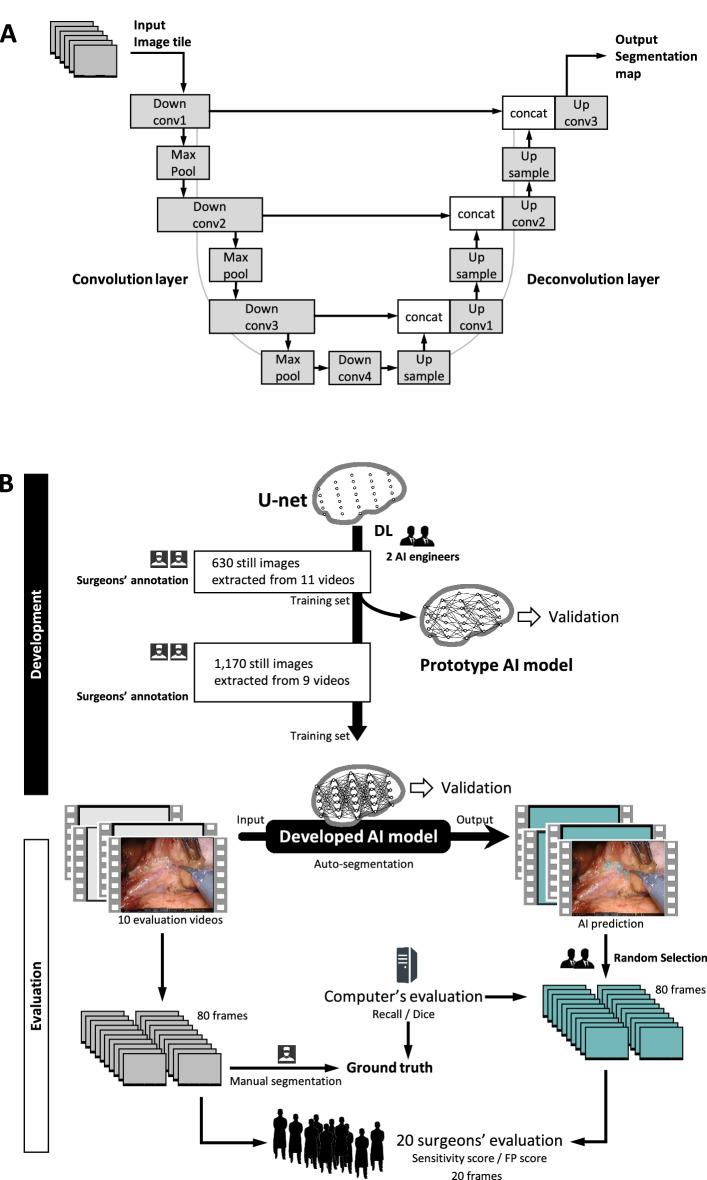
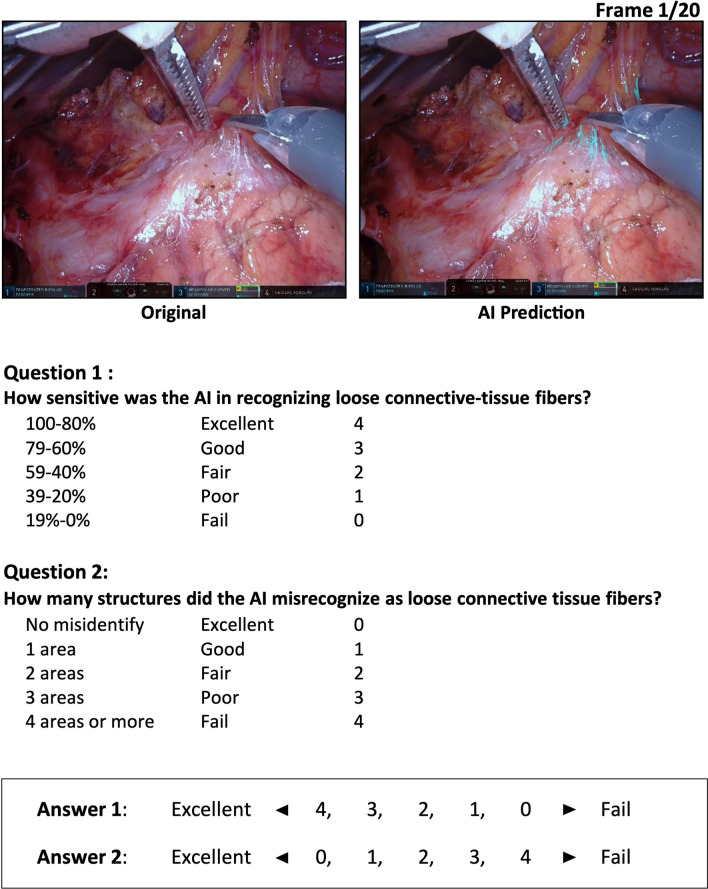
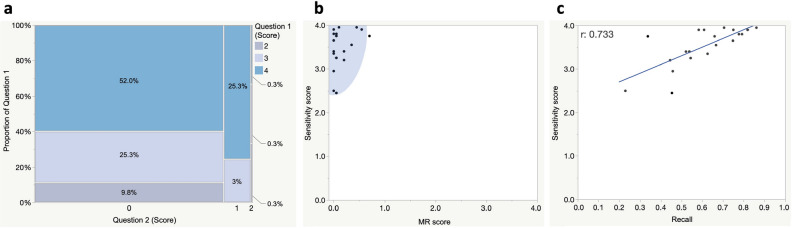
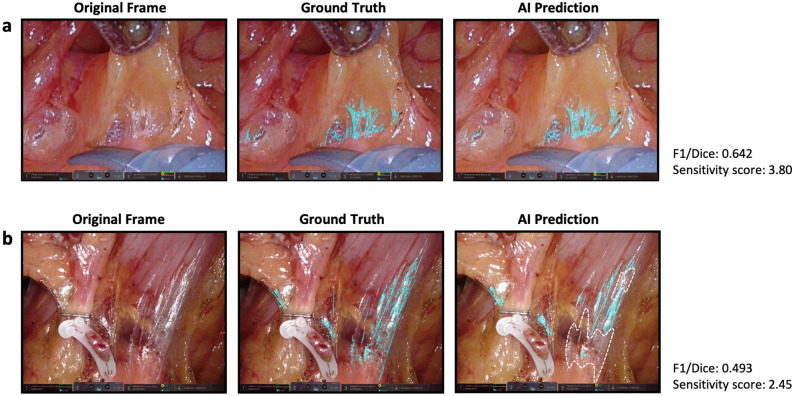
The prediction of anatomical structures within the surgical field by artificial intelligence (AI) is expected to support surgeons' experience and cognitive skills. We aimed to develop a deep-learning model to automatically segment loose connective tissue fibers (LCTFs) that define a safe dissection plane. The annotation was performed on video frames capturing a robot-assisted gastrectomy performed by trained surgeons. A deep-learning model based on U-net was developed to output segmentation results. Twenty randomly sampled frames were provided to evaluate model performance by comparing Recall and F1/Dice scores with a ground truth and with a two-item questionnaire on sensitivity and misrecognition that was completed by 20 surgeons. The model produced high Recall scores (mean 0.606, maximum 0.861). Mean F1/Dice scores reached 0.549 (range 0.335-0.691), showing acceptable spatial overlap of the objects. Surgeon evaluators gave a mean sensitivity score of 3.52 (with 88.0% assigning the highest score of 4; range 2.45-3.95). The mean misrecognition score was a low 0.14 (range 0-0.7), indicating very few acknowledged over-detection failures. Thus, AI can be trained to predict fine, difficult-to-discern anatomical structures at a level convincing to expert surgeons. This technology may help reduce adverse events by determining safe dissection planes.
人工智能 (AI) 预测手术领域的解剖结构,有望辅助外科医生的经验和认知技能。我们旨在开发一种深度学习模型,以自动分割疏松结缔组织纤维 (LCTFs),这些纤维界定了安全的解剖平面。注释是在捕获由训练有素的外科医生进行的机器人辅助胃切除术的视频帧上完成的。基于 U-net 的深度学习模型用于输出分割结果。我们提供了 20 个随机采样的帧,通过与地面实况和 20 位外科医生完成的敏感性和误识别的两个项目问卷的召回率和 F1/Dice 评分比较,评估模型性能。模型产生了较高的召回率(平均值为 0.606,最大值为 0.861)。平均 F1/Dice 评分达到 0.549(范围为 0.335-0.691),表明对象的空间重叠程度可接受。外科医生评估者的平均敏感性评分为 3.52(88.0%的评估者给予最高的 4 分;范围为 2.45-3.95)。平均误识别评分较低,为 0.14(范围为 0-0.7),表明很少有识别失败的情况。因此,AI 可以接受训练,以达到专家外科医生认可的精细、难以分辨的解剖结构的预测水平。这项技术可以通过确定安全的解剖平面来帮助减少不良事件。