Kiran Pothumarthy Venkata Swathi, Gupta Nitin, Prabhu Attur Ravindra, Sebastian Anjely, Boodman Carl, Kumar Tirlangi Praveen
Department of Infectious Diseases, Kasturba Medical College, Manipal, Manipal Academy of Higher Education, Manipal, 576104, India.
Institute of Tropical Medicine, Antwerp, 2000, Belgium.
Infection. 2025 Feb;53(1):25-37. doi: 10.1007/s15010-024-02455-y. Epub 2025 Jan 2.
Adenovirus nephritis is an increasingly recognized complication in adult kidney transplant recipients, characterized by its diverse clinical presentations and diagnostic challenges. This systematic review summarises the clinical profiles and outcomes of adenoviral nephritis in kidney allograft recipients.
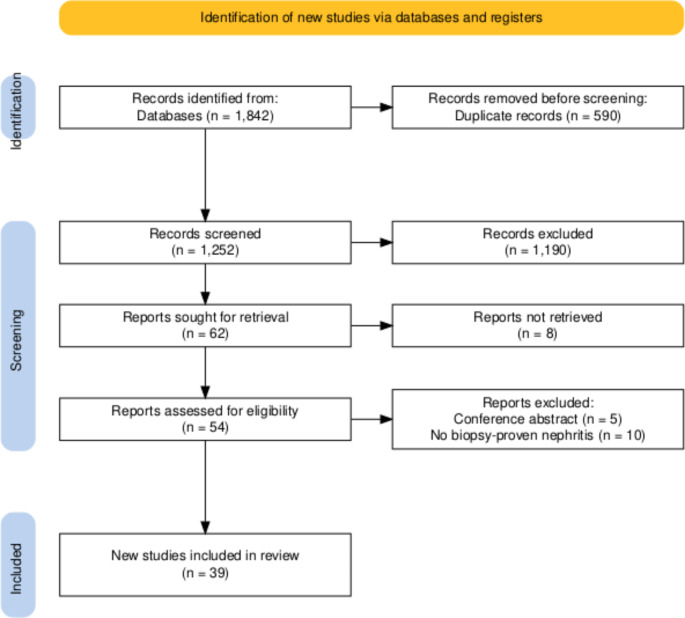
We conducted a systematic search of PubMed, Embase, and Web of Science for studies (case reports or series) with individual patient data on adult kidney transplant recipients with confirmed or presumptive adenoviral nephritis up to October 2, 2024. Clinical profile, treatment and outcome data with adenoviral nephritis were collected and summarised for all patients. We compared features of early and late adenoviral nephritis (diagnosis before and after 90 days post-transplantation).
Thirty-nine studies met inclusion criteria, involving 57 patients with a mean age of 45.7 years and a male predominance. The median time to infection post-transplant was 168 days. The most common symptoms were fever (68.5%), dysuria (49%) and diarrhoea (21%). Early adenoviral infection was more common in cadaveric graft recipients. Fever and gross haematuria were more common in late adenoviral infections. Biopsies showed interstitial nephritis (100%), with some having acute tubular necrosis (53%). Granulomas were seen in 61.2%. Glomeruli and peritubular capillaries were not affected in any of the biopsies. Reversible graft dysfunction was observed in 75% of cases, while mortality was noted in three patients.
Adenoviral nephritis is associated with diverse clinical manifestations with differing chronology post-transplantation. Graft dysfunction is associated with reversible interstitial nephritis. Further research is necessary to improve outcomes.
腺病毒肾炎是成年肾移植受者中一种日益被认识到的并发症,其特点是临床表现多样且诊断具有挑战性。本系统评价总结了肾移植受者腺病毒肾炎的临床特征及预后。
我们对PubMed、Embase和Web of Science进行了系统检索,以查找截至2024年10月2日有关确诊或疑似腺病毒肾炎的成年肾移植受者个体患者数据的研究(病例报告或系列研究)。收集并汇总了所有患者腺病毒肾炎的临床特征、治疗及预后数据。我们比较了早期和晚期腺病毒肾炎(移植后90天之前和之后诊断)的特征。
39项研究符合纳入标准,涉及57例患者,平均年龄45.7岁,男性居多。移植后感染的中位时间为168天。最常见的症状为发热(68.5%)、排尿困难(49%)和腹泻(21%)。早期腺病毒感染在尸体供肾受者中更为常见。发热和肉眼血尿在晚期腺病毒感染中更为常见。活检显示为间质性肾炎(100%),部分伴有急性肾小管坏死(53%)。61.2%可见肉芽肿。所有活检中肾小球和肾小管周围毛细血管均未受累。75%的病例观察到移植肾功能可逆性受损,3例患者死亡。
腺病毒肾炎与移植后不同时间的多种临床表现相关。移植肾功能障碍与可逆性间质性肾炎有关。需要进一步研究以改善预后。