Potter Rachael A, Moeller Ida H, Khan Sohrab, Haegel Hélène, Hollenstein Andreas, Steiner Guido, Wandel Christoph, Murphy Alexander P, Asher Damon R, Palatinsky Emanuel, Griffin Danielle A, Mason Stefanie, Iannaccone Susan T, Zaidman Craig M, Rodino-Klapac Louise R
Sarepta Therapeutics, Inc., Cambridge, MA, USA.
F. Hoffmann-La Roche Ltd, Basel, Switzerland.
Sci Rep. 2025 Jan 2;15(1):4. doi: 10.1038/s41598-024-84077-w.
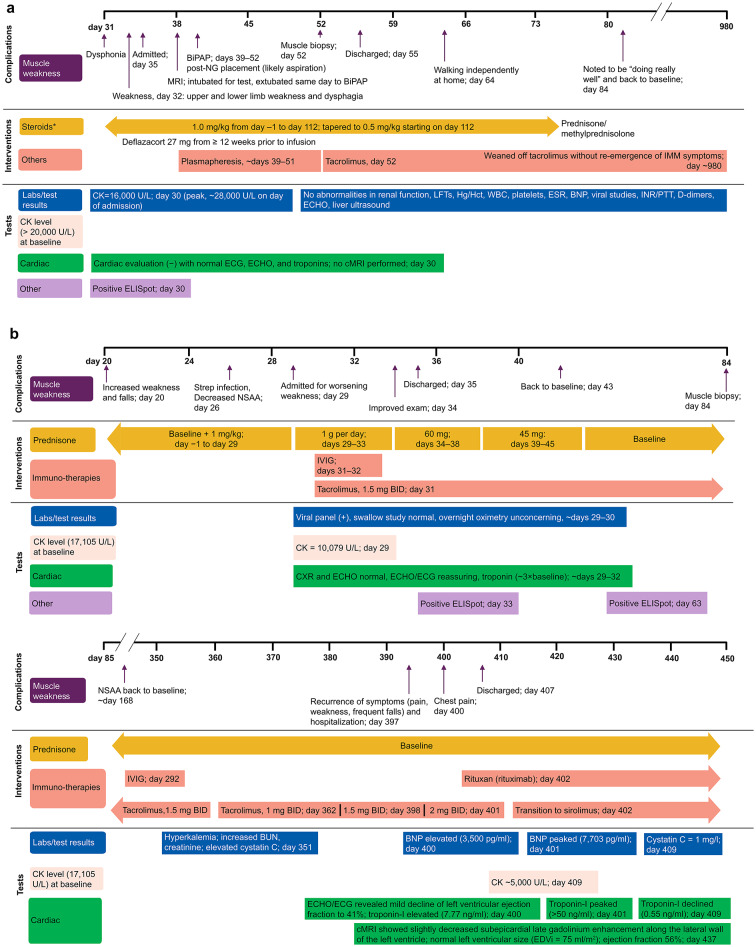
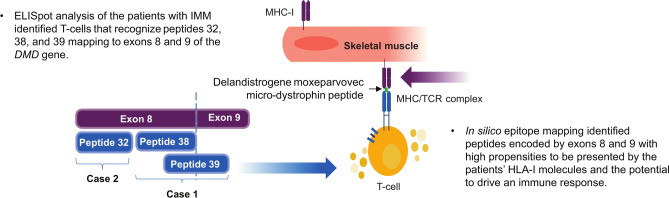
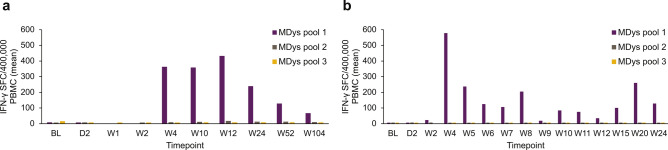
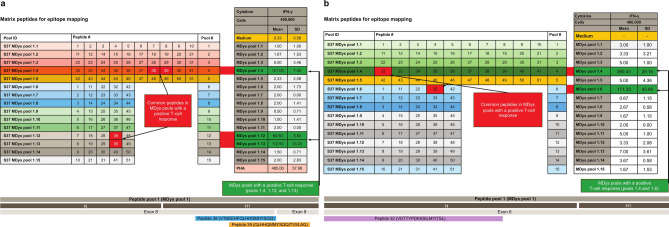
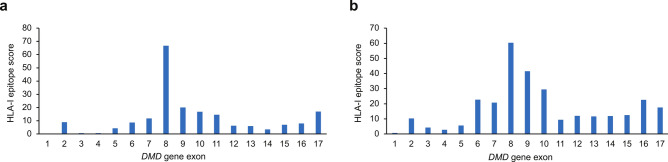
Delandistrogene moxeparvovec is an rAAVrh74 vector-based gene transfer therapy that delivers a transgene encoding delandistrogene moxeparvovec micro-dystrophin, an engineered, functional form of dystrophin shown to stabilize or slow disease progression in DMD. It is approved in the US and in other select countries. Two serious adverse event cases of immune-mediated myositis (IMM) were reported in the phase Ib ENDEAVOR trial (NCT04626674). We hypothesized that immune responses to the micro-dystrophin transgene product may have mediated these IMM events. An interferon-gamma ELISpot assay was used to detect T cell responses to delandistrogene moxeparvovec micro-dystrophin peptide pools. ELISpot analysis suggested that IMM resulted from T cell-mediated responses directed against specific micro-dystrophin peptides corresponding to exons 8 and 9 (Case 1) and exon 8 (Case 2) of the DMD gene. In silico epitope mapping based on the patients' HLA-I alleles indicated greater probability for peptides derived from exons 8 and/or 9 to bind HLA-I, providing further evidence that peptides derived from corresponding micro-dystrophin regions may have higher immunogenic potential. Collectively, these data suggest that patients with DMD gene deletions involving exons 8 and/or 9 may be at increased risk of IMM following delandistrogene moxeparvovec micro-dystrophin gene therapy infusion.
德蓝地昔韦是一种基于rAAVrh74载体的基因转移疗法,可递送编码德蓝地昔韦微抗肌萎缩蛋白的转基因,该微抗肌萎缩蛋白是一种经过工程改造的功能性抗肌萎缩蛋白,已证明可稳定或减缓杜氏肌营养不良症(DMD)的疾病进展。它已在美国和其他选定国家获得批准。在Ib期ENDEAVOR试验(NCT04626674)中报告了两例免疫介导性肌炎(IMM)严重不良事件病例。我们推测,对微抗肌萎缩蛋白转基因产物的免疫反应可能介导了这些IMM事件。使用干扰素-γ ELISpot检测法来检测T细胞对德蓝地昔韦微抗肌萎缩蛋白肽库的反应。ELISpot分析表明,IMM是由针对与DMD基因外显子8和9(病例1)以及外显子8(病例2)相对应的特定微抗肌萎缩蛋白肽的T细胞介导反应引起的。基于患者HLA-I等位基因的计算机表位作图表明,来自外显子8和/或9的肽与HLA-I结合的可能性更大,这进一步证明来自相应微抗肌萎缩蛋白区域的肽可能具有更高的免疫原性潜力。总体而言,这些数据表明,涉及外显子8和/或9的DMD基因缺失患者在接受德蓝地昔韦微抗肌萎缩蛋白基因治疗输注后发生IMM的风险可能会增加。