Wei Mengchao, Yang Wenjie, Qiao Yi, Ma Lin, Xu Weifeng, Dong Jie
Department of Urology, Peking Union Medical College Hospital, Chinese Academy of Medical Sciences and Peking Union Medical College, Dongcheng, Beijing, 100000, China.
Sci Rep. 2025 Jan 2;15(1):238. doi: 10.1038/s41598-024-84681-w.
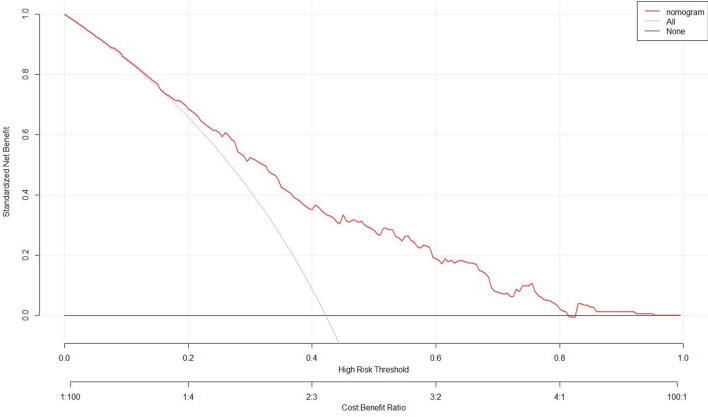
There are inconsistent results pertaining to risk factors for venous thromboembolism (VTE) in patients following urologic surgeries. We attempted to establish a visualization model to shed further light upon this topic. Consequently, a total of 436 patients who were tested for VTE following urologic surgeries were retrospectively enrolled. Least absolute shrinkage and selection operator method (LASSO) method was utilized to determine risk factors for VTE and a subsequent nomogram was constructed. The concordance index (C-index) and calibration curve were utilized to evaluate the nomogram. The results suggested that age, history of smoking, D-dimer levels on the first postoperative day, transfusion volume and body mass index (BMI) were identified as significant risk factors for VTE. The C-index of the nomogram composed of the five variables was 0.747 (95% CI 0.700-0.793) and the calibration plot demonstrated good performance. Therefore, the present nomogram could predict the risk of VTE following urologic surgeries.
关于泌尿外科手术后患者静脉血栓栓塞(VTE)的危险因素,研究结果并不一致。我们试图建立一个可视化模型,以进一步阐明这一主题。因此,我们回顾性纳入了436例泌尿外科手术后接受VTE检测的患者。采用最小绝对收缩和选择算子法(LASSO)确定VTE的危险因素,并构建了后续的列线图。利用一致性指数(C指数)和校准曲线来评估列线图。结果表明,年龄、吸烟史、术后第一天的D-二聚体水平、输血量和体重指数(BMI)被确定为VTE的重要危险因素。由这五个变量组成的列线图的C指数为0.747(95%CI 0.700-0.793),校准图显示出良好的性能。因此,目前的列线图可以预测泌尿外科手术后VTE的风险。