Lau Lay Khoon, Lun Penny, Gao Jonathan, Tan Edward, Ding Yew Yoong
Geriatric Education and Research Institute (GERI), 2 Yishun Central 2, Singapore, 768024, Singapore.
Department of Geriatric Medicine & Institute of Geriatric and Active Ageing, Tan Tock Seng Hospital, Singapore, Singapore.
BMC Geriatr. 2025 Jan 2;25(1):2. doi: 10.1186/s12877-024-05615-9.
Comprehensive Geriatric Assessment is the gold standard of clinical care for older patients but its application in the primary care setting is limited, possibly due to its time-consuming process. Hence, a brief geriatric assessment could be a feasible alternative. We conducted a scoping review to identify which brief geriatric assessment tools have been evaluated or implemented in primary and community care settings and to identify the domains assessed including their reported outcomes.
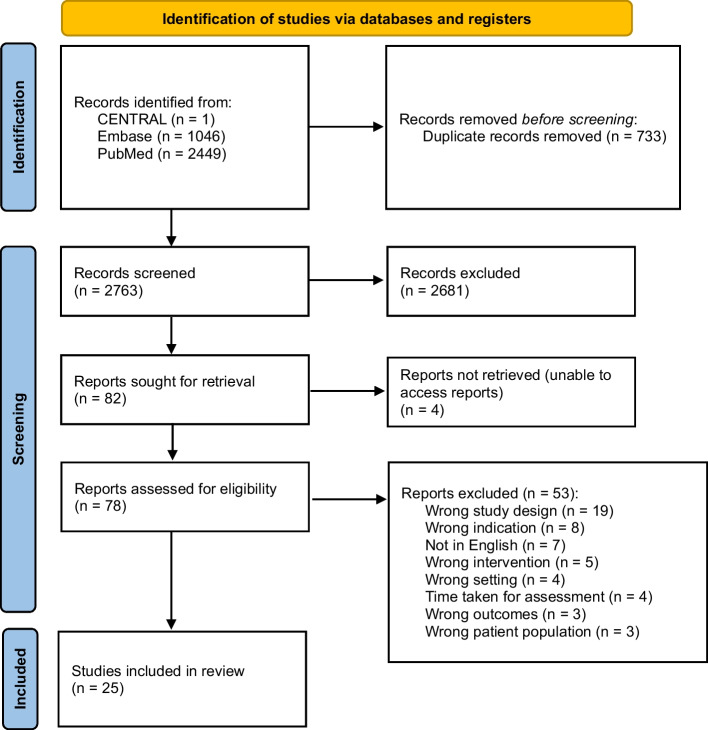
CENTRAL, PubMed and Embase were searched using specific text words and MeSH for articles published from inception that studied evaluation or implementation of brief geriatric assessments in primary care or community setting.
Twenty-five articles were included in the review, of which 11 described brief geriatric assessments implemented in community, nine in primary care and five in mixed settings. Physical health, functional, mobility/balance and psychological/mental emerged as four domains that are most assessed in brief geriatric assessments. Self-reported questionnaire is the key approach, but uncertainty remains on the validity of subjective cognitive assessments. Brief geriatric assessments have been administered by non-healthcare professionals. The duration taken to complete ranged from five to 20 min. Studies did not report significant change in the clinical outcomes of older adults except for better identification of those with higher needs.
The studies reported that brief geriatric assessments could identify older adults with unmet needs or geriatric syndromes, but they did not report improved health outcomes when combined with clinical intervention pathways. Clarity of brief geriatric assessments' questions is important to ensure the feasibility of using self-administered questionnaire by older adults. Future studies should determine which groups of older adults benefit the most from the brief assessments when these are paired with additional evaluations and interventions.
综合老年评估是老年患者临床护理的金标准,但其在初级保健环境中的应用有限,可能是由于其过程耗时。因此,简短老年评估可能是一种可行的替代方法。我们进行了一项范围综述,以确定哪些简短老年评估工具已在初级和社区护理环境中得到评估或实施,并确定所评估的领域,包括报告的结果。
使用特定文本词和医学主题词(MeSH)在CENTRAL、PubMed和Embase中检索自起始以来发表的研究初级保健或社区环境中简短老年评估的评估或实施情况的文章。
该综述纳入了25篇文章,其中11篇描述了在社区实施的简短老年评估,9篇在初级保健中实施,5篇在混合环境中实施。身体健康、功能、活动能力/平衡和心理/精神成为简短老年评估中评估最多的四个领域。自我报告问卷是关键方法,但主观认知评估的有效性仍存在不确定性。简短老年评估已由非医疗专业人员进行。完成评估所需的时间为5至20分钟。除了能更好地识别需求较高的老年人外,研究未报告老年人临床结果有显著变化。
研究报告称,简短老年评估可以识别有未满足需求或患有老年综合征的老年人,但与临床干预途径相结合时,未报告健康结果得到改善。简短老年评估问题的清晰度对于确保老年人使用自我管理问卷的可行性很重要。未来的研究应确定在进行简短评估并结合额外评估和干预措施时,哪些老年人群体受益最大。