Hadian Shirin Alsadat, Rezayatmand Reza, Ketabi Saeedeh, Shaarbafchizadeh Nasrin, Pourghaderi Ahmad Reza
School of Management and Medical Information Sciences, Isfahan University of Medical Sciences, Isfahan, Iran.
Health Management and Economics Research Center , Isfahan University of Medical Sciences, Isfahan, Iran.
BMC Health Serv Res. 2025 Jan 2;25(1):5. doi: 10.1186/s12913-024-12145-y.
Hospitals are a vital pillar of the health system, and measuring their performance by an appropriate quantitative model is crucial. This study evaluated the performance of hospitals affiliated with Isfahan University of Medical Sciences. It deals with the nature of dynamics (the performance of evaluation indicators over time), examining controllable, uncontrollable, and undesirable input and output indicators.
This study evaluated the performance of 26 Isfahan University of Medical Science hospitals in terms of efficiency and productivity with hybrid Data Envelopment Analysis (DEA) models, namely, the additive classic, Malmquist productivity index (MPI), and super-efficiency models, from 2019 through 2022. Thirteen indicators (four inputs and nine outputs) were selected as model variables by brainstorming in the expert panel.
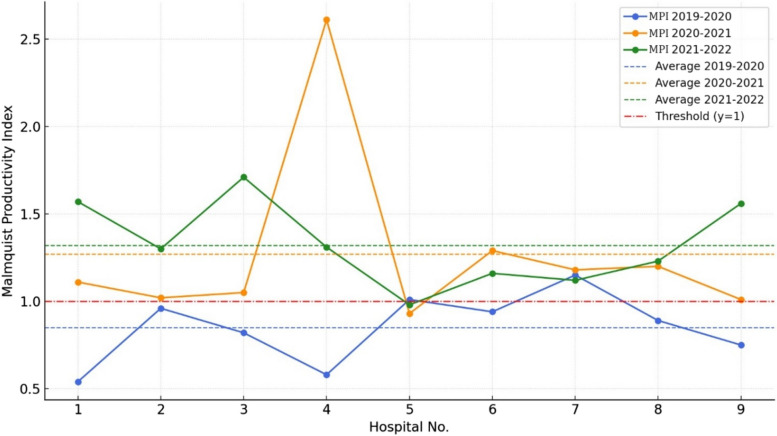
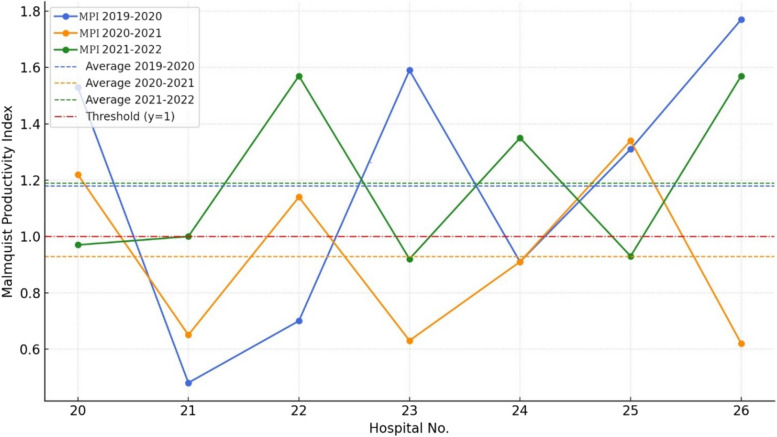
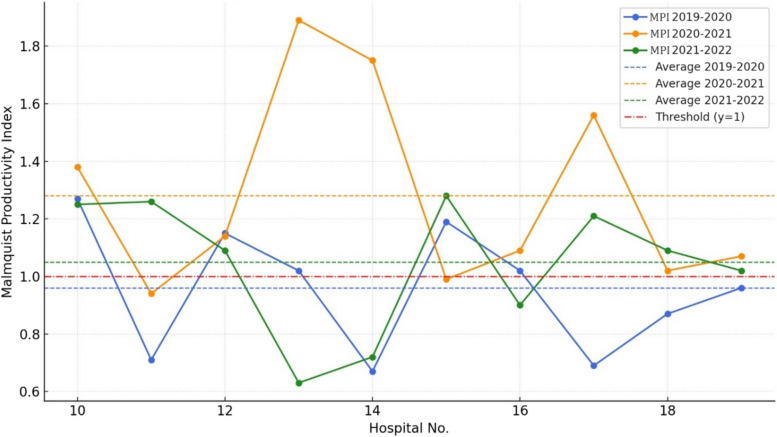
The average technical efficiency of hospitals during the four periods was 0.86, indicating an average inefficiency of 14%. Malmquist productivity index results over four periods showed hospitals operating with an average of 11% positive growth, reflecting an overall increase in productivity. Notably, some hospitals with high technical efficiency displayed lower total productivity growth rates due to fluctuations in specific indicators. On average, in the four under study years, 12 hospitals were efficient, of which 75% (9 hospitals) had performance progress (average MPI > 1). On the contrary, among the 14 inefficient hospitals during the four studied years, more than 90% of the hospitals had improved performance.
This study introduces a multidimensional and dynamic model for evaluating hospital performance. While classic DEA models provide a statistical performance evaluation, the Malmquist Productivity Index reveals dynamic performance changes over time. These findings underscore the need for hospitals to adopt advanced quantitative models to optimize resource allocation and enhance service delivery.
医院是卫生系统的重要支柱,通过适当的定量模型衡量其绩效至关重要。本研究评估了伊斯法罕医科大学附属医院的绩效。它涉及动态性的本质(评估指标随时间的绩效),考察可控、不可控和不良的投入与产出指标。
本研究使用混合数据包络分析(DEA)模型,即加法经典模型、Malmquist生产率指数(MPI)和超效率模型,从2019年至2022年评估了26家伊斯法罕医科大学医院的效率和生产率。通过专家小组头脑风暴选择了13个指标(4个投入和9个产出)作为模型变量。
四个时期医院的平均技术效率为0.86,表明平均无效率为14%。四个时期的Malmquist生产率指数结果显示,医院平均以11%的正增长运营,反映出生产率的总体提高。值得注意的是,一些技术效率高的医院由于特定指标的波动,总生产率增长率较低。在研究的四年中,平均有12家医院是有效的,其中75%(9家医院)绩效有进步(平均MPI>1)。相反,在研究的四年中14家无效率的医院中,超过90%的医院绩效有所改善。
本研究引入了一个用于评估医院绩效的多维动态模型。虽然经典DEA模型提供了统计绩效评估,但Malmquist生产率指数揭示了随时间的动态绩效变化。这些发现强调医院需要采用先进的定量模型来优化资源配置并提高服务提供水平。