• 文献检索
  • 文档翻译
  • 深度研究
  • 学术资讯
  • Suppr Zotero 插件Zotero 插件
  • 邀请有礼
  • 套餐&价格
  • 历史记录
应用&插件
Suppr Zotero 插件Zotero 插件浏览器插件Mac 客户端Windows 客户端微信小程序
定价
高级版会员购买积分包购买API积分包
服务
文献检索文档翻译深度研究API 文档MCP 服务
关于我们
关于 Suppr公司介绍联系我们用户协议隐私条款
关注我们

Suppr 超能文献

核心技术专利:CN118964589B侵权必究
粤ICP备2023148730 号-1Suppr @ 2026

文献检索

告别复杂PubMed语法,用中文像聊天一样搜索,搜遍4000万医学文献。AI智能推荐,让科研检索更轻松。

立即免费搜索

文件翻译

保留排版,准确专业,支持PDF/Word/PPT等文件格式,支持 12+语言互译。

免费翻译文档

深度研究

AI帮你快速写综述,25分钟生成高质量综述,智能提取关键信息,辅助科研写作。

立即免费体验

由丝氨酸蛋白酶抑制剂E1(SERPINE1)介导的胃癌来源外泌体中的let-7 g-5p促进巨噬细胞M2极化和胃癌进展。

Gastric cancer-derived exosomal let-7 g-5p mediated by SERPINE1 promotes macrophage M2 polarization and gastric cancer progression.

作者信息

Ye Zhenzhen, Yi Jianfeng, Jiang Xiangyan, Shi Wengui, Xu Hao, Cao Hongtai, Qin Long, Liu Lixin, Wang Tianming, Ma Zhijian, Jiao Zuoyi

机构信息

Department of General Surgery, The Second Clinical Medical School, The Second Hospital of Lanzhou University, Lanzhou University, Lanzhou, Gansu, 730000, China.

The First School of Clinical Medicine, Gansu University of Chinese Medicine, Lanzhou, Gansu, 730000, China.

出版信息

J Exp Clin Cancer Res. 2025 Jan 2;44(1):2. doi: 10.1186/s13046-024-03269-4.

DOI:10.1186/s13046-024-03269-4
PMID:39748408
原文链接:https://pmc.ncbi.nlm.nih.gov/articles/PMC11694445/
Abstract

BACKGROUND

Tumor-associated macrophages (TAMs), particularly M2-polarized TAMs, are significant contributors to tumor progression, immune evasion, and therapy resistance in gastric cancer (GC). Despite efforts to target TAM recruitment or depletion, clinical efficacy remains limited. Consequently, the identification of targets that specifically inhibit or reprogram M2-polarized TAMs presents a promising therapeutic strategy.

OBJECTIVE

This study aims to identify a dual-function target in GC cells that drives both malignant phenotypes and M2 macrophage polarization, revealing its molecular mechanisms to provide novel therapeutic targets for selectivly targeting M2-polarized TAMs in GC.

METHODS

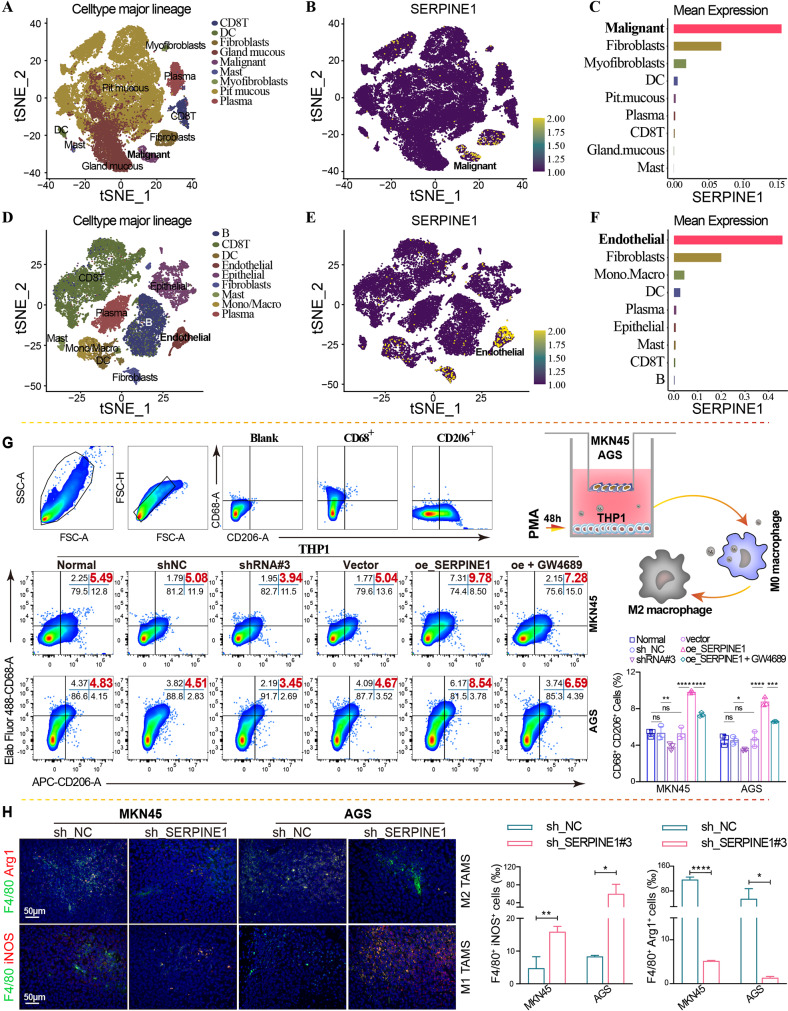
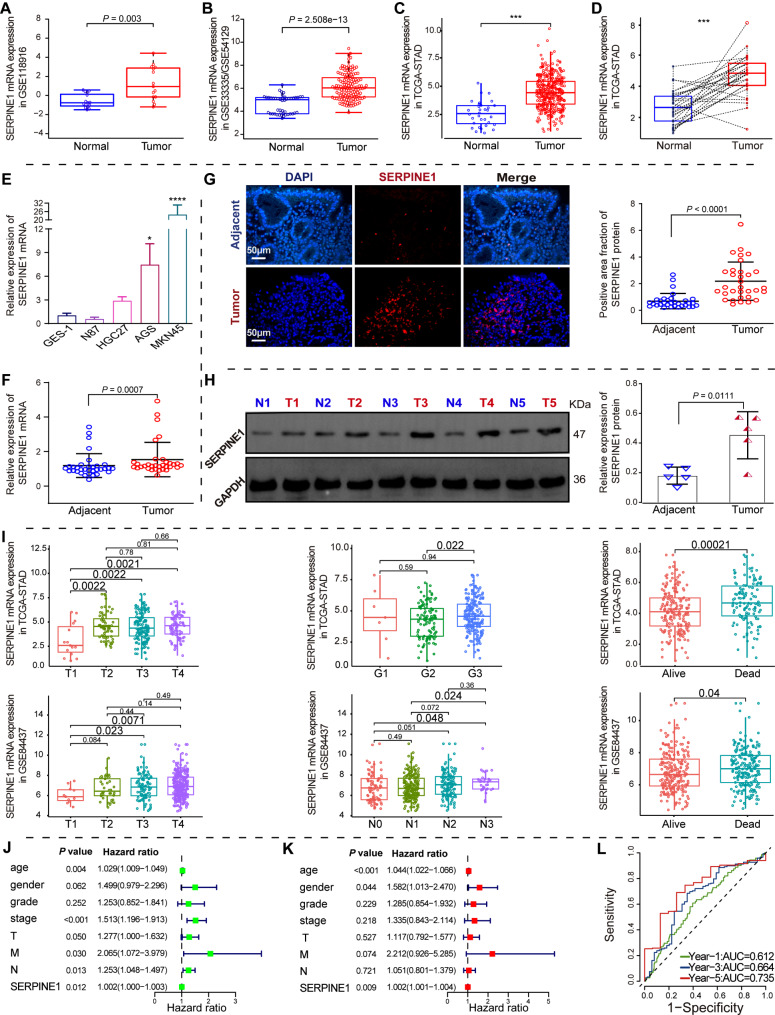
Transcriptomic and clinical data from GC and adjacent tissues were utilized to identify mRNAs associated with high M2 macrophage infiltration and poor prognosis. Single-cell sequencing elucidated cell types expressing the target gene. Transwell co-culture and exosome intervention experiments demonstrated its role in M2 polarization. Small RNA sequencing of exosomes, western blotting, and CoIP assays revealed the molecular mechanisms underlying exosome-mediated M2 polarization. Protein array, ChIP and dual-luciferase reporter assays clarified the molecular mechanisms by which the target gene regulated exosomal miRNA. In vivo validation was performed using xenograft tumor models.

RESULTS

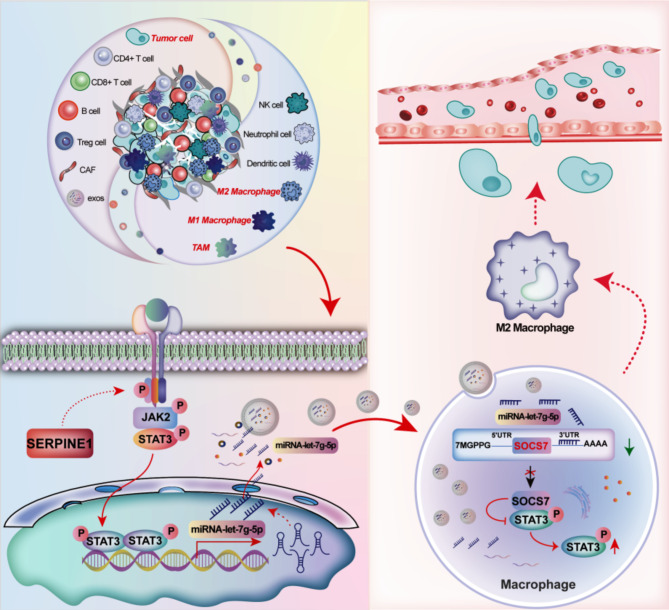
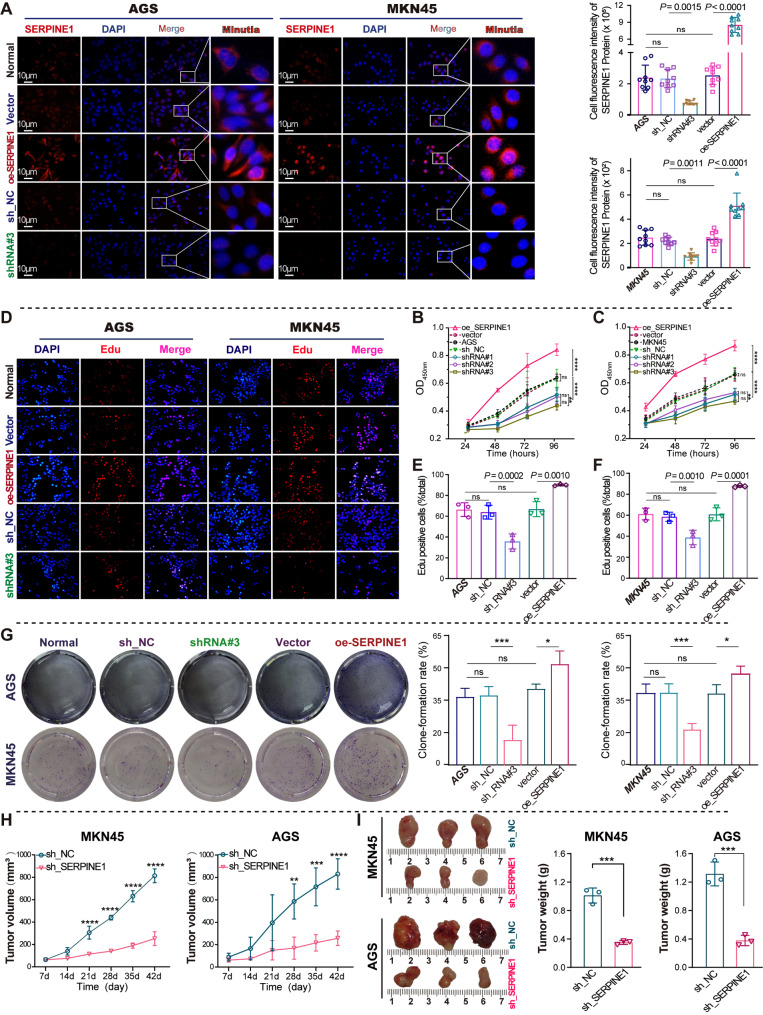
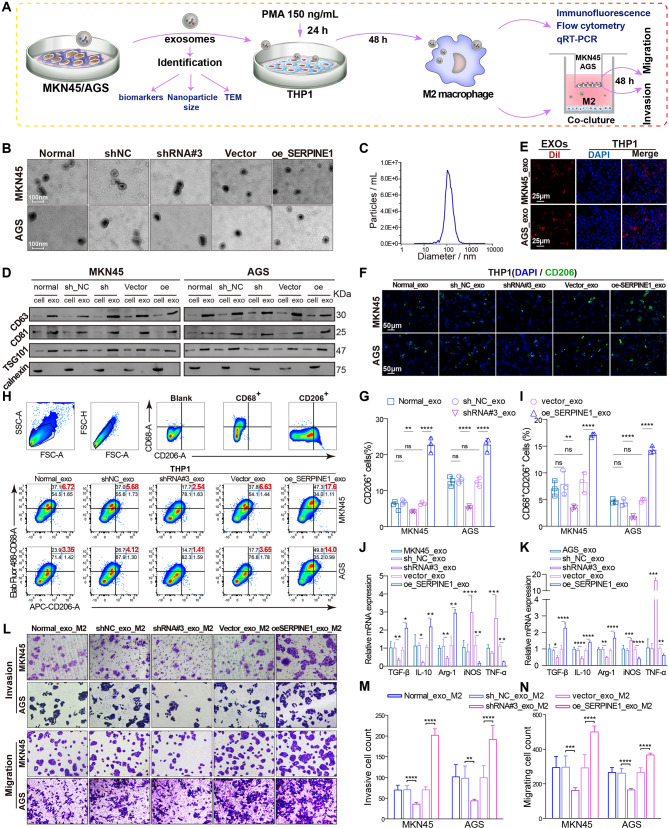
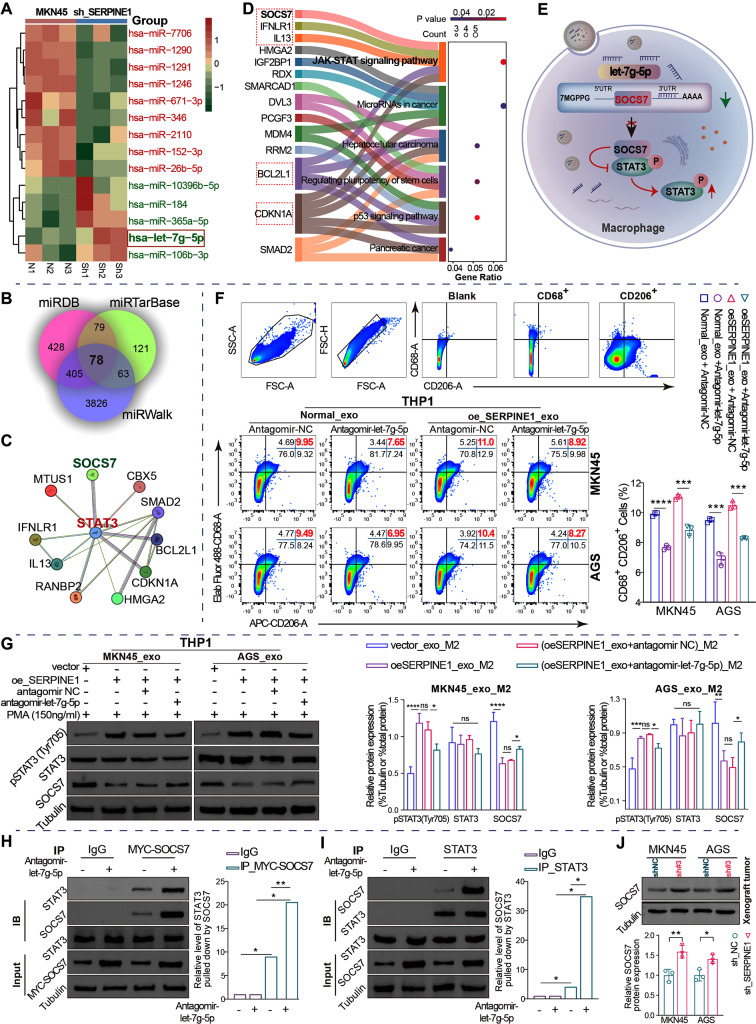
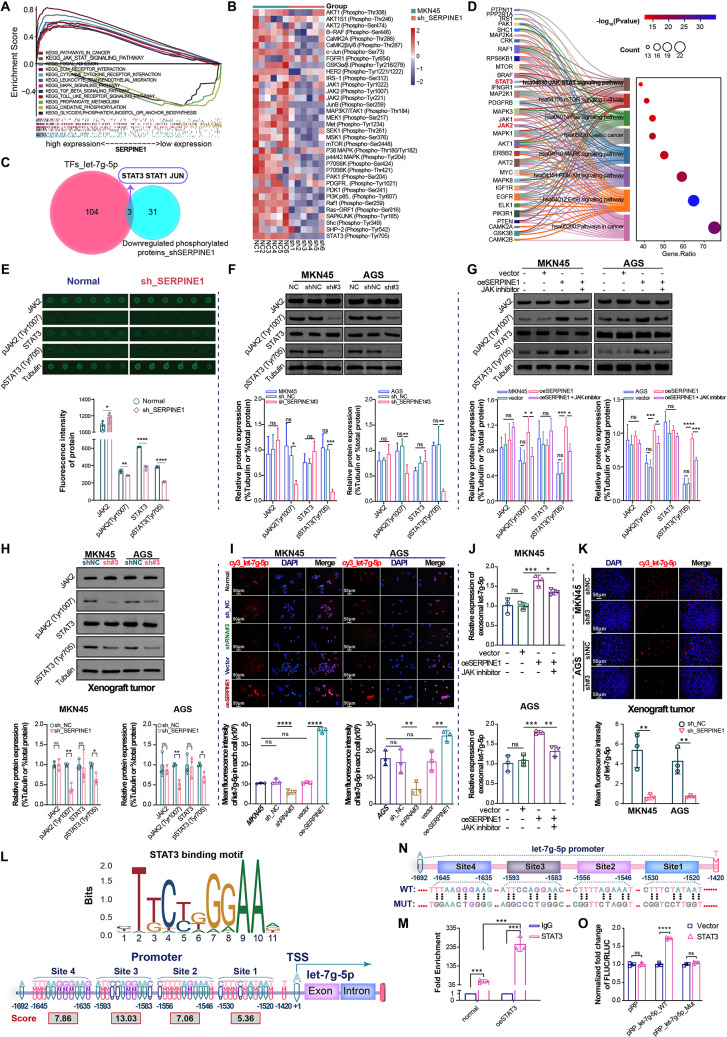
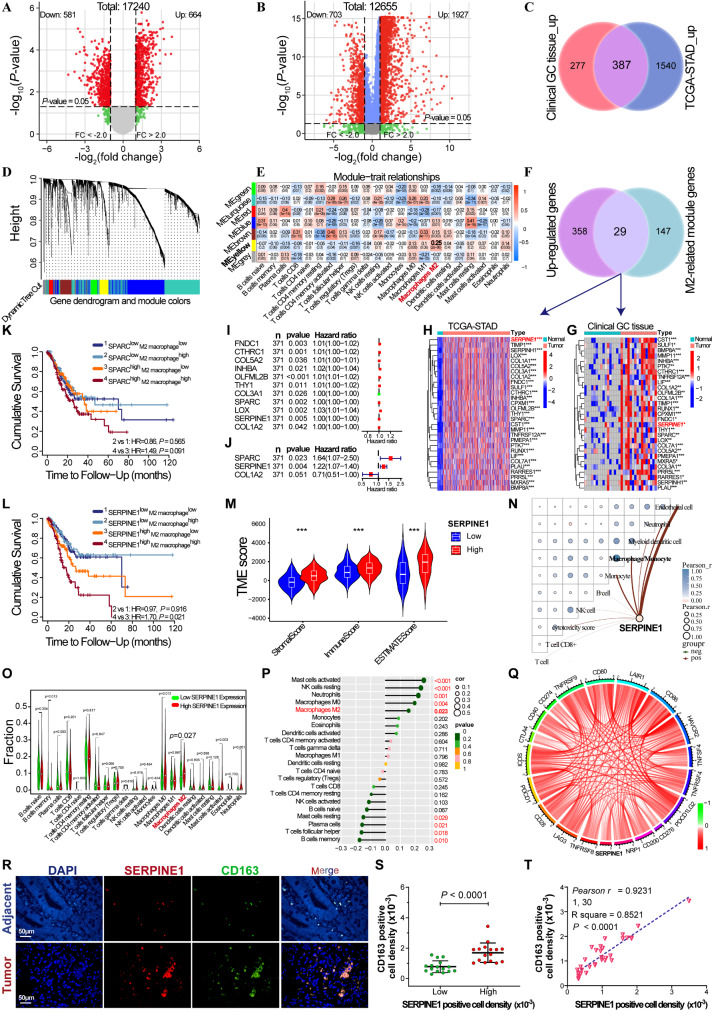
SERPINE1 was identified as a highly expressed mRNA in GC tissues and cells, significantly associated with advanced clinical stages, worse prognosis, and higher M2 macrophage infiltration in patients with GC. SERPINE1 overexpression in GC cells promoted tumor growth and M2 macrophage polarization. SERPINE1 facilitated the transfer of let-7 g-5p to macrophages via cancer-derived exosomes, inducing M2 polarization. Exosomal let-7 g-5p internalized by macrophages downregulated SOCS7 protein levels, disrupting its interaction with STAT3 and relieving the inhibition of STAT3 phosphorylation, thereby leading to STAT3 hyperactivation, which consequently drove M2 polarization. Additionally, in GC cells, elevated SERPINE1 expression activated JAK2, enhancing STAT3 binding to the let-7 g-5p promoter and promoting its transcription, thereby increasing let-7 g-5p levels in exosomes.

CONCLUSION

GC cell-derived SERPINE1, functioning as a primary driver of GC growth and TAM M2 polarization, promotes M2 polarization through the regulation of exosomal let-7 g-5p transfer via autocrine activation of the JAK2/STAT3 signaling pathway. These findings elucidate a novel mechanism of SERPINE1-induced M2 polarization and highlight SERPINE1 as a promising target for advancing immunotherapy and targeted treatments in GC.

摘要

背景

肿瘤相关巨噬细胞(TAM),尤其是M2极化的TAM,是胃癌(GC)肿瘤进展、免疫逃逸和治疗抵抗的重要促成因素。尽管人们努力靶向TAM募集或耗竭,但临床疗效仍然有限。因此,鉴定特异性抑制或重编程M2极化TAM的靶点是一种有前景的治疗策略。

目的

本研究旨在鉴定GC细胞中驱动恶性表型和M2巨噬细胞极化的双功能靶点,揭示其分子机制,为选择性靶向GC中M2极化TAM提供新的治疗靶点。

方法

利用GC及癌旁组织的转录组和临床数据来鉴定与高M2巨噬细胞浸润和不良预后相关的mRNA。单细胞测序阐明了表达靶基因的细胞类型。Transwell共培养和外泌体干预实验证明了其在M2极化中的作用。外泌体的小RNA测序、蛋白质免疫印迹和免疫共沉淀实验揭示了外泌体介导的M2极化的分子机制。蛋白质芯片、染色质免疫沉淀和双荧光素酶报告基因实验阐明了靶基因调控外泌体miRNA的分子机制。使用异种移植肿瘤模型进行体内验证。

结果

SERPINE1被鉴定为GC组织和细胞中高表达的mRNA,与GC患者的晚期临床分期、较差预后和较高的M2巨噬细胞浸润显著相关。GC细胞中SERPINE1的过表达促进肿瘤生长和M2巨噬细胞极化。SERPINE1通过癌症来源的外泌体促进let-7 g-5p向巨噬细胞的转移,诱导M2极化。巨噬细胞内化的外泌体let-7 g-5p下调SOCS7蛋白水平,破坏其与STAT3的相互作用,解除对STAT3磷酸化的抑制,从而导致STAT3过度激活,进而驱动M2极化。此外,在GC细胞中,SERPINE1表达升高激活JAK2,增强STAT3与let-7 g-5p启动子的结合并促进其转录,从而增加外泌体中let-7 g-5p的水平。

结论

GC细胞来源的SERPINE1作为GC生长和TAM M2极化的主要驱动因子,通过JAK2/STAT3信号通路的自分泌激活调节外泌体let-7 g-5p转移,从而促进M2极化。这些发现阐明了SERPINE1诱导M2极化的新机制,并突出了SERPINE1作为推进GC免疫治疗和靶向治疗的有前景靶点。
https://cdn.ncbi.nlm.nih.gov/pmc/blobs/1b78/11694445/8a682e835ffb/13046_2024_3269_Fig8_HTML.jpg
https://cdn.ncbi.nlm.nih.gov/pmc/blobs/1b78/11694445/f4833736d715/13046_2024_3269_Fig1_HTML.jpg
https://cdn.ncbi.nlm.nih.gov/pmc/blobs/1b78/11694445/99950a346881/13046_2024_3269_Fig2_HTML.jpg
https://cdn.ncbi.nlm.nih.gov/pmc/blobs/1b78/11694445/7d501d3ed6c7/13046_2024_3269_Fig3_HTML.jpg
https://cdn.ncbi.nlm.nih.gov/pmc/blobs/1b78/11694445/9c99b4ec9165/13046_2024_3269_Fig4_HTML.jpg
https://cdn.ncbi.nlm.nih.gov/pmc/blobs/1b78/11694445/a811ef81526f/13046_2024_3269_Fig5_HTML.jpg
https://cdn.ncbi.nlm.nih.gov/pmc/blobs/1b78/11694445/0f57c2fa2be7/13046_2024_3269_Fig6_HTML.jpg
https://cdn.ncbi.nlm.nih.gov/pmc/blobs/1b78/11694445/f2f2b597561a/13046_2024_3269_Fig7_HTML.jpg
https://cdn.ncbi.nlm.nih.gov/pmc/blobs/1b78/11694445/8a682e835ffb/13046_2024_3269_Fig8_HTML.jpg
https://cdn.ncbi.nlm.nih.gov/pmc/blobs/1b78/11694445/f4833736d715/13046_2024_3269_Fig1_HTML.jpg
https://cdn.ncbi.nlm.nih.gov/pmc/blobs/1b78/11694445/99950a346881/13046_2024_3269_Fig2_HTML.jpg
https://cdn.ncbi.nlm.nih.gov/pmc/blobs/1b78/11694445/7d501d3ed6c7/13046_2024_3269_Fig3_HTML.jpg
https://cdn.ncbi.nlm.nih.gov/pmc/blobs/1b78/11694445/9c99b4ec9165/13046_2024_3269_Fig4_HTML.jpg
https://cdn.ncbi.nlm.nih.gov/pmc/blobs/1b78/11694445/a811ef81526f/13046_2024_3269_Fig5_HTML.jpg
https://cdn.ncbi.nlm.nih.gov/pmc/blobs/1b78/11694445/0f57c2fa2be7/13046_2024_3269_Fig6_HTML.jpg
https://cdn.ncbi.nlm.nih.gov/pmc/blobs/1b78/11694445/f2f2b597561a/13046_2024_3269_Fig7_HTML.jpg
https://cdn.ncbi.nlm.nih.gov/pmc/blobs/1b78/11694445/8a682e835ffb/13046_2024_3269_Fig8_HTML.jpg

相似文献

1
Gastric cancer-derived exosomal let-7 g-5p mediated by SERPINE1 promotes macrophage M2 polarization and gastric cancer progression.由丝氨酸蛋白酶抑制剂E1(SERPINE1)介导的胃癌来源外泌体中的let-7 g-5p促进巨噬细胞M2极化和胃癌进展。
J Exp Clin Cancer Res. 2025 Jan 2;44(1):2. doi: 10.1186/s13046-024-03269-4.
2
EGCG targeting STAT3 transcriptionally represses PLXNC1 to inhibit M2 polarization mediated by gastric cancer cell-derived exosomal miR-92b-5p.EGCG 通过靶向 STAT3 转录抑制 PLXNC1,从而抑制胃癌细胞来源的外泌体 miR-92b-5p 介导的 M2 极化。
Phytomedicine. 2024 Dec;135:156137. doi: 10.1016/j.phymed.2024.156137. Epub 2024 Oct 19.
3
Gastric cancer cell-derived exosomal miR-541-5p induces M2 macrophage polarization through DUSP3/JAK2/STAT3 pathway.胃癌细胞来源的外泌体 miR-541-5p 通过 DUSP3/JAK2/STAT3 通路诱导 M2 巨噬细胞极化。
BMC Cancer. 2024 Aug 6;24(1):957. doi: 10.1186/s12885-024-12672-1.
4
miRNA-221-3p derived from M2-polarized tumor-associated macrophage exosomes aggravates the growth and metastasis of osteosarcoma through SOCS3/JAK2/STAT3 axis.M2 极化肿瘤相关巨噬细胞来源的 exosomes 中的 miRNA-221-3p 通过 SOCS3/JAK2/STAT3 轴加重骨肉瘤的生长和转移。
Aging (Albany NY). 2021 Aug 13;13(15):19760-19775. doi: 10.18632/aging.203388.
5
Exosomal transfer of tumor-associated macrophage-derived miR-21 confers cisplatin resistance in gastric cancer cells.肿瘤相关巨噬细胞衍生的miR-21通过外泌体转移赋予胃癌细胞顺铂耐药性。
J Exp Clin Cancer Res. 2017 Apr 13;36(1):53. doi: 10.1186/s13046-017-0528-y.
6
Exosome-mediated transfer of lncRNA HCG18 promotes M2 macrophage polarization in gastric cancer.外泌体介导的 lncRNAHCG18 转移促进胃癌中 M2 巨噬细胞的极化。
Mol Immunol. 2021 Dec;140:196-205. doi: 10.1016/j.molimm.2021.10.011. Epub 2021 Oct 29.
7
M2 Tumor-Associated Macrophages-Derived Exosomal MALAT1 Promotes Glycolysis and Gastric Cancer Progression.M2 肿瘤相关巨噬细胞衍生的外泌体 MALAT1 促进糖酵解和胃癌进展。
Adv Sci (Weinh). 2024 Jun;11(24):e2309298. doi: 10.1002/advs.202309298. Epub 2024 Apr 19.
8
Gastric cancer-derived exosomal miR-519a-3p promotes liver metastasis by inducing intrahepatic M2-like macrophage-mediated angiogenesis.胃癌衍生的外泌体 miR-519a-3p 通过诱导肝内 M2 样巨噬细胞介导的血管生成促进肝转移。
J Exp Clin Cancer Res. 2022 Oct 10;41(1):296. doi: 10.1186/s13046-022-02499-8.
9
Exosomal miR-106a-5p from highly metastatic colorectal cancer cells drives liver metastasis by inducing macrophage M2 polarization in the tumor microenvironment.高转移性结直肠癌细胞来源的外泌体 miR-106a-5p 通过诱导肿瘤微环境中巨噬细胞 M2 极化促进肝转移。
J Exp Clin Cancer Res. 2024 Oct 9;43(1):281. doi: 10.1186/s13046-024-03204-7.
10
Cancer-derived exosomal miR-138-5p modulates polarization of tumor-associated macrophages through inhibition of KDM6B.肿瘤来源的外泌体 miR-138-5p 通过抑制 KDM6B 来调节肿瘤相关巨噬细胞的极化。
Theranostics. 2021 May 3;11(14):6847-6859. doi: 10.7150/thno.51864. eCollection 2021.

引用本文的文献

1
The recent progress of tumor cell-derived exosomes in the pathogenesis, diagnosis and therapeutic strategies of tumors.肿瘤细胞衍生外泌体在肿瘤发病机制、诊断及治疗策略方面的最新进展
J Transl Med. 2025 Aug 18;23(1):925. doi: 10.1186/s12967-025-06883-8.
2
Recent progress in the study of exosomes in the gastric cancer immune microenvironment.胃癌免疫微环境中细胞外囊泡研究的最新进展
Front Immunol. 2025 Jul 23;16:1595124. doi: 10.3389/fimmu.2025.1595124. eCollection 2025.
3
Single-cell RNA sequencing reveals altered immune and stromal landscape in primary and liver metastasis of gastric cancer.

本文引用的文献

1
EGCG targeting STAT3 transcriptionally represses PLXNC1 to inhibit M2 polarization mediated by gastric cancer cell-derived exosomal miR-92b-5p.EGCG 通过靶向 STAT3 转录抑制 PLXNC1,从而抑制胃癌细胞来源的外泌体 miR-92b-5p 介导的 M2 极化。
Phytomedicine. 2024 Dec;135:156137. doi: 10.1016/j.phymed.2024.156137. Epub 2024 Oct 19.
2
Upregulation of MELK promotes chemoresistance and induces macrophage M2 polarization via CSF-1/JAK2/STAT3 pathway in gastric cancer.MELK的上调通过CSF-1/JAK2/STAT3途径促进胃癌的化疗耐药并诱导巨噬细胞M2极化。
Cancer Cell Int. 2024 Aug 12;24(1):287. doi: 10.1186/s12935-024-03453-8.
3
单细胞RNA测序揭示了胃癌原发性和肝转移中免疫和基质景观的改变。
Biochem Biophys Rep. 2025 Jul 18;43:102163. doi: 10.1016/j.bbrep.2025.102163. eCollection 2025 Sep.
4
NFATC2/SERPINE1/JAK3/STAT3 signaling feedback loop in gastric cancer: immune evasion and anti-PD-1 resistance.胃癌中NFATC2/SERPINE1/JAK3/STAT3信号反馈回路:免疫逃逸与抗PD-1耐药性
Cell Biol Toxicol. 2025 Jun 13;41(1):102. doi: 10.1007/s10565-025-10050-6.
5
Tumor immune evasion and the Let-7 family: insights into mechanisms and therapies.肿瘤免疫逃逸与Let-7家族:机制与治疗的见解
Naunyn Schmiedebergs Arch Pharmacol. 2025 May 27. doi: 10.1007/s00210-025-04283-9.
6
Reprogramming tumor-associated macrophages in gastric cancer: a pathway to enhanced immunotherapy.重编程胃癌中的肿瘤相关巨噬细胞:增强免疫治疗的途径
Front Immunol. 2025 Mar 3;16:1558091. doi: 10.3389/fimmu.2025.1558091. eCollection 2025.
7
Prospect of extracellular vesicles in tumor immunotherapy.细胞外囊泡在肿瘤免疫治疗中的前景。
Front Immunol. 2025 Feb 26;16:1525052. doi: 10.3389/fimmu.2025.1525052. eCollection 2025.
8
Exosomal SphK1 from colorectal cancer cells promotes cancer cell migration and activates hepatic stellate cells.结直肠癌细胞来源的外泌体鞘氨醇激酶1促进癌细胞迁移并激活肝星状细胞。
Mol Med Rep. 2025 Mar;31(3). doi: 10.3892/mmr.2025.13438. Epub 2025 Jan 24.
Tumor-Secreted Extracellular Vesicles Counteract Therapy Response by Triggering Inflammatory Mesenchymal Stem Cell Development.
肿瘤分泌的细胞外囊泡通过触发炎症性间充质干细胞的发展来对抗治疗反应。
Clin Cancer Res. 2024 Oct 15;30(20):4714-4728. doi: 10.1158/1078-0432.CCR-23-4097.
4
Gastric cancer cell-derived exosomal miR-541-5p induces M2 macrophage polarization through DUSP3/JAK2/STAT3 pathway.胃癌细胞来源的外泌体 miR-541-5p 通过 DUSP3/JAK2/STAT3 通路诱导 M2 巨噬细胞极化。
BMC Cancer. 2024 Aug 6;24(1):957. doi: 10.1186/s12885-024-12672-1.
5
Pan-cancer analysis of SERPINE1 with a concentration on immune therapeutic and prognostic in gastric cancer.SERPINE1在胃癌中的泛癌分析:聚焦免疫治疗与预后
J Cell Mol Med. 2024 Aug;28(15):e18579. doi: 10.1111/jcmm.18579.
6
Cancer Cell Secreted Legumain Promotes Gastric Cancer Resistance to Anti-PD-1 Immunotherapy by Enhancing Macrophage M2 Polarization.癌细胞分泌的天冬酰胺酶通过增强巨噬细胞M2极化促进胃癌对抗PD-1免疫疗法的抗性。
Pharmaceuticals (Basel). 2024 Jul 16;17(7):951. doi: 10.3390/ph17070951.
7
LDHA-mediated M2-type macrophage polarization via tumor-derived exosomal EPHA2 promotes renal cell carcinoma progression.LDHA 通过肿瘤来源的外泌体 EphA2 介导 M2 型巨噬细胞极化促进肾细胞癌进展。
Mol Carcinog. 2024 Aug;63(8):1486-1499. doi: 10.1002/mc.23737. Epub 2024 May 23.
8
Exosome circATP8A1 induces macrophage M2 polarization by regulating the miR-1-3p/STAT6 axis to promote gastric cancer progression.外泌体 circATP8A1 通过调控 miR-1-3p/STAT6 轴诱导巨噬细胞 M2 极化促进胃癌进展。
Mol Cancer. 2024 Mar 8;23(1):49. doi: 10.1186/s12943-024-01966-4.
9
miR-345-3p Modulates M1/M2 Macrophage Polarization to Inhibit Inflammation in Bone Infection via Targeting MAP3K1 and NF-κB Pathway.miR-345-3p 通过靶向 MAP3K1 和 NF-κB 通路调节 M1/M2 巨噬细胞极化抑制骨感染炎症。
J Immunol. 2024 Mar 1;212(5):844-854. doi: 10.4049/jimmunol.2300561.
10
HMGB1 in exosomes derived from gastric cancer cells induces M2-like macrophage polarization by inhibiting the NF-κB signaling pathway.外泌体来源的 HMGB1 通过抑制 NF-κB 信号通路诱导胃癌细胞 M2 样巨噬细胞极化。
Cell Biol Int. 2024 Mar;48(3):334-346. doi: 10.1002/cbin.12110. Epub 2023 Dec 17.