Chen Zhongyan, Bi Qingling, Lv Yong, Liu Yang, Tian Yuanyuan, Liu Jianfeng, Yang Wenjing, Zhou Yukun, Huang Weiluo, Li Yuan
Department of Otolaryngology, China-Japan Friendship Hospital, Beijing, China.
Department of Otorhinolaryngology Head and Neck Surgery, Children's Hospital, Capital Institute of Pediatrics, Beijing, China.
Eur Arch Otorhinolaryngol. 2025 Jun;282(6):3005-3017. doi: 10.1007/s00405-024-09185-9. Epub 2025 Jan 3.
This study examined the relationships between electrophysiological measures of the electrically evoked auditory brainstem response (EABR) with speech perception measured in quiet after cochlear implantation (CI) to identify the ability of EABR to predict postoperative CI outcomes.
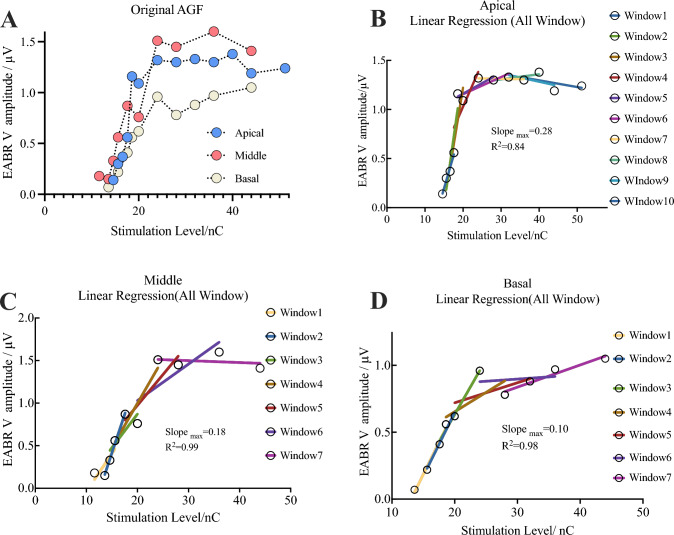
Thirty-four patients with congenital prelingual hearing loss, implanted with the same manufacturer's CI, were recruited. In each participant, the EABR was evoked at apical, middle, and basal electrode locations. The following EABR measures were analyzed: wave III and V input/output (I/O) function, latency, threshold, threshold and Gibson scoring. Patients' speech perception abilities were assessed using the Mandarin Speech Perception (MSP) materials presented in quiet. The Categories of Auditory Performance (CAP) and Speech Intelligibility Rating (SIR) were also used to assess CI outcomes. A regression model was developed to explore the relationship between EABR and each speech measure, to identify parameters with significant predictive ability.
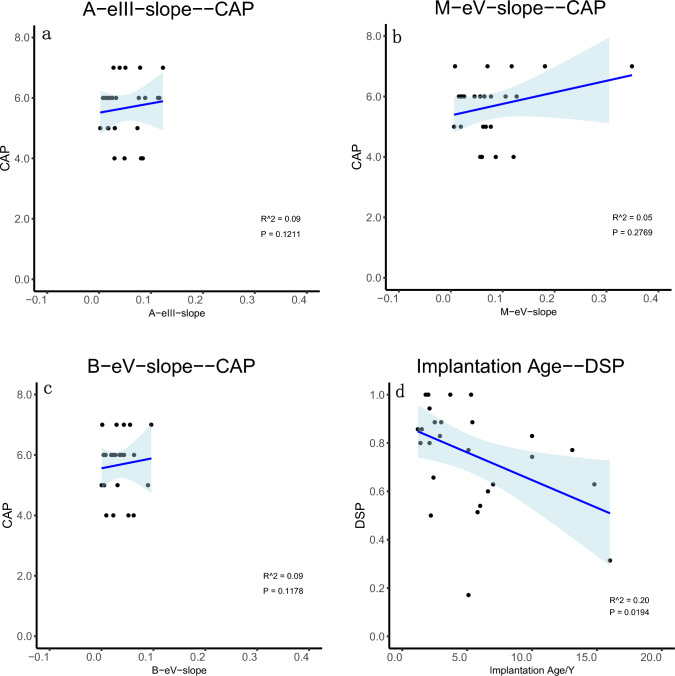
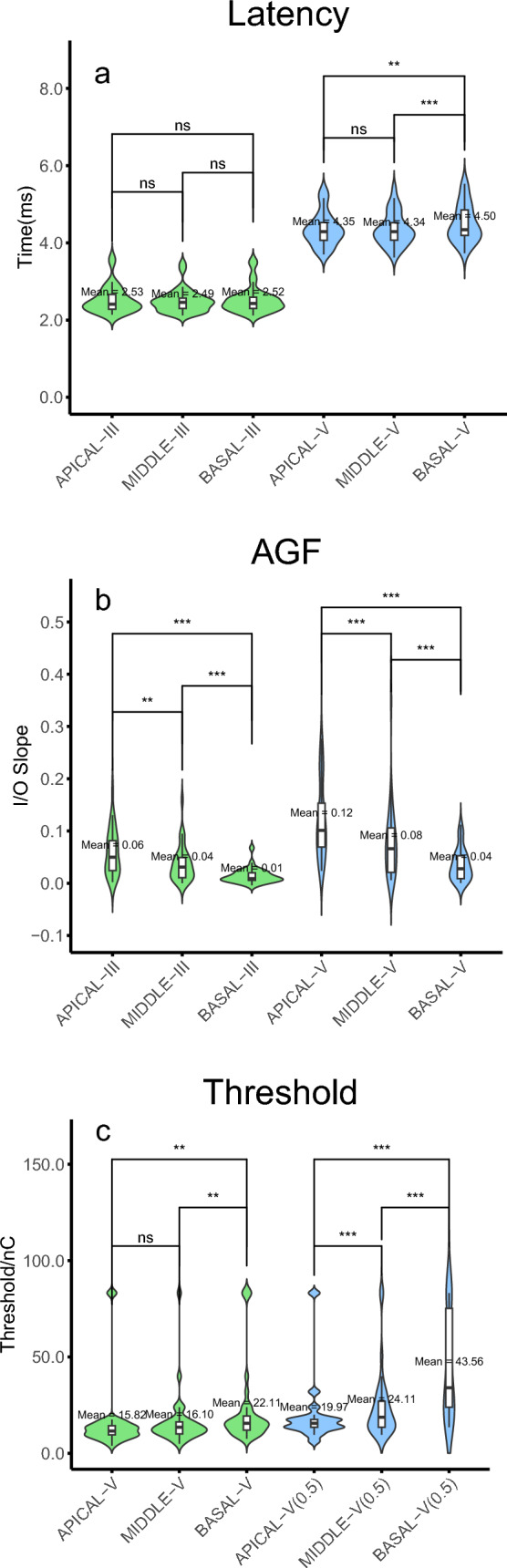
A significantly shorter eV latency, lower eV threshold, lower eV threshold and steeper I/O slopes for both eV and eIII were observed when these responses were evoked at the apical electrode, compared to the middle and basal positions. Implantation age was significantly negatively correlated with bisyllables recognition rate (R = 0.20, p = 0.0194). The eIII slope at the apical site and the eV slope at the basal site demonstrated the highest R2 values in positive correlation with CAP, both with R = 0.09. Among the EABR parameters, the regression models based on MSP bisyllables recognition rate, basal eV latency, eV thresholds and threshold recorded at the apical and middle positions were statistically significant.
Our study identified an apex-to-base gradient in EABR responsiveness following prolonged CI use. The threshold and I/O slopes of EABR appear to be informative predictors of speech perception performance in CI users, especially in the low-to-middle frequency range. However, further validation is needed.
本研究探讨人工耳蜗植入(CI)后在安静环境下测量的电诱发听觉脑干反应(EABR)的电生理指标与言语感知之间的关系,以确定EABR预测CI术后结果的能力。
招募了34例先天性语前聋患者,他们均植入了同一厂家的CI。在每个受试者中,分别在电极的顶部、中部和底部位置诱发EABR。分析了以下EABR指标:波III和波V的输入/输出(I/O)功能、潜伏期、阈值、阈值及吉布森评分。使用安静环境下呈现的普通话言语感知(MSP)材料评估患者的言语感知能力。听觉表现类别(CAP)和言语可懂度评分(SIR)也用于评估CI结果。建立回归模型以探索EABR与各项言语指标之间的关系,确定具有显著预测能力的参数。
与中部和底部位置相比,当在顶部电极诱发这些反应时,观察到eV潜伏期显著缩短、eV阈值降低、eV和eIII的阈值降低且I/O斜率更陡。植入年龄与双音节识别率显著负相关(R = 0.20,p = 0.0194)。顶部位置的eIII斜率和底部位置的eV斜率与CAP呈正相关,R²值最高,均为R = 0.09。在EABR参数中,基于MSP双音节识别率、底部eV潜伏期、eV阈值以及顶部和中部位置记录的阈值建立的回归模型具有统计学意义。
我们的研究发现,长期使用CI后EABR反应性存在从顶部到底部的梯度变化。EABR的阈值和I/O斜率似乎是CI使用者言语感知表现的有效预测指标,尤其是在中低频范围内。然而,还需要进一步验证。