Jin Changyu, Lu Zehong, Chen Yuzhan, Hu Huijie, Zhou Miao, Zhang Yanli, Ouyang Guifang, Li Tongyu, Sheng Lixia
Department of Hematology, The First Affiliated Hospital of Ningbo University, No.59 Liu-Ting Road, Ningbo, 315000, People's Republic of China.
Discov Oncol. 2025 Jan 3;16(1):2. doi: 10.1007/s12672-024-01699-2.
Chronic lymphocytic leukemia (CLL) is a common hematologic malignancy. Although previous research has explored associations between plasma proteins and CLL, the causal relationships remain unclear. This study used Mendelian randomization (MR) to investigate the causal relationship between 7156 plasma proteins and CLL risk.
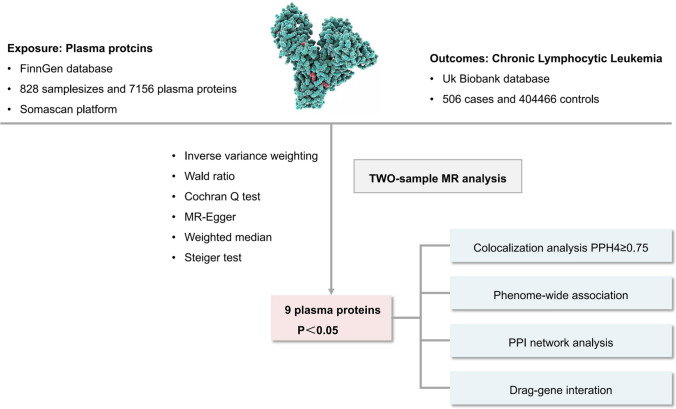
A two-sample MR analysis assessed the impact of specific plasma proteins on CLL risk, using data from the Finngen Proteomics project (analyzing 828 participants) and the UK Biobank. Additional analyses included colocalization, phenomenon-wide MR, and protein-protein interaction networks.
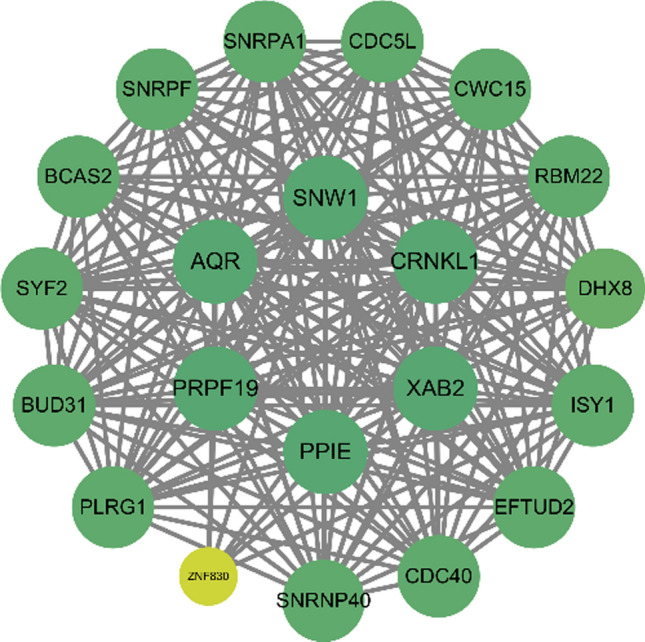
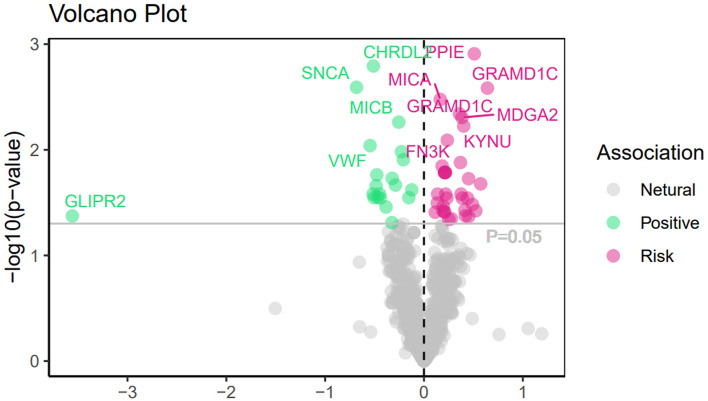
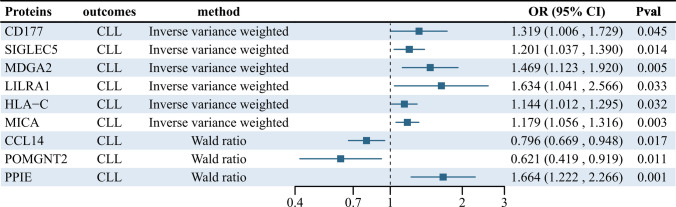
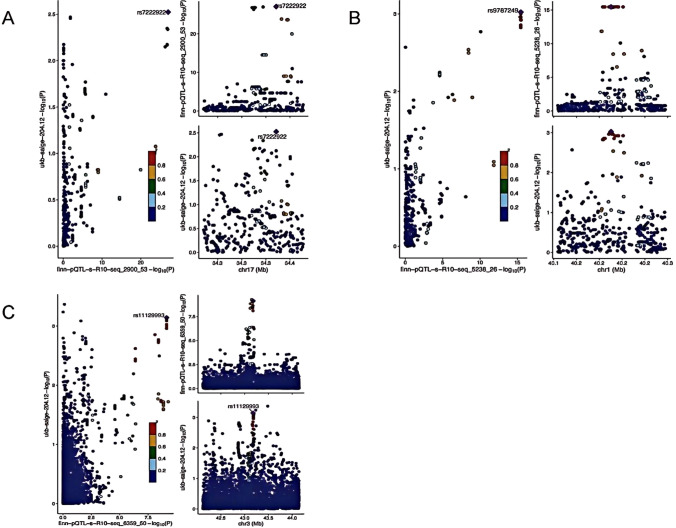
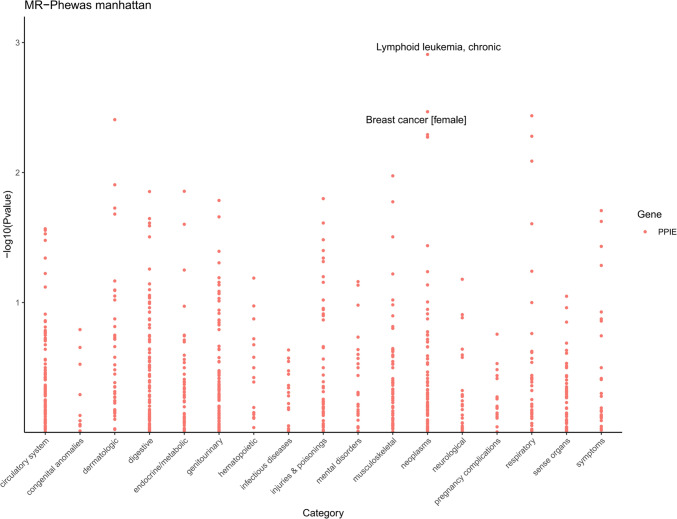
The study identified nine plasma proteins significantly associated with CLL risk. Increased levels of Peptidyl-prolyl cis-trans isomerase E (PPIE) (OR = 1.66, 95% CI 1.22-2.27, P = 0.001) were associated with an increased risk of developing CLL, whereas Protein O-Mannosyltransferase 2 (POMGNT2) (OR = 0.62, 95% CI 0.41-0.91, P = 0.017) and C-C Motif Chemokine Ligand 14(CCL14) (OR = 0.80, 95% CI 0.67-0.94, P = 0.010) were associated with a reduced risk of CLL. Colocalization analysis suggested that PPIE may share pathogenic variants with CLL (PP.H4 = 0.758). Phenomenon-wide MR analysis of PPIE also indicated associations with other clinical features, including rheumatic diseases and type 2 diabetes. Protein-protein interaction and drug-gene interaction analyses highlighted CDC5L and SNW1 as potential therapeutic targets.
This study identifies nine plasma proteins linked to CLL risk, with PPIE offering new insights into the disease's pathogenesis. Further research is needed to validate these findings and explore their potential as therapeutic targets.
慢性淋巴细胞白血病(CLL)是一种常见的血液系统恶性肿瘤。尽管先前的研究已经探讨了血浆蛋白与CLL之间的关联,但其因果关系仍不明确。本研究采用孟德尔随机化(MR)方法来研究7156种血浆蛋白与CLL风险之间的因果关系。
采用两样本MR分析评估特定血浆蛋白对CLL风险的影响,使用来自芬兰基因组蛋白质组学项目(分析828名参与者)和英国生物银行的数据。额外的分析包括共定位、全现象MR和蛋白质-蛋白质相互作用网络。
该研究确定了9种与CLL风险显著相关的血浆蛋白。肽基脯氨酰顺反异构酶E(PPIE)水平升高(OR = 1.66,95%CI 1.22 - 2.27,P = 0.001)与患CLL的风险增加相关,而蛋白O-甘露糖基转移酶2(POMGNT2)(OR = 0.62,95%CI 0.41 - 0.91,P = 0.017)和C-C基序趋化因子配体14(CCL14)(OR = 0.80,95%CI 0.67 - 0.94,P = 0.010)与CLL风险降低相关。共定位分析表明PPIE可能与CLL共享致病变异(PP.H4 = 0.758)。对PPIE的全现象MR分析还表明其与其他临床特征相关,包括风湿性疾病和2型糖尿病。蛋白质-蛋白质相互作用和药物-基因相互作用分析突出了细胞分裂周期蛋白5样蛋白(CDC5L)和SWI/SNF相关、基质相关、肌动蛋白依赖的调节因子1(SNW1)作为潜在的治疗靶点。
本研究确定了9种与CLL风险相关的血浆蛋白,PPIE为该疾病的发病机制提供了新的见解。需要进一步研究来验证这些发现并探索它们作为治疗靶点的潜力。