de Oliveira Whitaker Carolina, de Oliveira Tamara Lopes Rocha, Ferreira Adriana Lúcia Pires, Nouér Simone Aranha, Chamon Raiane Cardoso, Dos Santos Kátia Regina Netto
Departamento de Microbiologia Médica, Instituto de Microbiologia Paulo de Góes, Universidade Federal do Rio de Janeiro, Rio de Janeiro, 21951-902, Brazil.
Departamento de Doenças Infecciosas e Parasitárias, Hospital Universitário Clementino Fraga Filho, Universidade Federal do Rio de Janeiro, Rio de Janeiro, 21951-913, Brazil.
Sci Rep. 2025 Jan 2;15(1):597. doi: 10.1038/s41598-024-84307-1.
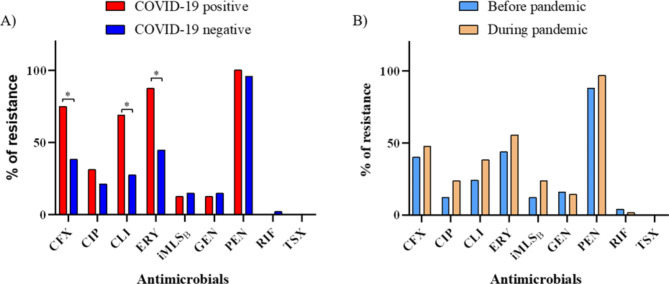
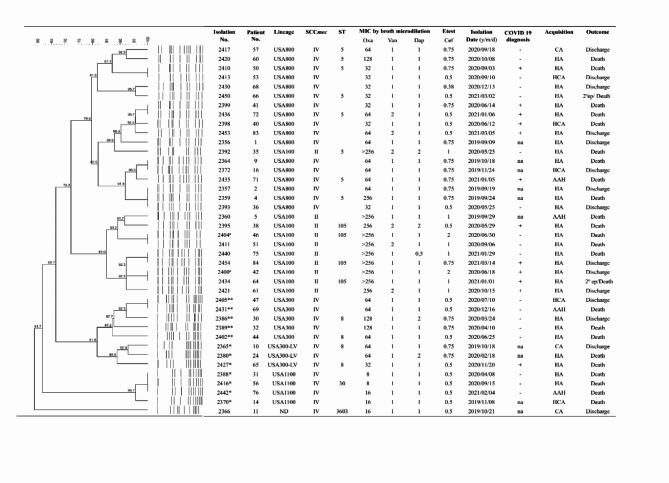
Staphylococcus aureus is a relevant pathogen in bloodstream infections (BSI), and the emergency of the COVID-19 pandemic increased its antimicrobial resistance. S. aureus isolates from BSI (September/2019 - March/2021) were analyzed phenotypically and molecularly, in addition to the clinical features of the patients. Of 88 S. aureus isolates recovered from 85 patients, 25 were isolated before the pandemic and 63 during it, and 16 were from patients with COVID-19. A rate of 45.5% of methicillin-resistant isolates (MRSA) were found, and 5% of them were ceftaroline susceptible dose-dependent. Daptomycin non-susceptibility was observed in 9.1% of isolates. The USA800/ST5/SCCmecIV lineage was prevalent among MRSA isolates (41.8%). Besides, 30.2% of the isolates were associated with community-associated MRSA (CA-MRSA) genotypes. There was a significant impact on the resistance rates for cefoxitin, clindamycin and erythromycin among S. aureus isolates from BSI in COVID-19 patients and association with the previous use of azithromycin by them (p < 0.05). A clonal alternation and an increase in the emergence of CA-MRSA lineages were also found, highlighting the importance of constant microbiological surveillance.
金黄色葡萄球菌是血流感染(BSI)中的一种重要病原体,而新冠疫情的出现增加了其耐药性。除了分析患者的临床特征外,还对从BSI中分离出的金黄色葡萄球菌(2019年9月至2021年3月)进行了表型和分子分析。从85名患者中分离出88株金黄色葡萄球菌,其中25株在疫情前分离得到,63株在疫情期间分离得到,16株来自新冠患者。发现耐甲氧西林菌株(MRSA)的比例为45.5%,其中5%对头孢洛林敏感呈剂量依赖性。在9.1%的分离株中观察到对达托霉素不敏感。USA800/ST5/SCCmecIV谱系在MRSA分离株中占主导地位(41.8%)。此外,30.2%的分离株与社区获得性MRSA(CA-MRSA)基因型相关。新冠患者BSI中金黄色葡萄球菌分离株对头孢西丁、克林霉素和红霉素的耐药率受到显著影响,且与他们之前使用阿奇霉素有关(p < 0.05)。还发现了克隆更替以及CA-MRSA谱系出现增加的情况,突出了持续进行微生物监测的重要性。