Lin Josephine, Zhang Jinli, Ma Li, Fang He, Ma Rui, Groneck Camille, Filippova Galina N, Deng Xinxian, Kinoshita Chizuru, Young Jessica E, Ma Wenxiu, Disteche Christine M, Berletch Joel B
Department of Laboratory Medicine and Pathology, School of Medicine, University of Washington, Seattle, WA, 98195, USA.
Department of Statistics, University of California Riverside, Riverside, CA, 92521, USA.
Biol Sex Differ. 2025 Jan 3;16(1):1. doi: 10.1186/s13293-024-00683-3.
X chromosome inactivation (XCI) is a female-specific process in which one X chromosome is silenced to balance X-linked gene expression between the sexes. XCI is initiated in early development by upregulation of the lncRNA Xist on the future inactive X (Xi). A subset of X-linked genes escape silencing and thus have higher expression in females, suggesting female-specific functions. One of these genes is the highly conserved gene Kdm6a, which encodes a histone demethylase that removes methyl groups at H3K27 to facilitate gene expression. KDM6A mutations have been implicated in congenital disorders such as Kabuki Syndrome, as well as in sex differences in development and cancer.
Kdm6a was knocked out (KO) using CRISPR/Cas9 gene editing in hybrid female mouse embryonic stem (ES) cells derived either from a 129 × Mus castaneus (cast) cross or a BL6 x cast cross. In one of the lines a transcriptional stop signal inserted in Tsix results in completely skewed X silencing upon differentiation. The effects of both homozygous and heterozygous Kdm6a KO on Xist expression during the onset of XCI were measured by RT-PCR and RNA-FISH. Changes in gene expression and in H3K27me3 enrichment were investigated using allele-specific RNA-seq and Cut&Run, respectively. KDM6A binding to the Xist gene was characterized by Cut&Run.
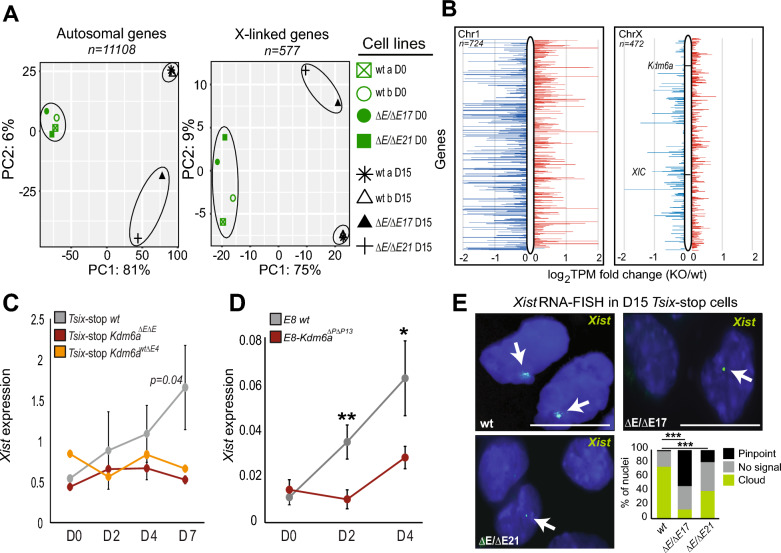
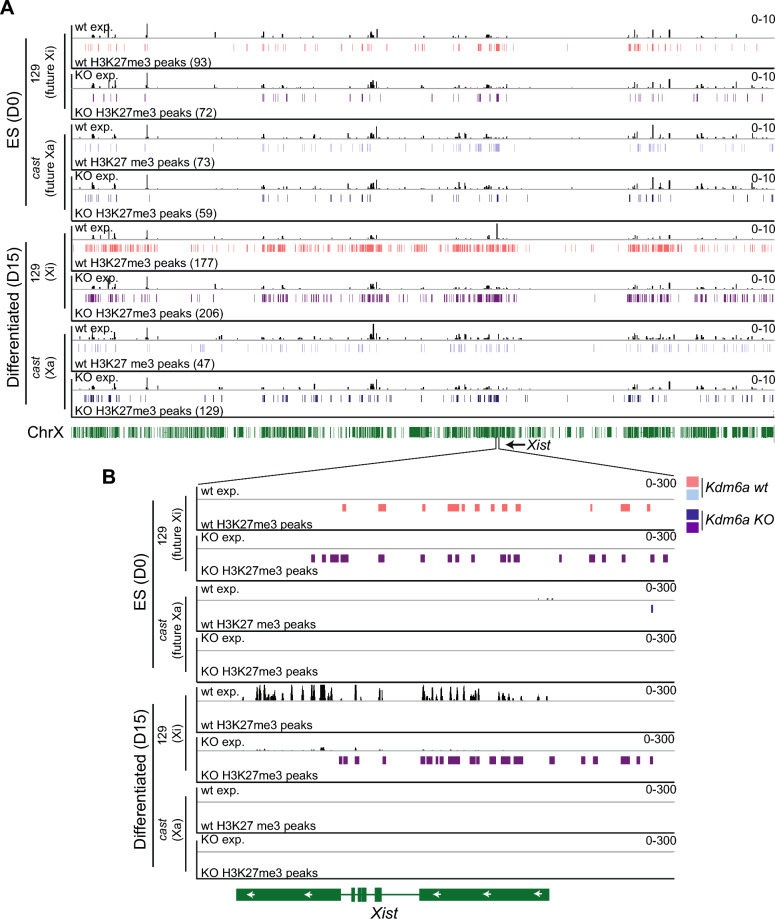
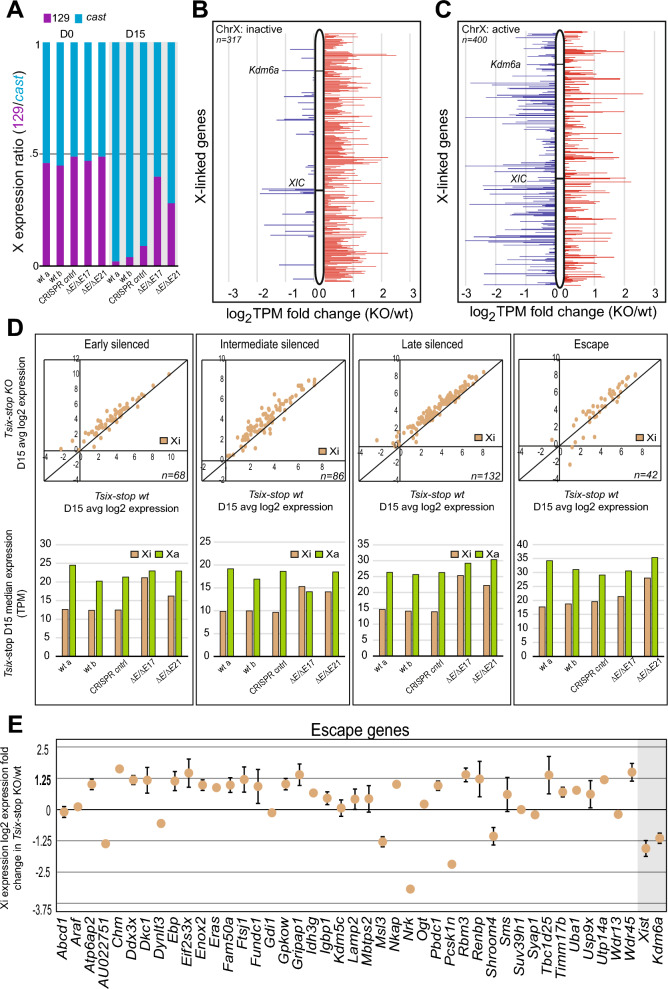
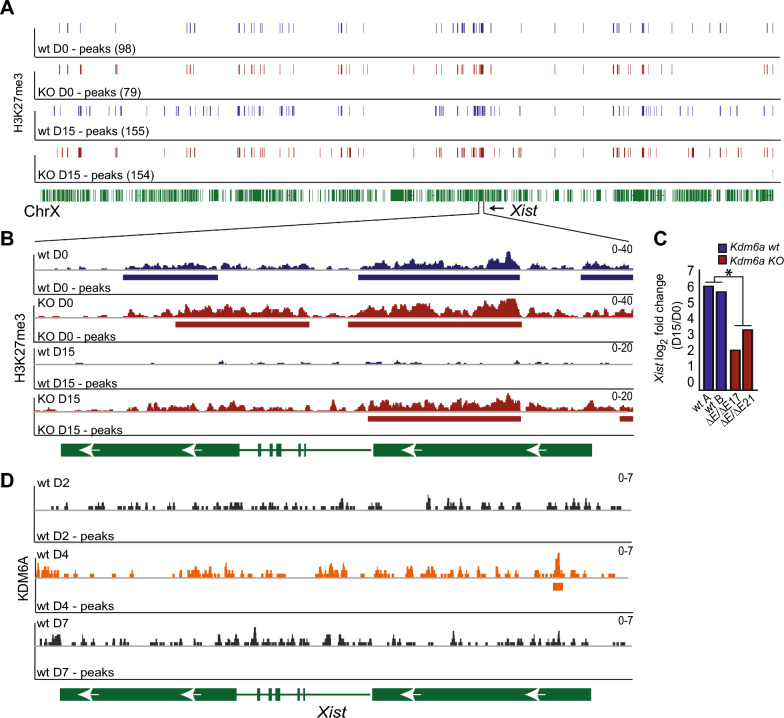
We observed impaired upregulation of Xist and reduced coating of the Xi during early stages of differentiation in Kdm6a KO cells, both homozygous and heterozygous, suggesting a threshold effect of KDM6A. This was associated with aberrant overexpression of genes from the Xi after differentiation, indicating loss of X inactivation potency. Consistent with KDM6A having a direct role in Xist regulation, we found that the histone demethylase binds to the Xist promoter and KO cells show an increase in H3K27me3 at Xist, consistent with reduced expression.
These results reveal a novel female-specific role for the X-linked histone demethylase, KDM6A in the initiation of XCI through histone demethylase-dependent activation of Xist during early differentiation. X chromosome inactivation is a female-specific mechanism that evolved to balance sex-linked gene dosage between females (XX) and males (XY) by silencing one X chromosome in females. X inactivation begins with the upregulation of the long noncoding RNA Xist on the future inactive X chromosome. While most genes become silenced on the inactive X chromosome some genes escape inactivation and thus have higher expression in females compared to males, suggesting that escape genes may have female-specific functions. One such gene encodes the histone demethylase KDM6A which function is to turn on gene expression by removing repressive histone modifications. In this study, we investigated the role of KDM6A in the regulation of Xist expression during the onset of X inactivation. We found that KDM6A binds to the Xist gene to remove repressive histone marks and facilitate its expression in early development. Indeed, depletion of KDM6A prevents upregulation of Xist due to abnormal persistence of repressive histone modifications. In turn, this results in aberrant overexpression of genes from the inactive X chromosome. Our findings point to a novel mechanism of Xist regulation during the initiation of X inactivation, which may lead to new avenues of treatment to alleviate congenital disorders such as Kabuki syndrome and sex-biased immune disorders where X-linked gene dosage is perturbed.
X染色体失活(XCI)是一种雌性特异性过程,其中一条X染色体被沉默,以平衡两性之间X连锁基因的表达。XCI在早期发育过程中通过未来失活X染色体(Xi)上lncRNA Xist的上调而启动。一部分X连锁基因逃避沉默,因此在雌性中具有更高的表达,提示其具有雌性特异性功能。其中一个基因是高度保守的基因Kdm6a,它编码一种组蛋白去甲基化酶,可去除H3K27上的甲基基团以促进基因表达。KDM6A突变与先天性疾病如歌舞伎综合征有关,也与发育和癌症中的性别差异有关。
在源自129×栗色小鼠(cast)杂交或BL6×cast杂交的杂种雌性小鼠胚胎干细胞(ES细胞)中,使用CRISPR/Cas9基因编辑敲除Kdm6a。在其中一个品系中,插入Tsix的转录终止信号导致分化时X沉默完全偏向。通过RT-PCR和RNA-FISH测量纯合和杂合Kdm6a敲除对XCI起始期间Xist表达的影响。分别使用等位基因特异性RNA测序和Cut&Run研究基因表达和H3K27me3富集的变化。通过Cut&Run表征KDM6A与Xist基因的结合。
我们观察到,在Kdm6a敲除细胞(纯合和杂合)分化的早期阶段,Xist的上调受损,Xi的包裹减少,提示KDM6A的阈值效应。这与分化后Xi上基因的异常过表达有关,表明X失活能力丧失。与KDM6A在Xist调控中具有直接作用一致,我们发现组蛋白去甲基化酶与Xist启动子结合,敲除细胞中Xist处的H3K27me3增加,与表达降低一致。
这些结果揭示了X连锁组蛋白去甲基化酶KDM6A在早期分化过程中通过组蛋白去甲基化酶依赖性激活Xist在XCI起始中具有新的雌性特异性作用。X染色体失活是一种雌性特异性机制,通过沉默雌性(XX)中的一条X染色体来平衡雌性和雄性(XY)之间的性连锁基因剂量。X失活始于未来失活X染色体上长链非编码RNA Xist的上调。虽然大多数基因在失活的X染色体上沉默,但一些基因逃避失活,因此与雄性相比在雌性中具有更高的表达,提示逃避失活的基因可能具有雌性特异性功能。其中一个这样的基因编码组蛋白去甲基化酶KDM6A,其功能是通过去除抑制性组蛋白修饰来开启基因表达。在本研究中,我们研究了KDM6A在X失活起始期间对Xist表达调控中的作用。我们发现KDM6A与Xist基因结合以去除抑制性组蛋白标记并促进其在早期发育中的表达。实际上,KDM6A的缺失由于抑制性组蛋白修饰的异常持续而阻止Xist的上调。反过来,这导致来自失活X染色体的基因异常过表达。我们的发现指出了X失活起始期间Xist调控的新机制,这可能导致新的治疗途径,以缓解先天性疾病如歌舞伎综合征和X连锁基因剂量受到干扰的性别偏向性免疫疾病。