Comparative Genomics Group, Evolution Ecology and Genetics, Research School of Biology, The Australian National University, Canberra, Australian Capital Territory, Australia.
PLoS One. 2011 Apr 25;6(4):e19040. doi: 10.1371/journal.pone.0019040.
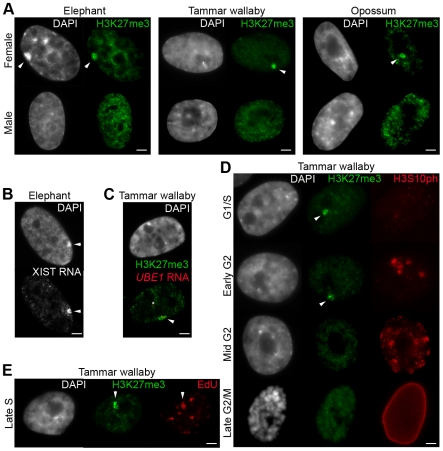
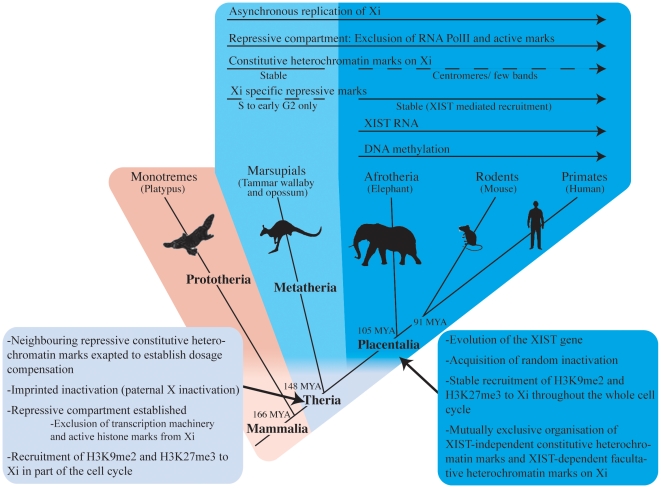
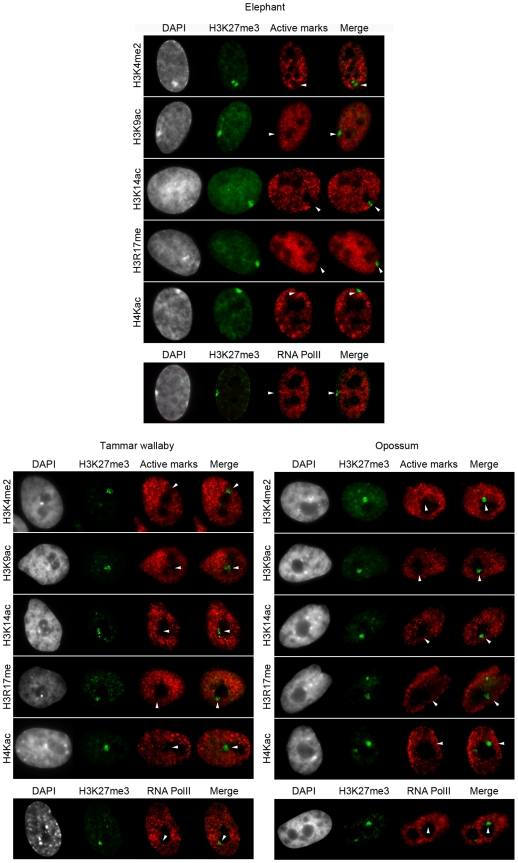
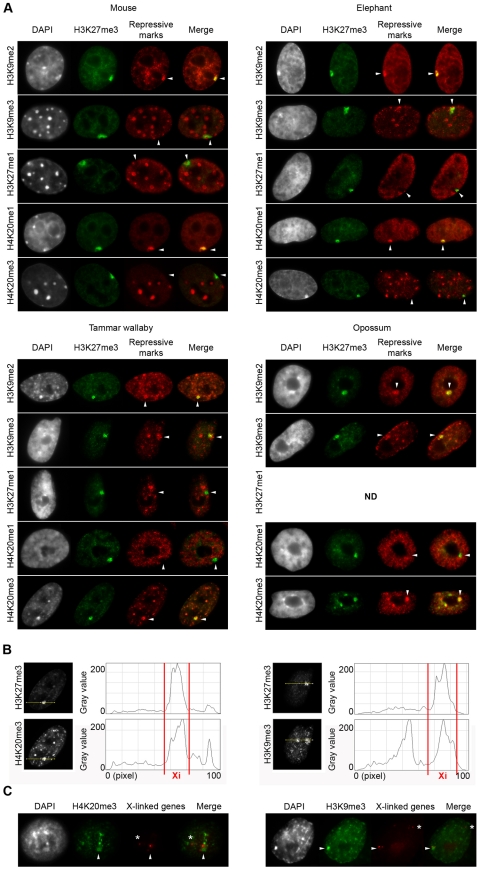
X chromosome inactivation (XCI) is the transcriptional silencing of one X in female mammals, balancing expression of X genes between females (XX) and males (XY). In placental mammals non-coding XIST RNA triggers silencing of one X (Xi) and recruits a characteristic suite of epigenetic modifications, including the histone mark H3K27me3. In marsupials, where XIST is missing, H3K27me3 association seems to have different degrees of stability, depending on cell-types and species. However, the complete suite of histone marks associated with the Xi and their stability throughout cell cycle remain a mystery, as does the evolution of an ancient mammal XCI system. Our extensive immunofluorescence analysis (using antibodies against specific histone modifications) in nuclei of mammals distantly related to human and mouse, revealed a general absence from the mammalian Xi territory of transcription machinery and histone modifications associated with active chromatin. Specific repressive modifications associated with XCI in human and mouse were also observed in elephant (a distantly related placental mammal), as was accumulation of XIST RNA. However, in two marsupial species the Xi either lacked these modifications (H4K20me1), or they were restricted to specific windows of the cell cycle (H3K27me3, H3K9me2). Surprisingly, the marsupial Xi was stably enriched for modifications associated with constitutive heterochromatin in all eukaryotes (H4K20me3, H3K9me3). We propose that marsupial XCI is comparable to a system that evolved in the common therian (marsupial and placental) ancestor. Silent chromatin of the early inactive X was exapted from neighbouring constitutive heterochromatin and, in early placental evolution, was augmented by the rise of XIST and the stable recruitment of specific histone modifications now classically associated with XCI.
X 染色体失活(XCI)是雌性哺乳动物中一条 X 染色体的转录沉默,平衡雌性(XX)和雄性(XY)之间 X 基因的表达。在胎盘哺乳动物中,非编码 XIST RNA 触发一条 X(Xi)的沉默,并募集一组特征性的表观遗传修饰,包括组蛋白标记 H3K27me3。在有袋动物中,缺失 XIST,H3K27me3 关联似乎具有不同程度的稳定性,取决于细胞类型和物种。然而,与 Xi 相关的完整组蛋白标记及其在整个细胞周期中的稳定性仍然是一个谜,就像古老哺乳动物 XCI 系统的进化一样。我们在与人类和小鼠关系较远的哺乳动物的细胞核中进行了广泛的免疫荧光分析(使用针对特定组蛋白修饰的抗体),揭示了哺乳动物 Xi 领域普遍缺乏与活跃染色质相关的转录机制和组蛋白修饰。在人类和小鼠中与 XCI 相关的特定抑制修饰也在大象(一种与胎盘哺乳动物关系较远的哺乳动物)中观察到,XIST RNA 也在积累。然而,在两个有袋动物物种中,Xi 要么缺乏这些修饰(H4K20me1),要么它们仅限于细胞周期的特定窗口(H3K27me3、H3K9me2)。令人惊讶的是,所有真核生物中,有袋动物 Xi 都稳定地富含与组成性异染色质相关的修饰(H4K20me3、H3K9me3)。我们提出,有袋动物 XCI 可与在共同胎盘哺乳动物(有袋动物和胎盘动物)祖先中进化的系统相媲美。早期失活 X 染色体的沉默染色质从邻近的组成性异染色质中适应而来,并且在早期胎盘进化过程中,由于 XIST 的出现和现在经典上与 XCI 相关的特定组蛋白修饰的稳定募集而增加。