Wang Mingming, Flexeder Claudia, Harris Carla P, Kress Sara, Schikowski Tamara, Peters Annette, Standl Marie
Institute of Epidemiology, Helmholtz Zentrum München-German Research Center for Environmental Health, Ingolstädter Landstraße 1, 85764, Neuherberg, Germany.
Institute for Medical Information Processing, Biometry and Epidemiology (IBE), Faculty of Medicine, LMU Munich, Pettenkofer School of Public Health, Munich, Germany.
World J Pediatr. 2025 Jan;21(1):48-61. doi: 10.1007/s12519-024-00872-5. Epub 2025 Jan 4.
Some studies have revealed various sleep patterns in adolescents and adults using multidimensional objective sleep parameters. However, it remains unknown whether these patterns are consistent from adolescence to young adulthood and how they relate to long-term obesity.
Seven-day accelerometry was conducted in German Infant Study on the influence of Nutrition Intervention PLUS environmental and genetic influences on allergy development (GINIplus) and Influence of Lifestyle factors on the development of the Immune System and Allergies in East and West Germany (LISA) birth cohorts during the 15-year and 20-year follow-ups, respectively. Five sleep clusters were identified by k-means cluster analysis using 12 sleep characteristics at each follow-up. Adjusted linear and logistic regression models using generalized estimating equations were examined. Further, the interaction effects with time of follow-ups and polygenic risk scores (PRS) for body mass index (BMI) were tested.
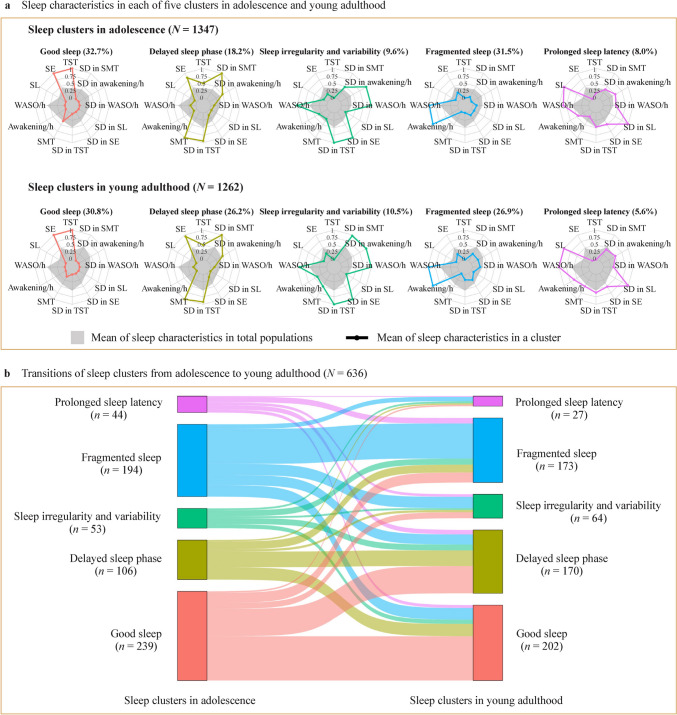
Five sleep clusters were classified consistently in both adolescence (n = 1347, aged 14.3-16.4 years) and young adulthood (n = 1262, aged 19.5-22.4 years). Adolescents in the "good sleep", "delayed sleep phase", and "fragmented sleep" clusters displayed greater stability transitioning into young adulthood, while those in the "sleep irregularity and variability", and "prolonged sleep latency" clusters showed lower stability (n = 636). Compared to the "good sleep" cluster, the "prolonged sleep latency" cluster exhibited associations with higher BMI [β = 0.56, 95% confidence interval (CI) = (0.06, 1.05)] and increased odds of overweight/obesity [Odds ratio = 1.55, 95% CI = (1.02, 2.34)]. No significant PRS-sleep cluster interaction was found for BMI or overweight/obesity. Among males only, the "delayed sleep phase", "sleep irregularity and variability" and "fragmented sleep" clusters showed stronger associations with overweight/obesity as age increased.
Adolescents and young adults shared five consistent sleep patterns, with the "prolonged sleep latency" pattern linked to higher BMI and overweight/obesity.
一些研究使用多维客观睡眠参数揭示了青少年和成年人的各种睡眠模式。然而,这些模式从青春期到青年期是否一致,以及它们与长期肥胖之间的关系仍不清楚。
分别在德国营养干预PLUS环境和遗传因素对过敏发展的影响研究(GINIplus)以及东西德生活方式因素对免疫系统和过敏发展的影响研究(LISA)出生队列的15年和20年随访期间,进行为期七天的加速度计测量。在每次随访时,使用12种睡眠特征通过k均值聚类分析确定五个睡眠簇。使用广义估计方程检查调整后的线性和逻辑回归模型。此外,还测试了随访时间与体重指数(BMI)的多基因风险评分(PRS)的交互作用。
在青少年(n = 1347,年龄14.3 - 16.4岁)和青年期(n = 1262,年龄19.5 - 22.4岁)中一致地分类出五个睡眠簇。“良好睡眠”、“睡眠相位延迟”和“睡眠碎片化”簇中的青少年在过渡到青年期时表现出更大的稳定性,而“睡眠不规则和多变”以及“睡眠潜伏期延长”簇中的青少年稳定性较低(n = 636)。与“良好睡眠”簇相比,“睡眠潜伏期延长”簇与较高的BMI [β = 0.56,95%置信区间(CI)=(0.06,1.05)]以及超重/肥胖几率增加相关[优势比 = 1.55,95% CI =(1.02,2.34)]。未发现BMI或超重/肥胖的显著PRS - 睡眠簇交互作用。仅在男性中,随着年龄增长,“睡眠相位延迟”、“睡眠不规则和多变”以及“睡眠碎片化”簇与超重/肥胖的关联更强。
青少年和青年共享五种一致的睡眠模式,“睡眠潜伏期延长”模式与较高的BMI和超重/肥胖相关。