Douden Bashar Kamal Ali, Abufara Yazan Mohammad Abdullah, Aldrabeeh Mahmood Fayez Ali, Tell Naela Ramadan Mohammad, Abudaya Ismail
Faculty of Medicine, Department of Medicine, Al-Quds University, Jerusalem, Palestine.
Faculty of Medicine, Department of Neurology, Al-Quds University, Jerusalem, Palestine.
BMC Neurol. 2025 Jan 4;25(1):7. doi: 10.1186/s12883-024-04018-y.
Vanishing white matter disease (VWMD) is a rare autosomal recessive leukoencephalopathy. It is typified by a gradual loss of white matter in the brain and spinal cord, which results in impairments in vision and hearing, cerebellar ataxia, muscular weakness, stiffness, seizures, and dysarthria cogitative decline. Many reports involve minors. Very few instances worldwide have been reported, with adult onset of vanishing white matter considered to account for 15% of cases. Clinical evaluation, MRI results, and confirmatory genetic testing are used to diagnose VWMD.
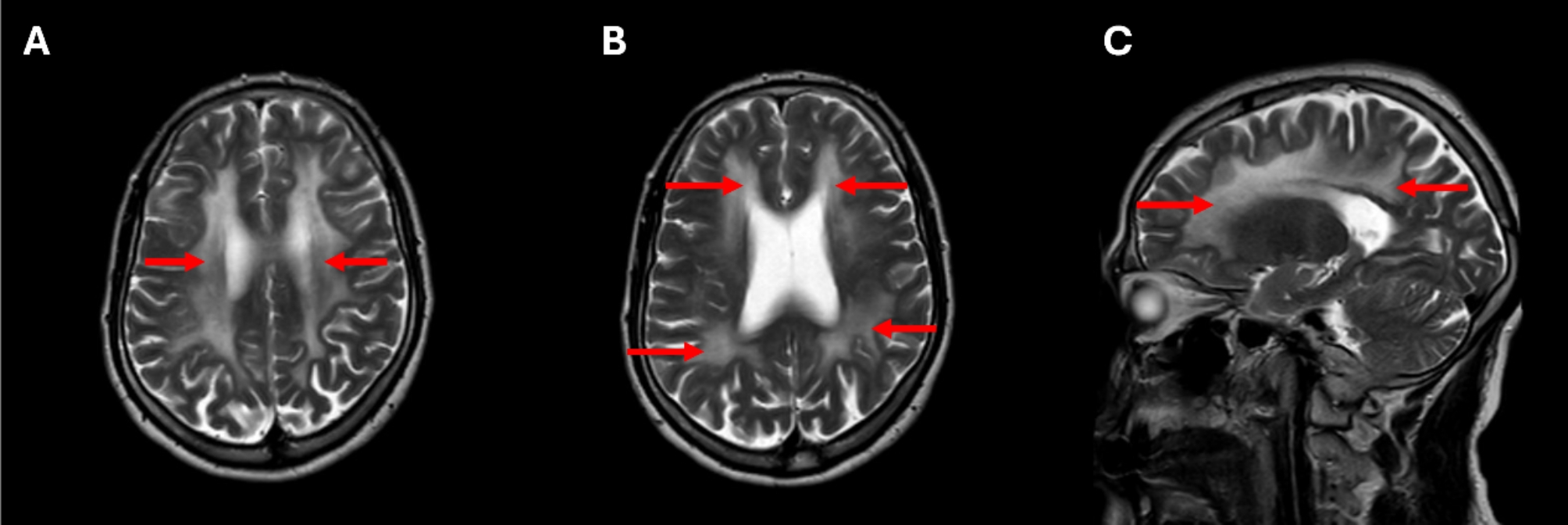
A 39-year-old male from Hebron, Palestine, presented with a 7-month history of postural instability, imbalanced gait, and progressive deterioration of his lower extremities. Additionally, the patient suffered from ocular abnormalities and sphincteric issues. The patient's sibling showed comparable symptoms but was never diagnosed, as he passed away because of colon cancer. Reduced cognitive function, spastic quadriparesis, hyperreflexia, bradykinesia, and shuffling gait were found during a neurological examination. Normal results were obtained from routine laboratory tests, including cerebrospinal fluid (CSF), blood, and urine. Periventricular white matter hyperintensities, which are indicative of vanishing white matter leukoencephalopathy (VWML), were identified during an MRI. The diagnosis of adult-onset VWML with movement disability was substantiated by genetic testing, which named a homozygous pathogenic missense variant, EIF2B3, and a deletion in PRKN/PARK2. The patient's motor symptoms were temporarily alleviated following the administration of Levodopa/Carbidopa. Nevertheless, the long-term consequences are uncertain due to the illness's ongoing progression and the absence of a cure currently.
This instance of vanishing white matter leukoencephalopathy (VWML) is particularly remarkable in adults because of its rarity and complexity. The diagnosis is further complicated by the coexistence of Parkinsonism and VWML. Although a cure is not currently known. Early discovery is crucial to effectively manage symptoms. This example underscores the importance of more VWML research, particularly in Palestine, where studies on neurological disorders are limited. These findings underscore the importance of enhancing the region's diagnostic and therapeutic capabilities.
消失性白质病(VWMD)是一种罕见的常染色体隐性遗传性白质脑病。其典型特征是大脑和脊髓中的白质逐渐丧失,导致视力和听力受损、小脑共济失调、肌肉无力、僵硬、癫痫发作和构音障碍以及认知功能下降。许多报告涉及未成年人。全球报道的病例很少,成人起病的消失性白质病病例被认为占15%。临床评估、MRI结果和确诊的基因检测用于诊断VWMD。
一名来自巴勒斯坦希布伦的39岁男性,有7个月的姿势不稳、步态失衡和下肢进行性恶化病史。此外,该患者还患有眼部异常和括约肌问题。该患者的兄弟姐妹有类似症状,但未被诊断出来,因为他因结肠癌去世。神经检查发现认知功能减退、痉挛性四肢瘫、反射亢进、运动迟缓及拖曳步态。常规实验室检查,包括脑脊液(CSF)、血液和尿液检查结果均正常。MRI检查发现脑室周围白质高信号,提示为消失性白质脑病(VWML)。基因检测证实了成人起病的伴有运动障碍的VWML诊断,检测发现一个纯合致病性错义变异EIF2B3以及PRKN/PARK2基因的一个缺失。服用左旋多巴/卡比多巴后,患者的运动症状暂时得到缓解。然而,由于疾病的持续进展以及目前尚无治愈方法,其长期后果尚不确定。
这例消失性白质脑病(VWML)在成人中尤为罕见且复杂。帕金森病与VWML并存使诊断更加复杂。虽然目前尚无治愈方法,但早期发现对于有效控制症状至关重要。这个例子强调了更多关于VWML研究的重要性,特别是在巴勒斯坦,那里对神经系统疾病的研究有限。这些发现强调了提高该地区诊断和治疗能力的重要性。